
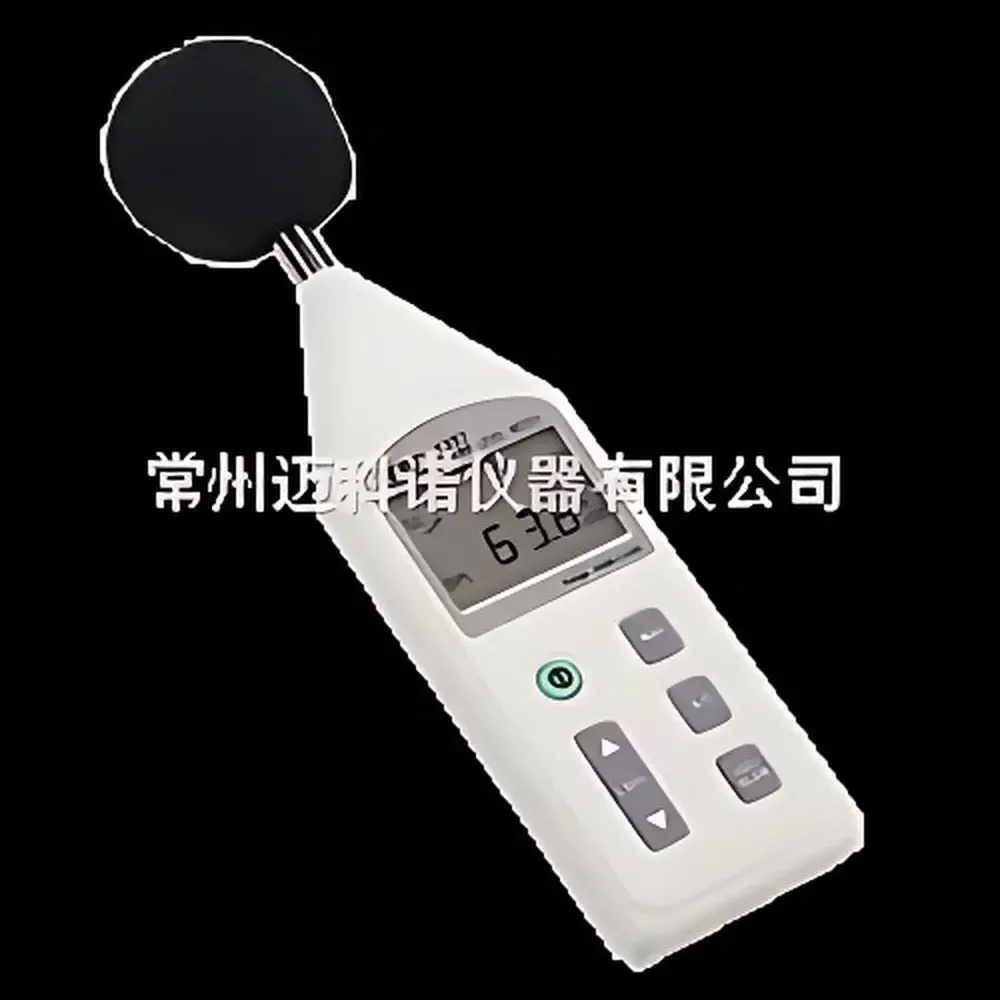
MKN TES-1358 Real-Time 1/1 and 1/3 Octave Band Audio Analyzer
| Brand | MKN |
|---|---|
| Origin | Zhejiang, China |
| Model | TES-1358 Real-Time 1/1 and 1/3 Octave Band Audio Analyzer |
| Microphone | 1/2″ Polarized Condenser |
| Accuracy | ±1.5 dB (at 94 dB @ 1 kHz) |
| Measurement Range | 30–130 dB |
| Frequency Range | 25 Hz–10 kHz |
| Frequency Weighting | A, C, Flat (F) |
| Time Weighting | Fast, Slow |
| Display | 160×160 dot-matrix LCD with backlight |
| Data Storage | 12,280 records (Sound Level Mode), 1,024 spectra (Octave Mode) |
| Compliance | IEC 60651:1979 Type 2, IEC 60804:1985 Type 2, BS EN 60651:1994, IEC 61260:1995 Class 2 |
| Interface | RS-232 (9-pin D-sub), AC/DC adapter input (6 V, 1 A) |
| Power | 4 × AA alkaline batteries (~2 h operation) |
| Dimensions | 345 × 100 × 60 mm |
| Weight | ~950 g (incl. batteries) |
Overview
The MKN TES-1358 Real-Time 1/1 and 1/3 Octave Band Audio Analyzer is a portable, precision-engineered instrument designed for field and laboratory-based acoustic characterization in environmental, occupational, and industrial noise assessment applications. It operates on the fundamental principle of analog-to-digital conversion of microphone output followed by real-time digital filtering and spectral computation using standardized octave and fractional-octave band algorithms per IEC 61260-1:2014 (Class 2). The device integrates a calibrated 1/2″ polarized condenser microphone—sensitive across 25 Hz to 10 kHz—with hardware-implemented A-, C-, and flat (F) frequency weightings and Fast/Slow time constants, enabling compliance-conformant measurements aligned with ISO 1996, ISO 9612, and EU Directive 2002/44/EC. Its dual-mode architecture supports simultaneous time-domain sound level logging (Lp, Leq, LE, Lmax, Lmin) and frequency-domain analysis, making it suitable for noise source identification, barrier performance evaluation, and regulatory reporting where spectral content—not just overall level—is critical.
Key Features
- Real-time 1/1 and 1/3 octave band analysis with 9 and 27 center frequencies respectively, conforming to IEC 61260-1:2014 Class 2 tolerances
- High-resolution 160×160 dot-matrix LCD with adjustable backlight for low-light field operation
- Integrated real-time clock with date/time stamping on all stored records and spectral snapshots
- Dual data storage architecture: 12,280 entries in sound level mode (0.5 s update, 0.1 dB resolution); 1,024 full octave spectra (10 dB dynamic range per band, configurable span)
- RS-232 serial interface (9-pin D-sub) with bundled PC software for data export, report generation, and calibration traceability
- Simultaneous analog outputs: 2 Vrms AC (full-scale) and 10 mV/dB DC for connection to external data loggers or oscilloscopes
- Rugged ergonomic housing (345 × 100 × 60 mm, ~950 g) with integrated handle and IP54-rated ingress protection against dust and water splashes
Sample Compatibility & Compliance
The TES-1358 is optimized for use with standard 1/2″ free-field response condenser microphones (e.g., MKN TL-F47 series), including optional 5 m and 10 m extension cables for remote or hazardous-area deployment. Its measurement accuracy of ±1.5 dB (referenced to 94 dB at 1 kHz) satisfies IEC 60651:1979 Type 2 and IEC 60804:1985 Type 2 requirements for general-purpose sound level meters. The instrument’s octave band implementation complies with IEC 61260-1:1995 (reaffirmed 2001) Class 2 specifications for filter attenuation, center frequency tolerance, and passband ripple. All internal signal processing—including RMS detection, weighting network application, and band-limited energy integration—is implemented in firmware validated against reference calibrators traceable to NIM (China National Institute of Metrology). The device supports GLP-aligned workflows through timestamped, non-editable data files and audit-ready export logs.
Software & Data Management
The included Windows-compatible PC software provides full bidirectional communication via RS-232. Users can configure measurement parameters (weighting, time constant, range, trigger thresholds), initiate scheduled acquisitions, and download stored datasets in CSV or proprietary binary format. Spectral data is visualized as bar charts or line plots with selectable y-axis scaling (linear/logarithmic), overlay capability for comparative analysis, and annotation tools for site-specific metadata tagging. Export functions support PDF report generation compliant with ISO 1996-2:2017 Annex B templates, including instrument ID, calibration date, operator name, and environmental conditions. Raw time-history waveforms (sampled at 20 kHz) and octave band energy values are retained with full metrological traceability—no data interpolation or lossy compression applied during transfer.
Applications
- Environmental noise mapping around transportation corridors, construction sites, and industrial perimeters
- OHS-compliant workplace noise exposure assessment per OSHA 1910.95 and EU Physical Agents (Noise) Directive
- Acoustic validation of building envelope performance (walls, windows, HVAC ducts) using 1/3-octave insertion loss analysis
- Troubleshooting mechanical equipment (pumps, compressors, gearboxes) via spectral anomaly detection in mid- to high-frequency bands
- Educational acoustics laboratories requiring hands-on instruction in frequency-domain noise analysis fundamentals
- Pre-compliance screening for ISO 3744 and ISO 3745 sound power testing setups
FAQ
Does the TES-1358 support calibration traceability to national standards?
Yes—the microphone and analyzer system are supplied with a factory calibration certificate traceable to NIM (China National Institute of Metrology), and the instrument accepts periodic recalibration using Class 1 pistonphones or sound calibrators meeting IEC 60942 requirements.
Can the device perform long-term unattended monitoring?
While not designed for continuous multi-day logging, its 2-hour battery life (with alkaline cells) and optional 6 V DC external power input enable extended field sessions; data offload via RS-232 is recommended before buffer saturation.
Is third-party software integration possible?
The RS-232 protocol documentation (ASCII command set, baud rate, framing) is provided in the user manual, permitting custom integration with LabVIEW, Python (pySerial), or MATLAB environments for automated test sequences.
What is the temperature stability of the 1/3-octave filters?
Filter center frequencies and bandwidths maintain IEC 61260 Class 2 conformance across the specified operating range (0–40 °C, 10–80 % RH), verified during thermal soak testing at ±2 °C intervals.
How is data integrity ensured during power interruption?
All measurements are written to non-volatile memory only upon successful acquisition completion; partial records are discarded, preventing corrupted or incomplete spectral entries in the dataset.
Related Products







