
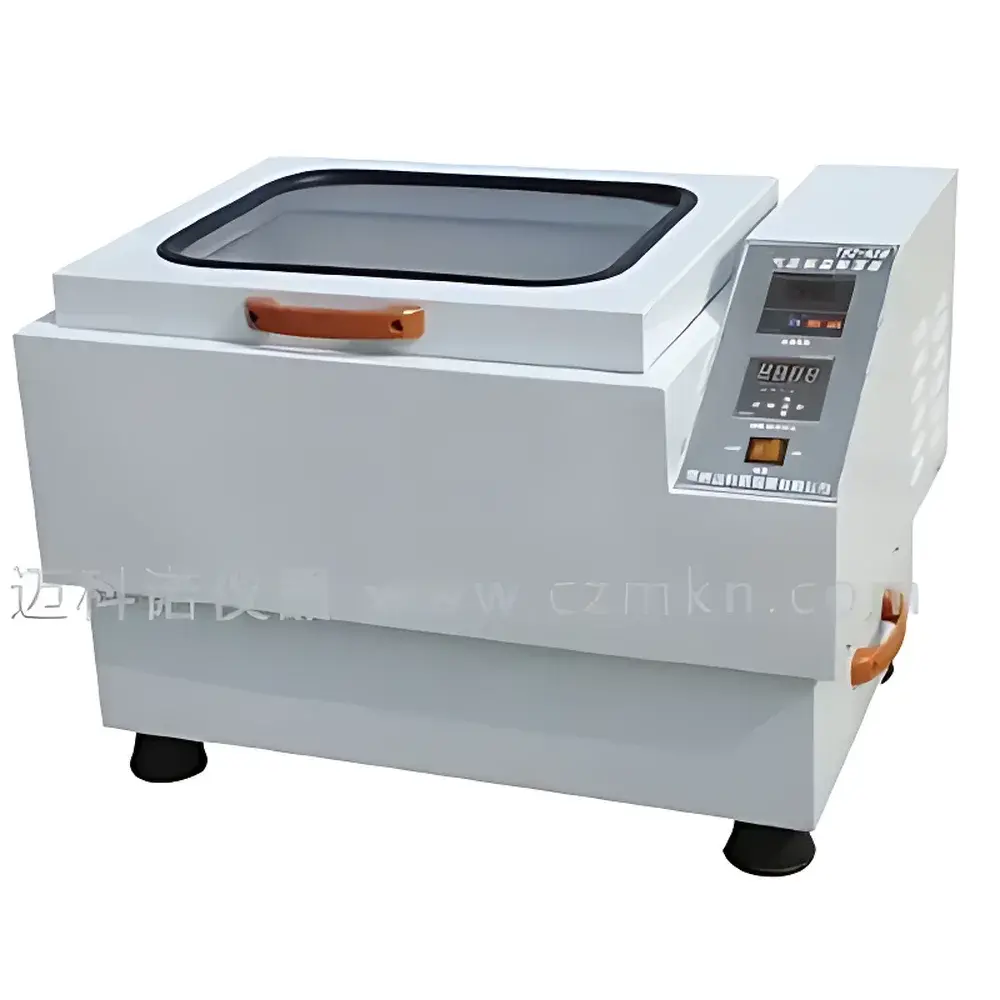
MKN THY-2A Air-Bath Constant-Temperature Orbital & Reciprocal Shaker
| Brand | MKN |
|---|---|
| Origin | Jiangsu, China |
| Model | THY-2A |
| Power Supply | 220 V, 50 Hz |
| Oscillation Frequency | 40–300 rpm (digital display) |
| Amplitude & Mode | 20 mm, dual-mode (orbital + reciprocal) |
| Temperature Range | RT to 50 °C (digital PID control) |
| Temperature Accuracy | ±1 °C (at steady state) |
| Platform Dimensions | 470 × 370 mm |
| Timer Range | 1–999 min or 1–999 h |
| Illuminated Chamber | Yes |
Overview
The MKN THY-2A Air-Bath Constant-Temperature Orbital & Reciprocal Shaker is an engineered platform for precise temperature-controlled agitation of biological and chemical samples in laboratory and industrial settings. Unlike water-bath shakers, this unit employs forced-air circulation within an insulated chamber to achieve uniform thermal distribution across the oscillating platform—eliminating condensation risks, simplifying maintenance, and enabling operation at temperatures above ambient without liquid management constraints. Its dual-mode oscillation mechanism—switchable between orbital and reciprocal motion—provides flexibility for diverse suspension requirements: orbital motion supports homogeneous cell suspension and aerobic microbial growth, while reciprocal motion enhances particle resuspension and extraction efficiency in solid–liquid systems. The system integrates a high-stability PID temperature controller with LED digital readout, delivering consistent thermal performance within ±1 °C under steady-state conditions. A built-in interior LED lamp enables real-time visual monitoring of sample status without opening the chamber—critical for maintaining sterility and thermal integrity during extended incubation cycles.
Key Features
- Dual oscillation mode: User-selectable orbital (circular) or reciprocal (back-and-forth) motion via front-panel toggle switch
- Digital speed control and display (40–300 rpm), calibrated and traceable to internal tachometric feedback
- PID-based temperature regulation with real-time digital display (RT to 50 °C), optimized for low thermal inertia and minimal overshoot
- Illuminated stainless-steel chamber with tempered glass viewing window and safety interlock
- Large working platform (470 × 370 mm) compatible with standard multi-well plates, Erlenmeyer flasks (up to 2 L), test tube racks, and culture bottles
- Programmable timer supporting both minute-scale (1–999 min) and hour-scale (1–999 h) operation with auto-shutdown
- Robust mechanical architecture: Balanced eccentric drive, reinforced aluminum alloy frame, and vibration-damping feet for stable operation at maximum speed and load
Sample Compatibility & Compliance
The THY-2A accommodates a broad range of sample containers—including borosilicate glass flasks, polypropylene tubes, polystyrene microplates, and silicone-sealed bioreactor vessels—without requiring custom clamps or adapters. Its air-bath design avoids direct contact between heating elements and samples, minimizing thermal gradient-induced stress on sensitive biologicals. The unit complies with general electrical safety standards IEC 61010-1 (Laboratory Equipment) and meets EMC directive 2014/30/EU for electromagnetic compatibility. While not certified for ISO 13485 or FDA 21 CFR Part 11 out-of-the-box, its digital logging-capable variants (optional firmware upgrade) support GLP/GMP-aligned data integrity practices—including user-accessible audit trails, timestamped parameter changes, and exportable CSV-formatted logs—when integrated into validated laboratory workflows.
Software & Data Management
The THY-2A operates as a standalone instrument with embedded firmware; no PC connection is required for basic operation. However, optional RS-232 or USB-to-serial interface modules enable integration with LabView, Python-based automation scripts, or LIMS platforms for centralized parameter logging and remote status polling. All setpoints (temperature, speed, timer) are stored in non-volatile memory and retained after power interruption. Firmware updates—distributed via secure download portal—include enhanced calibration routines, expanded timer resolution (±1 s), and improved thermal ramp profiling algorithms. Audit-ready configuration reports can be generated manually via serial command or automatically upon completion of timed runs, satisfying internal quality documentation requirements per ISO/IEC 17025 Clause 7.7.
Applications
- BOD analysis in environmental water testing per ASTM D5210 and ISO 5815-1
- Maintenance of bacterial, fungal, and yeast cultures under aerobic conditions (e.g., E. coli, S. cerevisiae, A. niger)
- Seed stock preservation and subculturing in pharmaceutical QC laboratories
- Plant tissue culture and callus induction under controlled agitation and thermal regimes
- Enzyme kinetics assays requiring simultaneous temperature stabilization and mixing
- Protein solubilization and antigen–antibody binding studies in immunoassay development
- Extraction protocols for natural products (e.g., polyphenols, alkaloids) from botanical matrices
FAQ
What is the difference between orbital and reciprocal oscillation modes?
Orbital motion generates gentle, circular agitation ideal for cell suspension and oxygen transfer in microbiological cultures. Reciprocal motion provides higher shear force and directional displacement—preferred for particle resuspension, solid-phase extractions, and immunoassay plate washing.
Can the THY-2A operate continuously for 72+ hours?
Yes—the unit is rated for unattended continuous operation within its specified temperature and speed ranges. Thermal protection circuitry and brushless motor design ensure long-term reliability under sustained duty cycles.
Is external calibration supported?
Yes—NIST-traceable PT100 probe inputs are available as an accessory option, allowing users to validate chamber temperature uniformity per ISO/IEC 17025 Annex A.3 guidelines.
Does the device meet IP rating requirements for humid environments?
The THY-2A carries an IP20 rating (no ingress protection against solids or liquids); it is intended for indoor laboratory use only and must be installed away from splash zones, condensation-prone surfaces, or uncontrolled ambient humidity exceeding 80% RH.
How is temperature uniformity verified across the platform?
Uniformity is characterized at three points (center, front-left, rear-right) using calibrated thermocouples during factory acceptance testing. Typical deviation is ≤ ±0.8 °C at 37 °C, per internal QA protocol MKN-QC-THY-002.



