
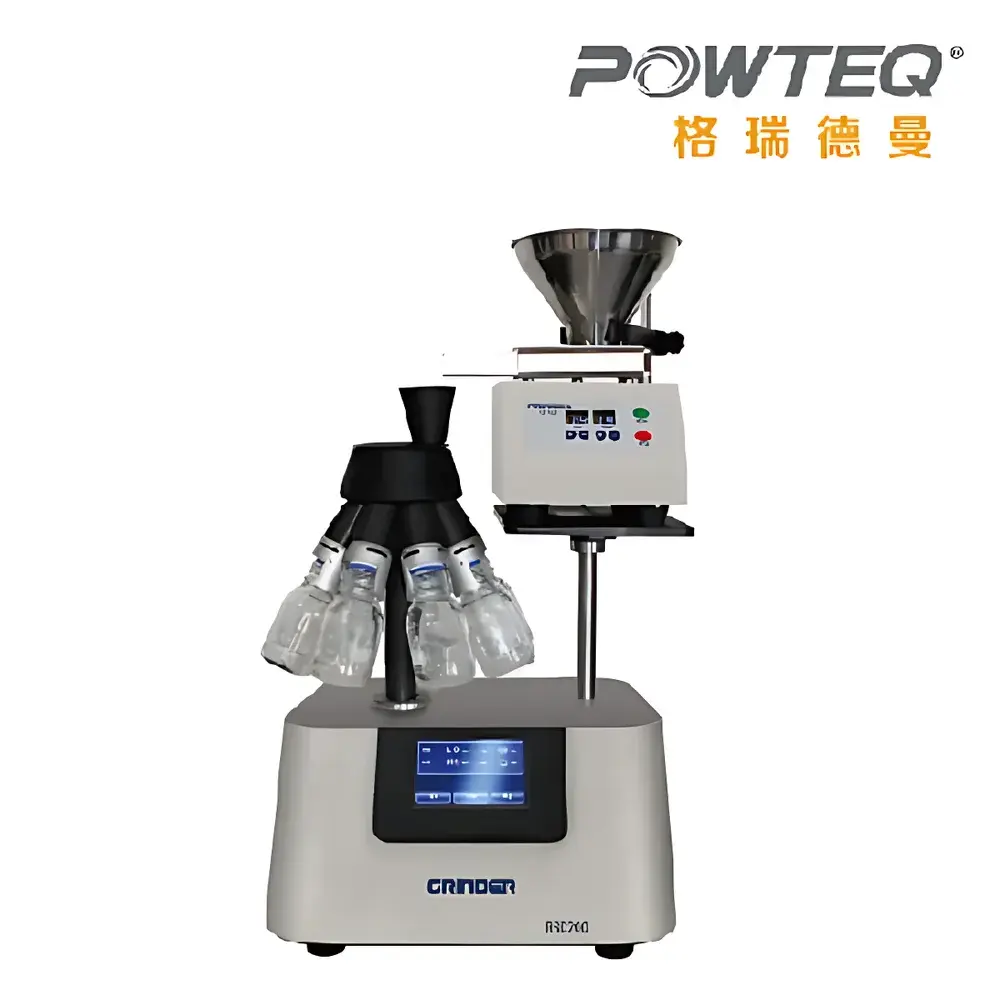
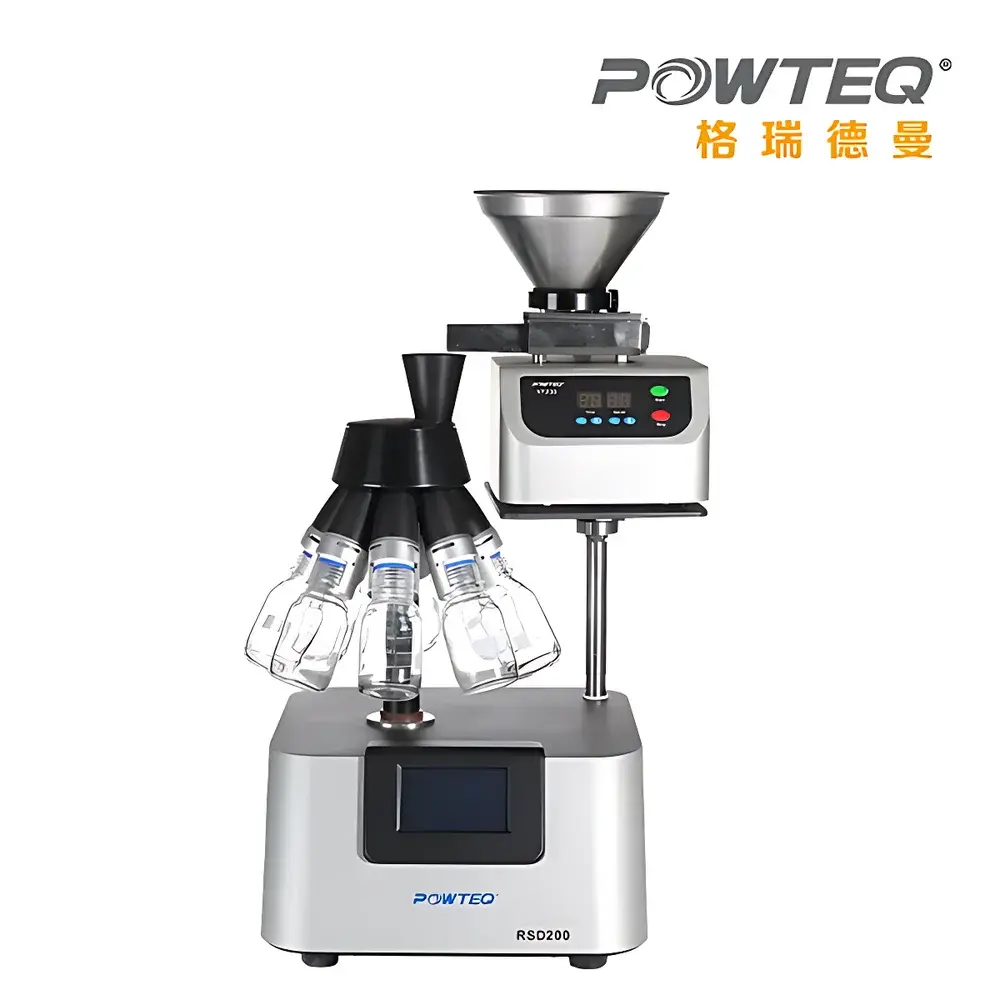
Grinderman RSD200 Rotary Sample Divider
| Brand | Grinderman |
|---|---|
| Origin | Beijing, China |
| Manufacturer Type | Direct Manufacturer |
| Model | RSD200 |
| Price Range | USD 7,000 – 14,000 |
| Dimensions (W×D×H) | 475 × 460 × 640 mm |
| Net Weight | 32 kg |
| Sample Feed Size | ≤ 10 mm |
| Dividing Speed | 80–120 rpm (continuously adjustable) |
| Number of Output Ports | 6 / 8 / 10 / 30 |
| Container Volumes | 10 / 20 / 30 / 250 / 500 mL |
| Batch Capacity | ≥ 2.5 kg |
| Timing Range | 0–99 h, 0–59 min |
| Material of Distributor Crown | POM (polyoxymethylene, wear-resistant & low-adhesion) |
| Sample Receptacles | Borosilicate Glass |
| Integrated Auto-Feeder | Yes |
| Speed Monitoring | Built-in Hall-effect tachometer |
| Throughput | Up to 1200 samples/hour |
| Compliance | Designed for ISO 14887, ASTM D6938, and GLP-aligned laboratory workflows |
Overview
The Grinderman RSD200 Rotary Sample Divider is an automated, precision-engineered instrument designed for the quantitative subdivision of bulk granular, powdered, or free-flowing particulate materials. Based on the principle of rotational centrifugal distribution, the RSD200 ensures statistically representative sub-sampling by uniformly dispersing material across multiple radially arranged collection channels under controlled angular velocity. Unlike gravity-fed or manual splitters, the RSD200 employs a continuously rotating conical distributor tube—driven by a brushless DC motor with closed-loop speed regulation—to induce consistent radial acceleration. This results in uniform trajectory dispersion of particles across 360°, minimizing segregation effects such as particle size stratification or density-driven bias. The system is calibrated to maintain mass balance within ±0.5% relative standard deviation (RSD) across replicates when operated within specified feed rate and particle size limits (≤10 mm). Its architecture conforms to fundamental sampling theory per Gy’s formula and supports compliance with ISO 14887 (soil and waste sampling), ASTM D6938 (asphalt mixture sampling), and EU Pharmacopoeia Chapter 2.9.30 (sampling of solid dosage forms).
Key Features
- Motor-driven rotary distributor with continuous speed control (80–120 rpm), monitored in real time via integrated Hall-effect sensor for traceable speed stability
- POM (polyoxymethylene) distributor crown—chemically inert, abrasion-resistant, and non-stick—ensures minimal sample retention and rapid cleaning between runs
- Modular output configuration supporting 6, 8, 10, or 30 collection ports; compatible with standardized borosilicate glass vials (10–500 mL)
- Integrated auto-feeder with vibration-assisted hopper and flow-regulating gate, synchronized with rotor timing to prevent bridging or pulsation
- Dedicated microprocessor controller with programmable timer (0–99 h / 0–59 min), digital parameter storage, and error logging
- No routine lubrication or mechanical maintenance required—brushless motor and sealed bearing design ensure long-term operational integrity
- 360° symmetrical channel geometry guarantees geometrically identical path lengths and residence times for all fractions
Sample Compatibility & Compliance
The RSD200 is validated for use with dry, non-cohesive, and moderately cohesive particulates—including pharmaceutical powders, mineral aggregates, agricultural grains, ceramic precursors, metallurgical ores, and recycled construction materials. It excludes sticky, hygroscopic, fibrous, or highly electrostatic materials unless pre-conditioned (e.g., via anti-static treatment or controlled humidity environment). All wetted components comply with USP for plastic materials and ISO 8536-4 for glass containers. The instrument supports audit-ready operation under GLP and GMP frameworks: event logs record timestamped start/stop commands, speed setpoints, actual rpm deviations (>±2 rpm triggers alert), and total runtime. Data export is available via USB interface for integration into LIMS or electronic lab notebooks.
Software & Data Management
The embedded controller provides local parameter configuration without external PC dependency. Settings—including speed, duration, port selection, and cycle count—are stored in non-volatile memory with password-protected access levels (operator vs. administrator). Optional firmware upgrade path enables future support for CSV log export and RS-232/Modbus RTU communication for centralized monitoring in multi-unit facilities. All operational data meets FDA 21 CFR Part 11 requirements for electronic records: actions are attributable, legible, contemporaneous, original, and accurate (ALCOA+ principles), with immutable timestamps and user ID tagging.
Applications
- Quality control laboratories processing raw materials for cement, asphalt, or refractory production
- Pharmaceutical R&D labs performing content uniformity testing on blended API-excipient mixtures
- Environmental testing facilities preparing subsamples from heterogeneous soil or sediment composites
- Agricultural research institutes analyzing grain homogeneity prior to milling or nutritional profiling
- Recycling plants validating compositional consistency of shredded e-waste or post-consumer plastics
- Academic materials science labs conducting reproducible powder rheology or compaction studies
FAQ
What sample types are incompatible with the RSD200?
Materials exhibiting strong adhesion (e.g., moist clays), high electrostatic charge (e.g., fine polymer powders), or fibrous morphology (e.g., cellulose pulp) may cause clogging or uneven distribution and require pretreatment or alternative sampling methods.
Is calibration certification included with purchase?
Yes—each unit ships with a factory-issued calibration report traceable to NIM (National Institute of Metrology, China), verifying rotational speed accuracy, timer linearity, and mass distribution repeatability across three port configurations.
Can the RSD200 be integrated into automated sample preparation lines?
The device features dry-contact relay outputs and optional Modbus RTU support, enabling synchronization with upstream crushers, sieves, or downstream analytical instruments such as XRF or laser diffraction particle analyzers.
How often does the POM distributor crown require replacement?
Under normal operation with non-abrasive materials (50,000 cycles of service life; visual inspection every 6 months is recommended, with replacement only upon measurable dimensional wear (>0.1 mm groove depth).



