
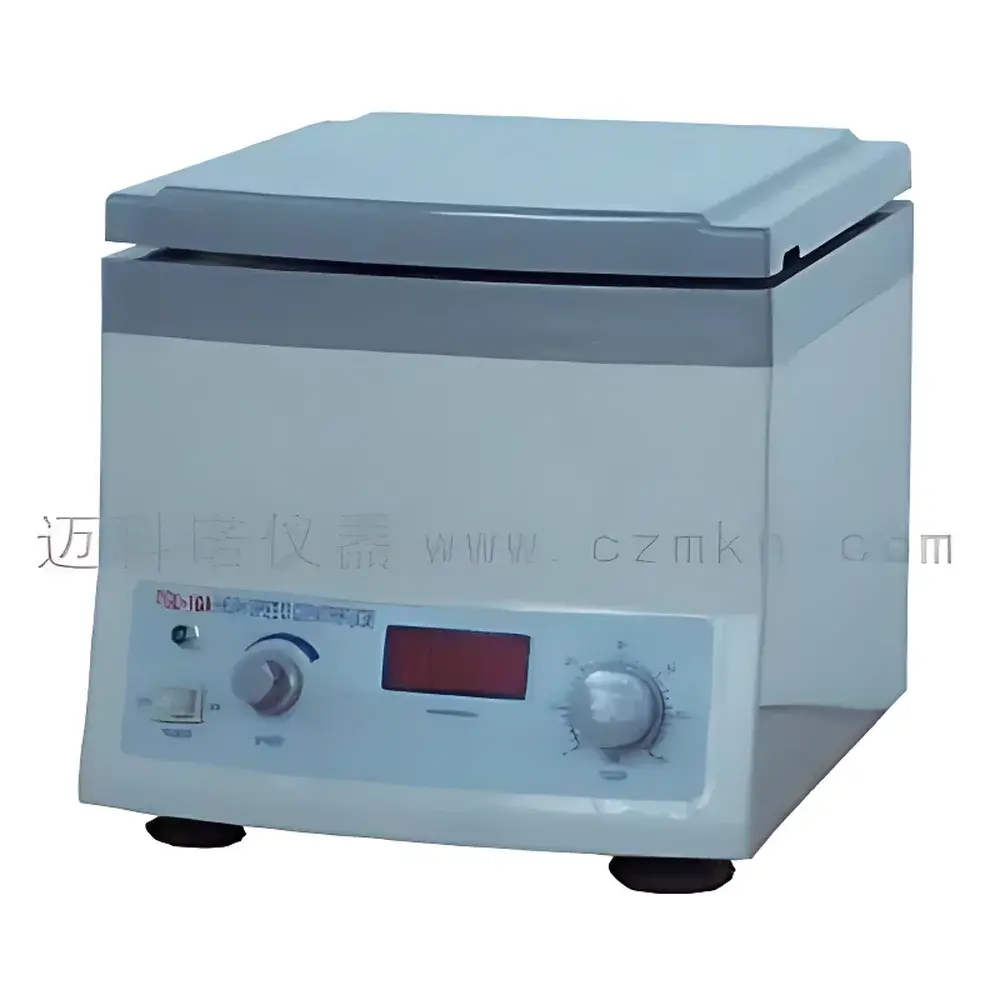
MKN TGL-16A Benchtop High-Speed Centrifuge
| Brand | MKN |
|---|---|
| Model | TGL-16A |
| Max Speed | 16,000 rpm (stepless digital speed control) |
| Relative Centrifugal Force (RCF) | 17,000 × g |
| Capacity | 12 × 1.5 mL or 12 × 0.5 mL or 8 × 5 mL tubes |
| Timer Range | 0–30 min |
| Noise Level | ≤60 dB(A) |
| Power Supply | AC 220 V, 50 Hz, 5 A |
| Rotor Material | Anodized Aluminum Alloy |
| Compliance | Designed for GLP-compliant laboratories |
Overview
The MKN TGL-16A Benchtop High-Speed Centrifuge is a precision-engineered, microprocessor-controlled centrifugation system designed for routine and research-grade separation of biological and chemical samples in compact laboratory environments. Operating on the principle of sedimentation under controlled rotational acceleration, the instrument generates up to 17,000 × g relative centrifugal force at its maximum speed of 16,000 rpm—enabling efficient pelleting of cellular components, subcellular organelles, macromolecules, and particulates from small-volume liquid suspensions. Its compact footprint, low thermal signature, and optimized aerodynamic rotor housing minimize operational heat buildup and vibration transmission—critical attributes for maintaining sample integrity during extended runs. The unit features real-time digital speed display with stepless speed regulation, allowing precise reproducibility across repeated protocols without mechanical gear shifting or discrete speed steps.
Key Features
- Stepless digital speed control (0–16,000 rpm) with ±50 rpm accuracy at full scale, enabling fine-tuned optimization for diverse sample viscosities and densities.
- Integrated automatic rotor imbalance detection and compensation system—halts operation if asymmetrical loading exceeds safe thresholds, preventing mechanical stress and ensuring long-term drive train reliability.
- Anodized aluminum alloy rotor with precision-machined tube pockets; corrosion-resistant surface enhances longevity and simplifies decontamination between runs.
- Microprocessor-based timer (0–30 minutes) with auto-brake function and audible end-of-run alert; programmable soft-start/soft-stop profiles reduce mechanical shock to sensitive pellets.
- Low-noise enclosure (<60 dB[A] at 1 m distance) engineered with acoustic dampening panels and balanced motor mountings—suitable for shared lab spaces and QC environments requiring ambient noise control.
- Thermally insulated chamber design limits temperature rise to <12 °C above ambient after 30 min continuous operation at maximum speed—preserving thermolabile analytes such as enzymes, antibodies, and nucleic acids.
Sample Compatibility & Compliance
The TGL-16A accommodates standard microcentrifuge formats including 0.5 mL, 1.5 mL, and 5 mL conical or round-bottom polypropylene tubes—compatible with most commercially available certified sterile and DNase/RNase-free consumables. Rotor geometry ensures uniform radial distribution of centrifugal force, minimizing wall-shear effects and supporting high-recovery pelleting of low-abundance targets. While not certified for biosafety level (BSL)-2+ containment, the unit complies with IEC 61010-1:2010 for electrical safety in laboratory equipment and incorporates double-insulated motor windings, grounded chassis, and overcurrent protection circuitry. It supports documentation workflows aligned with GLP and basic GMP practices, including operator ID logging (via optional external data interface), run timestamping, and parameter audit trails when integrated with compatible LIMS platforms.
Software & Data Management
The TGL-16A operates via an embedded firmware interface with no external software dependency—ensuring deterministic response, minimal validation overhead, and uninterrupted functionality in air-gapped or regulated environments. All critical parameters (speed, time, RCF, elapsed runtime) are displayed on a high-contrast LED screen with backlighting for visibility under varied lighting conditions. Though standalone, the device includes an RS-232 serial port (optional adapter) for integration into centralized instrument monitoring systems. When connected, it transmits ASCII-formatted run logs—including start/stop timestamps, setpoints, actual achieved RCF, and fault codes—for traceability in FDA 21 CFR Part 11–aligned environments where electronic record integrity is required. No proprietary drivers or cloud services are involved; raw data export is fully transparent and human-readable.
Applications
This centrifuge serves core separation tasks across clinical diagnostics, academic research, and industrial quality control laboratories. Typical applications include: rapid isolation of serum and plasma from whole blood (e.g., for ELISA, immunoassay, or coagulation testing); clarification of bacterial lysates prior to protein purification; concentration of viral particles or exosomes from cell culture supernatants; precipitation of nucleic acids using alcohol-based protocols; and removal of insoluble debris from enzyme reaction mixtures. Its versatility extends to preparative work in pharmaceutical development labs performing stability-indicating assays, where consistent RCF delivery and minimal carryover between runs support method robustness per ICH Q5A and USP .
FAQ
What is the maximum relative centrifugal force (RCF) achievable with the TGL-16A?
The unit delivers up to 17,000 × g at 16,000 rpm with the standard fixed-angle rotor.
Can this centrifuge accommodate PCR strip tubes or 8-tube racks?
No—it accepts only individual 0.5 mL, 1.5 mL, or 5 mL tubes; adapter accessories for multi-strip configurations are not supplied or validated by MKN.
Is rotor calibration traceable to national standards?
Yes—each rotor undergoes factory speed calibration against NIST-traceable tachometric references; calibration certificates are available upon request with purchase.
Does the device support continuous operation beyond 30 minutes?
No—the built-in timer caps at 30 minutes; for longer protocols, manual restart is required following cooldown and visual inspection of rotor integrity.
What maintenance intervals are recommended for optimal performance?
Visual inspection before each use; rotor cleaning with 70% ethanol after every run; biannual verification of speed accuracy and brake response using external tachometer and stopwatch—per MKN Service Bulletin TGL-16A-REV3.



