
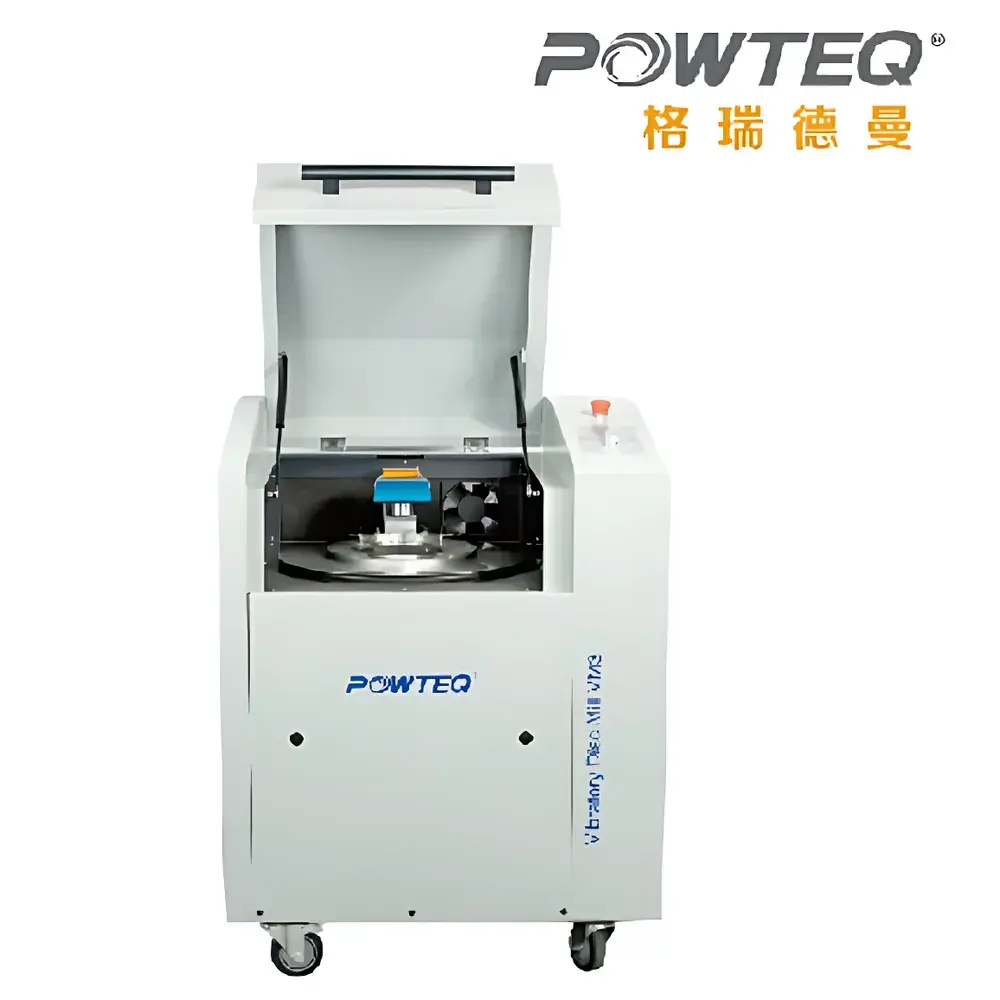
Grindemann VM3 Vibratory Cup Grinder
| Brand | Grindemann |
|---|---|
| Origin | Beijing, China |
| Manufacturer Type | Direct Manufacturer |
| Product Category | Domestic |
| Model | VM3 |
| Instrument Type | Vibratory Grinder |
| Sample Suitability | Hard & Brittle Materials |
| Feed Size | ≤15 mm |
| Final Particle Size (d95) | ≤75 µm |
| Output Granularity Range | 0.01–0.5 mm |
| Batch Capacity | 1 sample per run (20–250 g) |
| Speed Range | 700–1500 rpm (continuously adjustable) |
| Rated Power | 1.5 kW |
| Voltage/Frequency | 220 V, 50/60 Hz |
| Grinding Chamber Options | Multiple volumes available |
| Grinding Vessel Materials | Five material options (e.g., agate, stainless steel, tungsten carbide, zirconia, hardened steel) |
| Safety Features | Automatic agate identification, mechanical locking status monitoring, emergency stop integration |
| Footprint | Floor-standing, space-optimized design |
| Compliance | Designed for GLP-compliant laboratories |
Overview
The Grindemann VM3 Vibratory Cup Grinder is an engineered solution for high-reproducibility, batch-wise sample comminution in analytical laboratories requiring stringent particle size control for spectroscopic analysis—including XRF, ICP-OES, and AAS. It operates on the principle of three-dimensional vibrational energy transfer: a high-inertia eccentric drive generates controlled, multi-axis oscillations transmitted to a vertically constrained grinding cup assembly. Within this system, kinetic energy is converted into compressive impact, shear friction, and rolling pressure between the sample and grinding media—enabling rapid, low-contamination size reduction without thermal degradation or phase alteration. Unlike rotary or planetary mills, the VM3’s cup-based architecture eliminates cross-contamination risks between batches and ensures uniform energy distribution across heterogeneous hard materials such as ceramics, metallurgical slags, geological matrices, and construction aggregates.
Key Features
- Three-axis vibratory drive mechanism delivering consistent energy input across variable load masses (20–250 g), ensuring d95 ≤ 75 µm with <±3% inter-batch RSD for repeatable analytical performance.
- Modular grinding cup system with five certified vessel materials—agate (for trace-metal-free XRF prep), stainless steel (general-purpose), tungsten carbide (ultra-hard minerals), zirconia (abrasion-resistant organics), and hardened steel (high-toughness alloys)—each calibrated for optimal frequency coupling.
- Integrated mechanical lock verification and automatic agate recognition via embedded RFID tags, preventing operation unless cup type and clamping torque meet pre-defined safety thresholds.
- Ergonomic assist handle and low-center-of-gravity base design reduce operator fatigue during cup loading/unloading while maintaining structural rigidity under 1500 rpm dynamic loads.
- Floor-standing configuration with compact footprint (W × D × H: 420 × 510 × 860 mm) optimized for ISO Class 5–7 cleanroom integration and benchtop-limited lab environments.
- Variable-speed digital controller (700–1500 rpm) with programmable ramp-up/down profiles and real-time vibration amplitude feedback for method transferability across sample classes.
Sample Compatibility & Compliance
The VM3 is validated for comminution of medium-hard to extremely hard, brittle, and fibrous samples—including but not limited to cement clinker, basalt, sintered alumina, borosilicate glass, ferroalloy chips, lignocellulosic biomass, and contaminated soils. It meets mechanical safety requirements per IEC 61000-6-2 (immunity) and IEC 61000-6-4 (emissions), and its sealed grinding chamber conforms to ISO 13320 Annex B for laser diffraction sample dispersion integrity. For regulated environments, the instrument supports GLP/GMP-aligned workflows: all operational parameters (speed, duration, cup ID, torque confirmation) are timestamped and exportable in CSV or XML format, compatible with LIMS integration and 21 CFR Part 11–compliant electronic record systems when paired with validated third-party data acquisition software.
Software & Data Management
The VM3 operates via a standalone microcontroller interface with no external PC dependency. All grinding protocols—including speed setpoint, dwell time, acceleration profile, and cup identification—are stored locally in non-volatile memory (100+ methods). Parameter logs include start/stop timestamps, actual RPM deviation (<±2 rpm), total vibration cycles, and mechanical lock engagement status. Export functionality supports USB flash drive retrieval of audit trails with SHA-256 hash integrity verification. Optional Ethernet module enables remote monitoring via Modbus TCP for centralized lab equipment management platforms, facilitating preventive maintenance scheduling based on cumulative operational hours and vibration signature analysis.
Applications
- Preparation of homogenized pressed pellets for wavelength-dispersive X-ray fluorescence (WD-XRF) quantification of major and minor oxides in geological surveys and mining QA/QC.
- Routine pulverization of cementitious materials prior to hydraulic activity testing per ASTM C150 and EN 197-1 standards.
- Size reduction of recycled electronic waste (e-waste) fractions for leachability assessment under EPA Method 1311 (TCLP) and EN 12457 series.
- Homogenization of heterogeneous environmental soil cores for multi-element ICP-MS analysis with detection limits sub-ppt for As, Cd, Pb, and Hg.
- Production of spectrally representative powders from ceramic glazes and refractory bricks for Raman spectral library development.
FAQ
What sample types are incompatible with the VM3?
Samples with high elasticity (e.g., raw rubber, thermoplastic polymers), excessive moisture content (>15% w/w), or magnetic susceptibility (e.g., unshielded NdFeB magnets) may impair grinding efficiency or trigger false lock alarms.
Is cryogenic grinding supported?
No—the VM3 is not configured for liquid nitrogen cooling; ambient-temperature operation is standard. For heat-sensitive organics, zirconia cups and reduced speed settings (700–900 rpm) minimize thermal input.
How is calibration traceability maintained?
Grindemann provides factory calibration certificates for speed accuracy (NIST-traceable tachometer), torque threshold verification, and cup material composition (XRF-certified agate purity ≥99.998%). On-site recalibration services follow ISO/IEC 17025 procedures.
Can multiple cups be processed sequentially without manual reset?
Each run requires manual cup replacement and lock verification; automated multi-cup carousels are not supported. However, method recall and parameter auto-load reduce setup time to <60 seconds per batch.
What maintenance intervals are recommended?
Lubrication of the eccentric drive bearing every 1,000 operating hours; inspection of cup sealing gaskets and locking cam wear every 500 cycles; full vibration spectrum analysis annually using supplied diagnostic firmware.



