
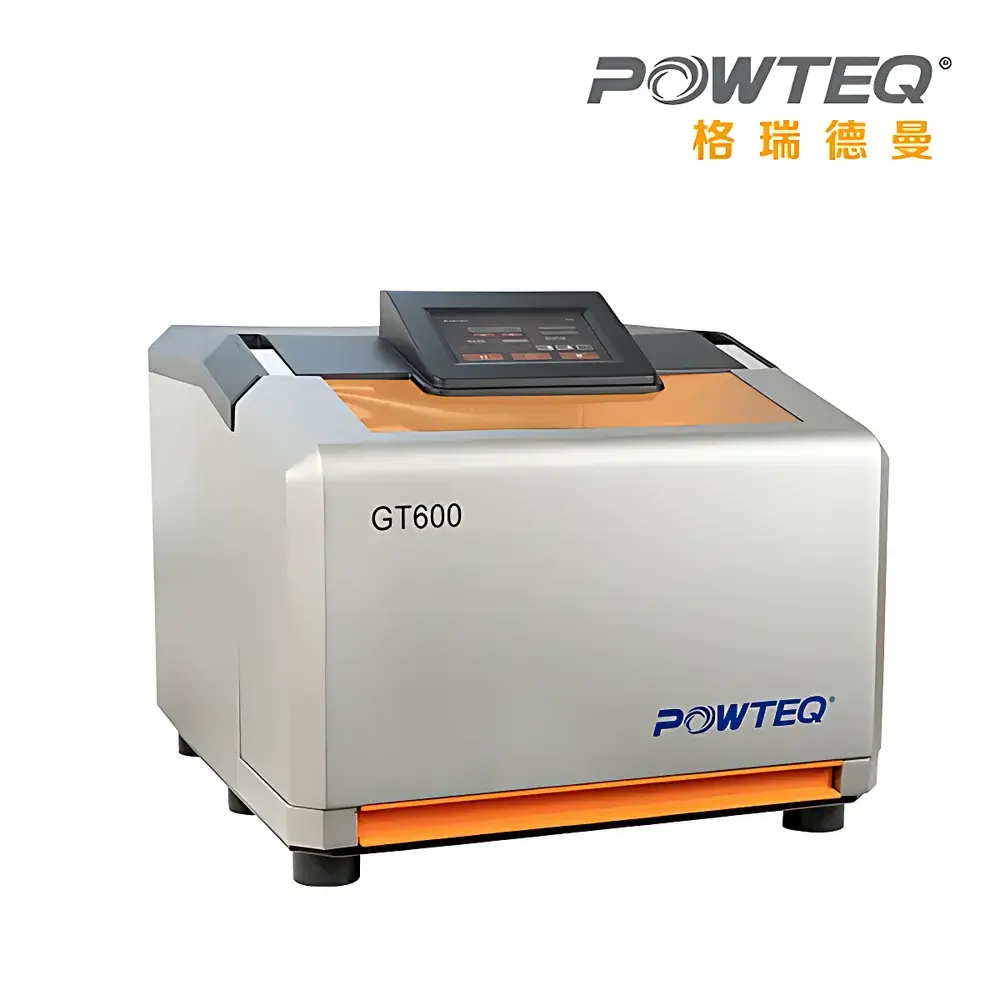
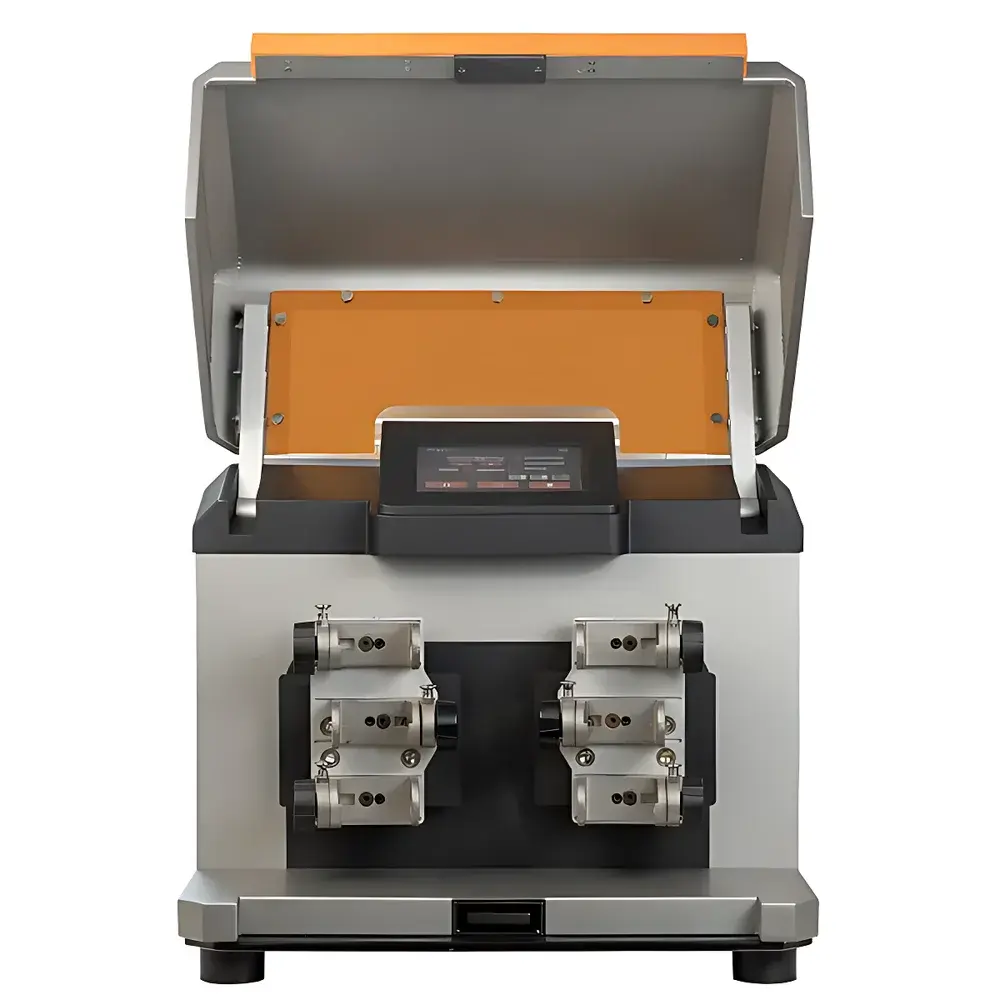
Grinderman GT600Multi Multi-Platform Vibratory Ball Mill
| Brand | Grinderman |
|---|---|
| Origin | Beijing, China |
| Manufacturer Type | Direct Manufacturer |
| Country of Origin | China |
| Model | GT600Multi |
| Instrument Type | Vibratory Ball Mill |
| Sample Suitability | Hard, Brittle, Fibrous, Elastic & Soft Materials |
| Feed Size | < 10 mm |
| Final Particle Size | < 5 µm (typical) |
| Batch Capacity | 6 × 20 mL |
| Operating Frequency Range | 180–2100 rpm (3–35 Hz) |
| Grinding Vessel Options | 1.5, 5, 10, 25, 35, 50, 80, 125 mL |
| Vessel Materials | Stainless Steel, Tungsten Carbide, Zirconia, Agate, PTFE, Hardened Steel |
| Programmable Cycles | Up to 99 |
| Preset Methods | 20 stored protocols |
| Safety | Interlocked transparent lid with automatic motor cutoff |
| Temperature Control | None (ambient or optional cryogenic adapter support) |
Overview
The Grinderman GT600Multi is a high-frequency vibratory ball mill engineered for reproducible, high-throughput sample comminution across diverse material classes. It operates on the principle of radial arc oscillation—where grinding vessels undergo controlled horizontal pendular motion at frequencies up to 35 Hz (2100 rpm), inducing intense collision dynamics between grinding media (balls) and sample particles. This mechanical energy transfer enables efficient particle size reduction through impact, shear, and compression mechanisms, without reliance on rotating drums or centrifugal forces typical of planetary mills. Unlike conventional mills, the GT600Multi’s multi-platform architecture decouples vessel motion from drive mechanics, minimizing cross-contamination risk and enabling simultaneous processing of heterogeneous sample types under identical kinetic conditions. Its design adheres to fundamental principles of mechanochemistry and solid-state fragmentation physics, making it suitable for applications demanding strict batch-to-batch consistency—particularly in regulated environments where method traceability and parameter control are critical.
Key Features
- Multi-platform configuration supporting up to six independent 20 mL grinding vessels—or scalable to 384 positions using microtiter plate adapters—enabling parallel processing without inter-vessel interference.
- Digital parameter control interface allowing precise presetting of oscillation frequency (180–2100 rpm), total duration (seconds to hours), rest intervals, and cycle repetition count (up to 99 cycles).
- Integrated safety system featuring a transparent polycarbonate lid with electromagnetic interlock: motor power is instantly cut upon lid displacement, complying with IEC 61000-6-2/6-4 EMC and EN 61000-1-2 functional safety guidelines.
- 20 user-defined method storage slots with timestamped execution logging—supporting audit-ready workflow documentation per GLP and ISO/IEC 17025 requirements.
- Modular grinding vessel compatibility: standardized threading accepts vials and jars in volumes from 1.5 mL to 125 mL, fabricated from stainless steel, tungsten carbide, zirconia, agate, PTFE, or hardened steel—ensuring chemical inertness and wear resistance across acidic, alkaline, or abrasive matrices.
- Real-time visual monitoring via optical-grade lid window; no need to interrupt operation for process verification.
Sample Compatibility & Compliance
The GT600Multi accommodates hard, brittle, fibrous, elastic, and soft biological and inorganic materials—including plant tissues (roots, stems, seeds), animal organs and bone, mineral ores, ceramics, polymers, pharmaceutical tablets, and electronic waste. Feed size limitation (<10 mm) ensures optimal energy coupling within the oscillation envelope; final particle size distribution typically achieves D90 < 5 µm, verified by laser diffraction (ISO 13320) or SEM imaging. The instrument meets CE marking requirements for laboratory equipment (2014/30/EU EMC Directive and 2014/35/EU LVD). While not intrinsically temperature-controlled, optional liquid nitrogen cooling adapters enable cryogenic grinding compliant with ASTM E2937-22 for heat-sensitive biomolecules and thermolabile compounds. All grinding components conform to USP Analytical Instrument Qualification standards for material contact surfaces.
Software & Data Management
The GT600Multi employs embedded firmware—not cloud-based software—to ensure deterministic real-time control and data integrity. Each run generates a local log file (CSV format) containing start/stop timestamps, applied frequency, total runtime, cycle count, and method ID. These logs are exportable via USB port for integration into LIMS or ELN platforms. The system supports 21 CFR Part 11-compliant audit trails when paired with validated third-party laboratory informatics systems—enabling electronic signatures, change history tracking, and role-based access control. No remote connectivity or internet dependency is implemented, preserving data sovereignty and reducing cybersecurity exposure in regulated QC labs.
Applications
This mill serves as a primary sample preparation tool in analytical workflows requiring homogenization prior to elemental analysis (ICP-MS/OES), molecular extraction (DNA/RNA/protein), XRD phase identification, SEM-EDS characterization, or dissolution testing. Key use cases include: (1) disruption of fibrous plant biomass for metabolomic profiling; (2) pulverization of alloy fragments for trace metal quantification; (3) cryo-grinding of frozen tissue for single-cell RNA-seq library prep; (4) nano-sizing of ceramic precursors for sintering optimization; and (5) deagglomeration of pharmaceutical excipients during formulation development. Its robustness supports routine operation in ISO 17025-accredited testing laboratories, FDA-regulated biomanufacturing facilities, and academic core facilities performing high-volume genomics or environmental screening.
FAQ
What is the maximum recommended feed size for optimal grinding efficiency?
For consistent energy transfer and minimal vessel wear, feed particles should be ≤10 mm in largest dimension—though pre-crushing is advised for highly heterogeneous or dense samples such as cast iron or granite.
Can the GT600Multi be used for cryogenic grinding?
Yes—when equipped with optional LN₂-compatible adapters and stainless-steel or zirconia vessels, it supports grinding at sub-zero temperatures per ASTM E2937-22 protocols.
Is method validation support available for GMP environments?
Grinderman provides IQ/OQ documentation templates aligned with ASTM E2500-22 and EU Annex 15; full PQ must be performed in situ by the end user per their internal SOPs.
How is cross-contamination prevented during high-throughput runs?
Each platform operates independently with sealed vessels; no shared drive shafts or air paths exist between positions—eliminating mechanical or aerosol-mediated carryover.
Does the instrument comply with FDA 21 CFR Part 11 requirements?
The device itself is Part 11–capable at the data acquisition layer; full compliance requires integration with a validated electronic record system meeting signature, audit trail, and retention criteria.
Related Products



