
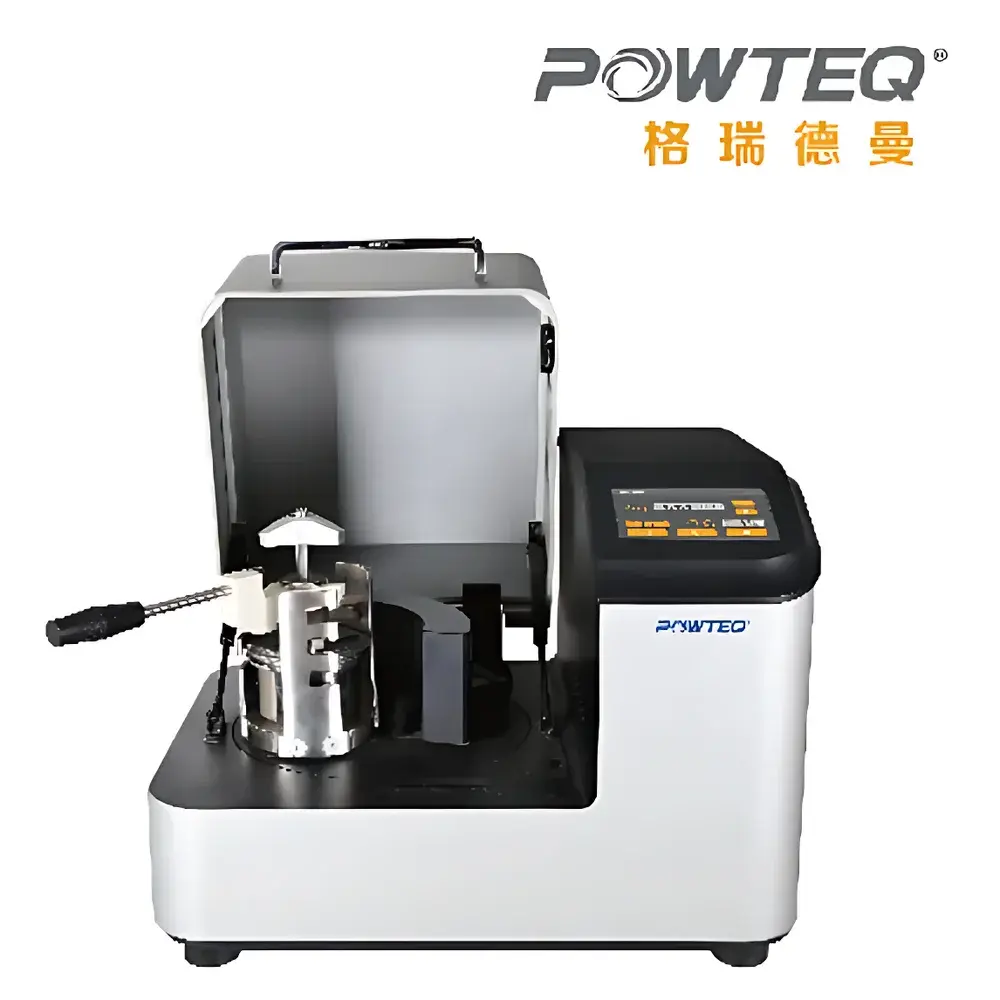
Grindemann BM6Pro Planetary Ball Mill
| Brand | Grindemann |
|---|---|
| Origin | Beijing, China |
| Manufacturer Type | Direct Manufacturer |
| Product Category | Domestic |
| Model | BM6Pro |
| Instrument Type | Planetary Ball Mill |
| Sample Suitability | Hard, Brittle, Fibrous, Medium-Hard, and Soft Materials (Dry or Wet Grinding) |
| Feed Size | < 10 mm |
| Final Particle Size | < 0.1 µm (down to colloidal/nanoscale with optimized wet grinding) |
| Rotational Speed Range | 100–650 rpm |
| Sun Wheel Diameter | 260 mm |
| Jar Volume Options | 50 / 80 / 125 / 250 / 500 mL |
| Power Rating | 750 W |
| Voltage | 220 V, 50/60 Hz |
| Time Setting | 0–999 min (with cycle count: 1–99) |
| Speed Ratio | 1:−2 (counter-rotating jar-to-sun-wheel) |
| Safety | Integrated safety lock, automatic ventilation, programmable reverse rotation |
Overview
The Grindemann BM6Pro Planetary Ball Mill is an engineered high-energy milling system designed for reproducible, scalable nanoscale particle size reduction through planetary motion mechanics. It operates on the principle of centrifugal acceleration combined with counter-rotational kinematics: a central sun wheel rotates at controlled speed while simultaneously driving up to one grinding jar (mounted eccentrically) to rotate in the opposite direction at a fixed speed ratio (1:−2). This dual-axis motion generates intense Coriolis and impact forces—up to 65× gravitational acceleration (g-force)—between grinding media (e.g., zirconia, stainless steel, or tungsten carbide balls) and sample material. The resulting mechanical energy input enables efficient comminution of hard, brittle, fibrous, and composite materials—whether dry or in liquid suspension—down to sub-100 nm median particle diameters under optimized conditions. Unlike conventional tumbling mills, the BM6Pro’s planetary architecture ensures uniform energy distribution across the entire sample volume, minimizing thermal gradients and agglomeration risks during extended operation.
Key Features
- High-speed planetary drive system with adjustable rotational speed (100–650 rpm) and precise 1:−2 counter-rotation ratio for maximal kinetic energy transfer
- Integrated automatic ventilation module to manage heat buildup during prolonged grinding cycles—critical for thermolabile compounds and nanomaterial synthesis
- Dual-layer safety interlock: mechanical latch + electronic sensor-based jar detection ensures mill halts immediately upon lid opening or jar misalignment
- Programmable reverse rotation function prevents sample stratification and media clustering, enhancing homogeneity and repeatability
- Industrial-grade 7-inch LED capacitive touchscreen interface with intuitive menu navigation, real-time parameter monitoring, and password-protected user profiles
- Robust aluminum alloy frame with vibration-dampening feet and IP20-rated enclosure for stable, low-noise operation in shared laboratory environments
- Modular jar compatibility: standardized mounting for 50–500 mL grinding jars in multiple materials (stainless steel, agate, zirconia, PTFE-lined)
Sample Compatibility & Compliance
The BM6Pro accommodates diverse sample types—including metallic alloys, ceramic precursors, pharmaceutical actives, geological minerals, polymer composites, and biological tissues—under both dry and wet grinding protocols. Its ability to achieve consistent sub-100 nm particle distributions supports method development aligned with ISO 13320 (laser diffraction particle sizing), ASTM E2919 (nanomaterial characterization), and USP <724> (micronized drug substance testing). The instrument’s programmable time/cycle control and audit-ready parameter logging meet foundational requirements for GLP-compliant documentation. While not inherently 21 CFR Part 11 compliant out-of-the-box, its digital interface supports integration with validated LIMS or ELN platforms via RS-232 or optional USB data export for traceable recordkeeping.
Software & Data Management
The BM6Pro features embedded firmware with non-volatile memory for storing ≥50 custom grinding methods—including speed, duration, rest intervals, rotation direction sequence, and cycle repetition counts. All parameters are timestamped and logged internally with date/time stamps; data can be exported as CSV files via USB flash drive for downstream statistical analysis (e.g., ANOVA of Dv50 reproducibility across batches). The touch interface includes calibration prompts for speed verification and jar weight compensation routines to maintain torque consistency across varying load masses. No cloud connectivity or remote access is implemented—ensuring full data sovereignty and compliance with institutional IT security policies.
Applications
- Mechanical alloying of intermetallics and amorphous metal powders for additive manufacturing feedstock preparation
- Nanocrystalline ceramic synthesis (e.g., TiO₂, ZnO, Al₂O₃) for photocatalysis and battery electrode materials
- Top-down nanomilling of APIs to enhance dissolution kinetics and bioavailability per ICH Q5A guidelines
- Homogenization of heterogeneous catalysts and supported metal nanoparticles for surface area optimization
- Preparation of reference standards for XRD line-broadening analysis and TEM sample thinning
- Soil and sediment digestion support for heavy metal speciation studies requiring ultra-fine liberation of mineral phases
- Recycling-oriented comminution of spent Li-ion battery cathodes prior to hydrometallurgical leaching
FAQ
What is the maximum recommended continuous run time for the BM6Pro?
The system is rated for uninterrupted operation up to 999 minutes per cycle; however, for optimal thermal management and bearing longevity, cycles exceeding 180 minutes should incorporate ≥10-minute cooling intervals between repetitions.
Can the BM6Pro process moisture-sensitive samples under inert atmosphere?
Yes—jars with gas-tight O-ring seals (optional accessories) support argon or nitrogen purging; users must implement external gas manifolds and pressure-relief valves per local lab safety protocols.
Is jar volume selection critical to achieving sub-100 nm particle size?
Yes—fill level directly affects impact frequency and energy density; Grindemann recommends 20–30% jar volume occupancy with grinding media and sample combined for nanoscale outcomes.
Does the BM6Pro support GMP documentation workflows?
It provides essential metadata (time, speed, cycle count, user ID) for raw data records; full GMP compliance requires supplementary validation of software functions, change control procedures, and periodic performance qualification per Annex 15.
How frequently should maintenance checks be performed?
Visual inspection of belts, locking mechanisms, and ventilation filters is advised before each use; full preventive maintenance—including torque verification of sun wheel bolts and motor brush inspection—is recommended every 1,000 operating hours or annually, whichever occurs first.



