
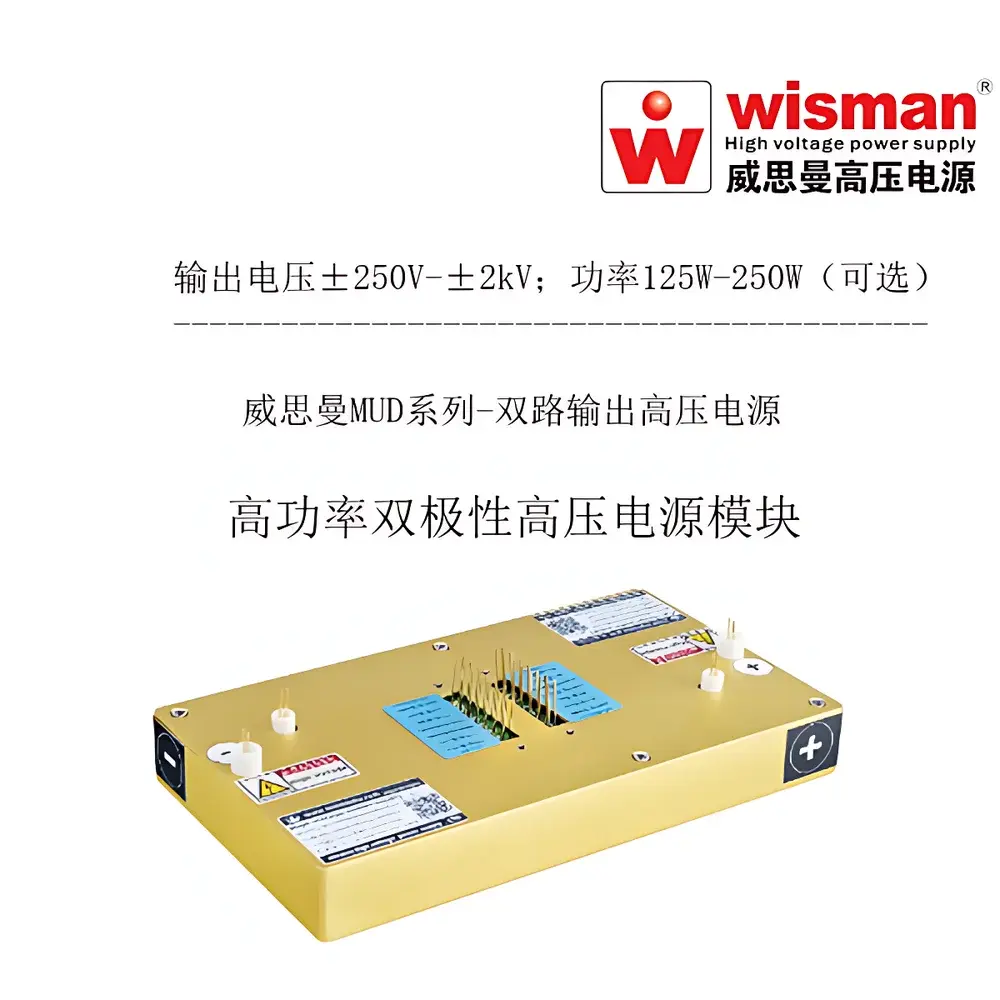
Wiseman MUD Series Dual-Channel High-Voltage Power Supply Module — 6 kV / 250 W
| Key | Brand: Wiseman |
|---|---|
| Output Voltage Range | ±0–6 kV (dual-channel, independently adjustable) |
| Max. Output Power | 250 W (125 W per channel) |
| Input Voltage | DC 11–32 V |
| Ripple | ≤0.1% RMS |
| Voltage Regulation | ≤0.01% (line & load) |
| Temp. Coefficient | 25 ppm/°C (optional 15 ppm/°C) |
| MTBF | >200,000 hrs @ 65°C |
| Operating Temp. | −10 to +65°C (optional −40 to +65°C) |
| Compliance | MIL-STD-810G (shock, vibration, thermal shock), RoHS, CE-marked for industrial use |
| Communication Interface | Optional RS-232 / RS-485 |
| Form Factor | 27 × 114.3 × 203.2 mm |
| Weight | 0.75 kg |
| Application-Specific Design | Mass spectrometry instrument power supply |
Overview
The Wiseman MUD Series Dual-Channel High-Voltage Power Supply Module is an OEM-optimized, surface-mount technology (SMT)-based DC/DC converter engineered for precision, stability, and high power density in demanding scientific and industrial applications. Designed specifically for integration into analytical instrumentation—including mass spectrometers—the MUD module delivers two fully independent, galvanically isolated high-voltage outputs with programmable polarity (positive, negative, or bipolar). Each channel operates across a continuous 0–6 kV range at up to 125 W, enabling combined 250 W operation while maintaining sub-0.01% line and load regulation. Its architecture leverages zero-current resonant switching and proprietary high-voltage insulation techniques to achieve ultra-low ripple (≤0.1% RMS), exceptional thermal stability (25 ppm/°C standard), and minimal electromagnetic interference—critical for noise-sensitive detector systems and time-of-flight mass spectrometry front-end biasing.
Key Features
- Dual-channel, independently controlled outputs with selectable polarity (±0–6 kV per channel)
- Wide input range: DC 11–32 V, supporting flexible system-level power architecture
- High power density: 250 W in a compact 27 × 114.3 × 203.2 mm footprint (0.75 kg)
- Ultra-stable output: <0.01%/8 hr drift after warm-up; <0.02%/24 hr long-term stability
- Fast transient response with minimal overshoot and <10 µs rise time (typ.)
- Fixed-frequency, low-energy-storage design optimized for pulse charging and repetitive high-current loads
- Comprehensive protection: short-circuit, over-temperature, and over-voltage fault handling with auto-recovery
- Optional digital interface: RS-232 or RS-485 for remote monitoring, setpoint adjustment, and status reporting
- MIL-STD-810G qualified: compliant with Method 503.4 (thermal shock), 514.5C-3 (vibration), and 516.5 (shock)
- OEM-customizable: pinout, voltage/current limits, enclosure options, and firmware logic available upon request
Sample Compatibility & Compliance
The MUD module is validated for direct integration into high-precision analytical platforms where stable, low-noise bias voltages are essential—particularly quadrupole and time-of-flight mass spectrometer ion optics, electron multipliers, and detector arrays. Its electrical isolation (>5 kVdc between channels and chassis) and low EMI profile meet IEC 61326-1 requirements for laboratory equipment in electromagnetic compatibility (EMC). While not FDA 21 CFR Part 11 certified as a standalone device, the module supports audit-ready system-level compliance when embedded in instruments adhering to GLP/GMP workflows. It conforms to RoHS Directive 2011/65/EU and carries CE marking for industrial use under EN 61000-6-2 (immunity) and EN 61000-6-4 (emissions). Thermal derating curves and environmental test reports (including storage at −55 to +105°C) are provided in OEM documentation packages.
Software & Data Management
The MUD module operates in open-loop or closed-loop mode via analog control (0–10 V or 4–20 mA) or optional digital command sets over RS-232/RS-485. Wiseman provides a standardized ASCII protocol with commands for voltage setpoint, enable/disable, readback of actual output, temperature, and fault status. No proprietary driver is required; integration with LabVIEW, Python (pySerial), or PLC-based SCADA systems is straightforward. For traceability-critical environments, OEMs may implement timestamped log files capturing output voltage, current, temperature, and error codes—supporting ISO/IEC 17025-compliant calibration records. Firmware updates are performed via serial bootload without hardware modification.
Applications
- Mass spectrometry: Ion source biasing, quadrupole RF/DC offset, electron multiplier gain control
- Pulsed power systems: Capacitor charging for laser flashlamps, pulsed electron beams, and piezoelectric actuators
- Scientific instrumentation: Electron/ion beam focusing, electrostatic lens arrays, field emission sources
- Industrial testing: Cable insulation resistance verification, dielectric strength evaluation, component burn-in
- Semiconductor characterization: High-voltage probe station biasing, MOSFET gate oxide stress testing
- Medical device subsystems: X-ray tube filament and anode supplies, electrophoresis power units
FAQ
Is the MUD module suitable for use in vacuum environments?
Yes—vacuum-compatible variants (designated with “-V” suffix) are available upon request. Standard units require atmospheric pressure for convection cooling; vacuum versions include conformal coating and alternate thermal management provisions.
Can both channels operate simultaneously at full 6 kV and 125 W?
Yes—each channel is rated for continuous 125 W at 6 kV (20.8 mA), with independent thermal monitoring ensuring safe parallel operation within specified ambient conditions.
What is the minimum output voltage resolution when using analog control?
With 0–10 V analog input, resolution is 0.06% of full scale (e.g., ~3.6 V per 6 kV), corresponding to ~3.6 V step size; digital control achieves 16-bit resolution (~0.0015% FS).
Does Wiseman provide calibration certificates traceable to NIST standards?
Yes—NIST-traceable calibration reports (ISO/IEC 17025 accredited lab) are available as an optional add-on for production units, including voltage accuracy, load regulation, and temperature coefficient verification.
How is safety isolation verified during manufacturing?
Every unit undergoes 100% hi-pot testing at 2× rated output voltage + 1 kV (e.g., 13 kVdc for 6 kV models) for 60 seconds between output and chassis, per IEC 61010-1 Clause 6.6.



