
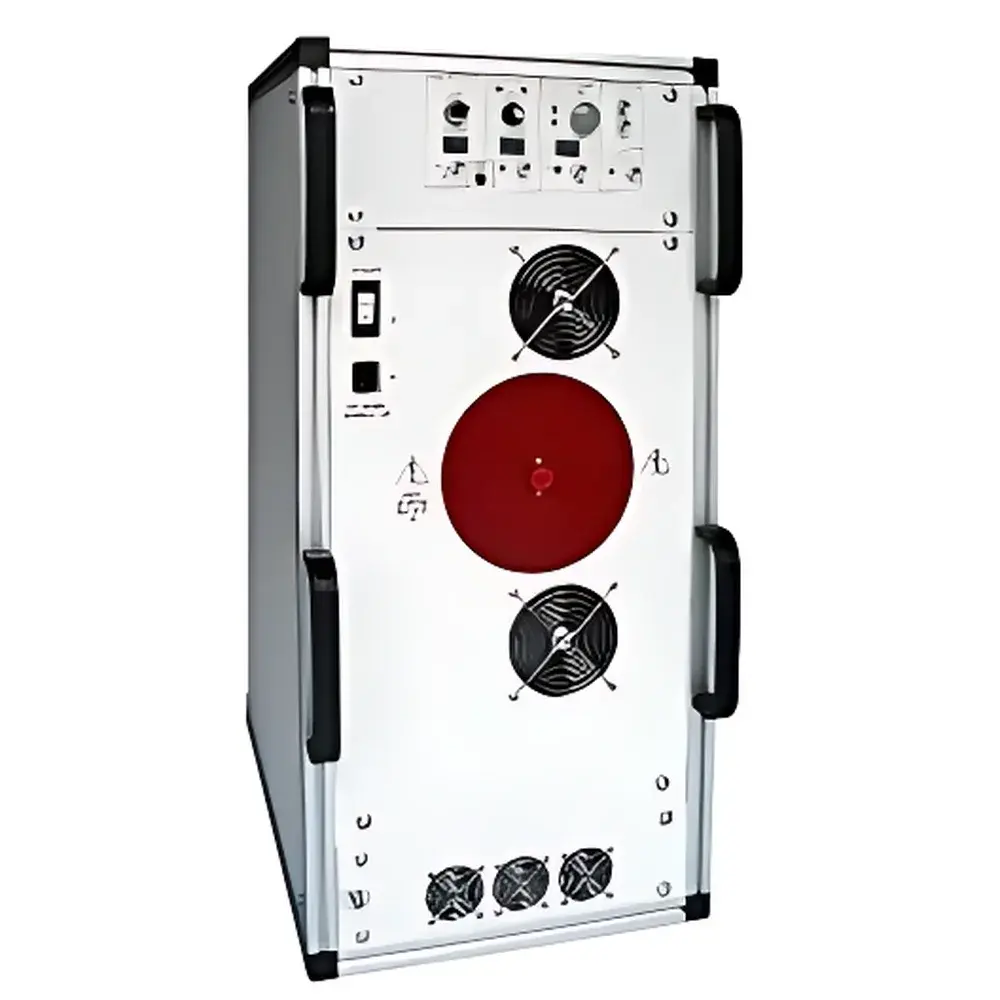
Wisman AMH±60 kV / 600 W High-Voltage Amplifier
| Brand | Wisman |
|---|---|
| Model | AMH |
| Output Voltage | ±60 kV (DC or AC peak) |
| Output Current | ±10 mA (DC or AC peak) |
| Power Rating | 600 W |
| Input Signal Range | ±10 V DC or AC peak |
| Input Impedance | 25 kΩ |
| DC Voltage Gain | 6000 V/V |
| Gain Accuracy | < 0.1% of full scale |
| Output Noise | < 10 V RMS |
| Slew Rate | > 350 V/µs (10%–90%) |
| Large-Signal Bandwidth | DC to > 1.4 kHz |
| Small-Signal Bandwidth (−3 dB, 1% THD) | DC to > 20 Hz |
| Stability | < 50 ppm/hr (non-cumulative) |
| Temperature Coefficient | < 25 ppm/°C |
| Operating Temperature | 0–40 °C |
| Relative Humidity | ≤75% RH (non-condensing) |
| Altitude | ≤2000 m |
| Dimensions | 1473.5 × 628.7 × 948.4 mm |
| Weight | 125–136 kg |
| Display Resolution | Voltage — 6000:1 (accuracy < 0.1% FS |
| Output Impedance | 47 Ω |
Overview
The Wisman AMH±60 kV / 600 W High-Voltage Amplifier is a precision-engineered, fully solid-state, four-quadrant power amplifier designed for demanding scientific and industrial applications requiring stable, low-noise, high-slew-rate bipolar high-voltage excitation. Based on advanced high-voltage insulation architecture and active feedback control, the AMH series delivers true bidirectional current sourcing and sinking across its entire ±60 kV output range—enabling precise dynamic control of capacitive, resistive, and reactive loads. Unlike conventional high-voltage supplies limited to unidirectional operation, the AMH’s four-quadrant capability supports closed-loop actuation in real-time electrostatic systems, such as beam steering in mass spectrometry or polarization cycling in ferroelectric characterization. Its wide small-signal bandwidth (>20 Hz at 1% THD) and large-signal bandwidth (>1.4 kHz) ensure fidelity in both static biasing and rapid transient response applications—including dielectric barrier discharge modulation and electro-optic waveform synthesis.
Key Features
- Four-Quadrant Active Output: Simultaneous sourcing and sinking of up to ±10 mA into reactive or capacitive loads—critical for closed-loop electrostatic actuators and feedback-stabilized high-voltage systems.
- Ultra-Low Output Noise: <10 V RMS broadband noise ensures signal integrity in sensitive measurements such as ion trajectory correction or piezoelectric hysteresis mapping.
- High Slew Rate & Bandwidth: >350 V/µs (10–90%) and >1.4 kHz large-signal bandwidth enable accurate replication of fast-rising waveforms used in pulsed plasma ignition or time-resolved electrophoresis.
- Programmable DC Stability: Drift <50 ppm/hr (non-cumulative) and temperature coefficient <25 ppm/°C support long-duration experiments compliant with GLP and ISO/IEC 17025 environmental monitoring protocols.
- Integrated Precision Monitoring: Dual high-resolution analog meters—voltage (6000:1 scaling, <0.1% FS accuracy, 2% FS accuracy, <±10 mV offset)—provide traceable, real-time diagnostics without external instrumentation.
- Robust Solid-State Architecture: Fully encapsulated, oil-free, maintenance-free design rated for continuous operation at altitudes up to 2000 m and ambient humidity ≤75% RH (non-condensing).
Sample Compatibility & Compliance
The AMH amplifier is compatible with a broad class of high-impedance, high-capacitance, and non-linear loads encountered in vacuum and atmospheric environments—including electrostatic deflectors, electrophoretic chambers, electro-rheological fluid cells, and ferroelectric polarization test fixtures. It meets IEC 61010-1:2010 safety requirements for measurement, control, and laboratory equipment. Its stable DC performance and calibrated analog outputs support audit-ready data acquisition under FDA 21 CFR Part 11 when integrated with compliant SCADA or LabVIEW-based DAQ systems. While not certified for medical use, its precision and repeatability align with ASTM D149 (dielectric breakdown), ASTM F1527 (electrostatic discharge testing), and ISO 25178-602 (surface charge mapping) test methodologies.
Software & Data Management
The AMH operates as an analog-controlled instrument, accepting standard ±10 V DC or AC peak input signals with 25 kΩ input impedance—ensuring seamless integration with arbitrary waveform generators (AWGs), lock-in amplifiers, and PID controllers. Optional digital interface modules (e.g., USB/Ethernet-enabled analog-to-digital converters) may be deployed externally to log voltage/current traces with timestamped metadata. All analog meter outputs are galvanically isolated and scaled for direct connection to data acquisition systems supporting IEEE 1588 PTP or NIST-traceable time synchronization. Audit trails, calibration logs, and operational parameters can be archived in CSV or HDF5 format to meet ISO/IEC 17025 documentation requirements.
Applications
- Mass spectrometer ion optics biasing and beam focusing
- Electrostatic deflection and particle acceleration in accelerator physics setups
- Pulsed DC and AC biasing for ferroelectric hysteresis loop measurement (P–E loops)
- Real-time control of electro-optic modulators and spatial light modulators
- Dielectric barrier discharge (DBD) and atmospheric pressure plasma jet actuation
- Electrophoretic mobility and zeta potential instrumentation
- Current rheological fluid response characterization under dynamic field conditions
- Materials science studies involving space charge accumulation and trap distribution analysis
FAQ
Is the AMH amplifier suitable for continuous-duty operation at full output?
Yes—the AMH is engineered for uninterrupted operation at rated ±60 kV / ±10 mA under forced-air cooling and ambient conditions within specification (0–40 °C, ≤75% RH).
Can it drive highly capacitive loads, such as parallel-plate electrodes with >1 nF capacitance?
Yes—its four-quadrant architecture and >350 V/µs slew rate allow stable driving of capacitive loads up to several nanofarads without oscillation or overshoot, provided proper grounding and shielding practices are followed.
Does the unit include factory calibration documentation traceable to national standards?
Each AMH amplifier ships with a NIST-traceable calibration certificate covering voltage gain, offset, linearity, and noise performance, valid for 12 months from date of shipment.
What safety interlocks are implemented?
The system includes hardware-based overvoltage, overcurrent, overtemperature, and arc-detection circuits that initiate immediate shutdown with latching fault indication—compliant with IEC 61010-1 Clause 6.3.2.
Is remote monitoring possible via Ethernet or USB?
The base model features analog I/O only; optional OEM interface modules provide isolated digital communication (RS-485, USB-CDC, or Ethernet TCP/IP) for remote status polling and parameter readback—subject to custom configuration.



