
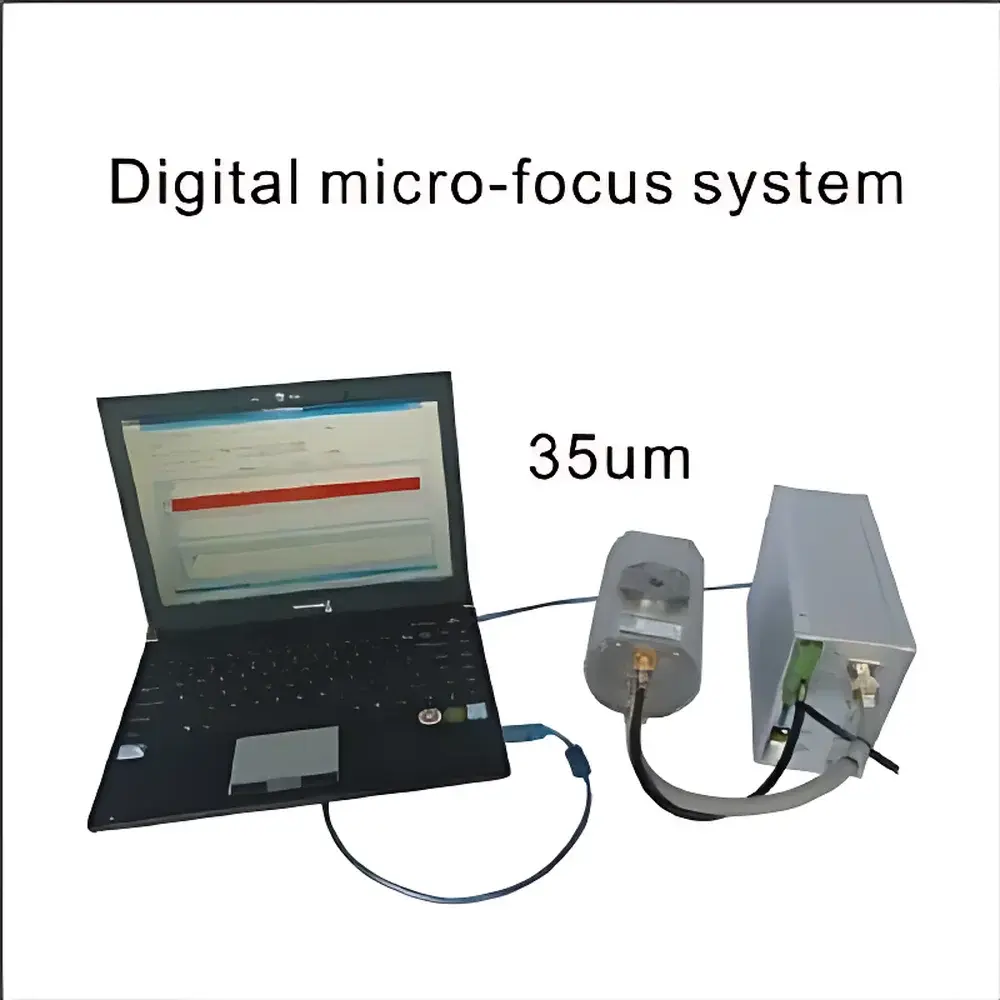

Wiseman WSM-35um Digital Microfocus X-ray Radiography System (50 kV / 50 W)
| Brand | Wiseman |
|---|---|
| Model | WSM-35um |
| Max. Output Voltage | 50 kV |
| Max. Output Current | 1 mA |
| Max. Power | 50 W |
| Focal Spot Size | 35 µm |
| Target Materials | Cu, W, Mo |
| High-Voltage Supply Interface | RS232 / RS422 |
| Origin | Shaanxi, China |
Overview
The Wiseman WSM-35um Digital Microfocus X-ray Radiography System is a compact, high-resolution non-destructive testing (NDT) platform engineered for precision internal inspection of small-scale components and materials. Operating on the principle of transmission X-ray imaging, the system utilizes a digitally controlled microfocus X-ray tube with a nominal focal spot size of 35 µm—enabling spatial resolution suitable for detecting sub-100 µm features in low-to-medium density samples. With a maximum accelerating voltage of 50 kV and a rated power output of 50 W, the system delivers stable, repeatable X-ray flux across adjustable voltage steps (20–50 kV in 10 kV increments), supporting both qualitative defect identification and semi-quantitative thickness or density assessment. Its fully digital architecture eliminates analog drift, ensures precise parameter reproducibility, and facilitates seamless integration into automated inspection workflows.
Key Features
- Digital microfocus X-ray source with certified 35 µm focal spot size—validated per ISO 17636-2 Annex B and ASTM E2737 calibration protocols
- Programmable high-voltage power supply (XRW50P50-B) offering 20–50 kV output in discrete 10 kV steps, with ±0.5% voltage stability under load
- Maximum tube current of 1 mA, enabling optimized signal-to-noise ratio for thin metallic foils, polymer composites, PCBs, and ceramic substrates
- Interchangeable anode targets (Cu, W, Mo) to tailor X-ray spectrum for material-specific contrast—e.g., Cu for aluminum alloys, Mo for soft-tissue simulants, W for higher-Z shielding evaluation
- Standard serial communication interfaces (RS232 and RS422) for remote control, real-time parameter logging, and synchronization with external motion stages or detector triggers
- Embedded thermal management and overcurrent/overvoltage protection circuits compliant with IEC 61010-1 safety requirements for Class I laboratory equipment
Sample Compatibility & Compliance
The WSM-35um system is validated for use with samples up to 80 mm in diameter and 50 mm in height when mounted on standard NDT sample holders. It supports non-destructive evaluation of electronics (e.g., solder joint integrity, wire bond voids), additive manufacturing parts (powder bed fusion porosity mapping), battery electrode layers, and miniature mechanical assemblies. The system adheres to key international standards governing radiographic NDT: ISO 5579 for exposure technique selection, ISO 17636-2 for image quality indicator (IQI) sensitivity verification, and EN 1435 for weld inspection methodology. While not certified as a medical device, its emission profile meets IEC 60601-2-54 radiation safety thresholds for industrial cabinet systems when operated within specified shielding configurations.
Software & Data Management
The system operates via Wiseman’s proprietary X-Ray Control Suite (v3.2+), a Windows-based application supporting full parameter scripting, exposure sequence automation, and DICOM-compliant image export. All acquisition parameters—including kV, µA, exposure time, target selection, and detector gain—are timestamped and stored in embedded audit trails meeting GLP/GMP documentation requirements. Raw projection data is saved in 16-bit TIFF format with embedded EXIF metadata (including focal spot size, filtration, and geometric magnification factor), ensuring traceability for QA/QC reporting. Optional SDK support enables integration with third-party image analysis platforms (e.g., MATLAB, Python OpenCV pipelines) for custom defect classification algorithms.
Applications
- Microelectronic package inspection: detection of die attach delamination, mold compound voids, and lead frame misalignment
- Quality assurance of miniaturized aerospace components: turbine blade cooling channel verification, braze joint continuity in heat exchangers
- Research-grade characterization of porous media: pore network analysis in fuel cell membranes and battery separators
- Educational use in materials science labs for hands-on demonstration of X-ray attenuation physics and Beer–Lambert law validation
- Reverse engineering support: high-magnification tomographic reconstruction (when paired with rotary stage) for geometric fidelity assessment
FAQ
What is the minimum detectable feature size under optimal magnification?
Under 5× geometric magnification with a high-resolution flat-panel detector (e.g., Hamamatsu C7942), the system resolves features ≥40 µm with >20% contrast in aluminum; actual resolution depends on detector pixel pitch and scatter conditions.
Is the X-ray tube replaceable in the field?
Yes—the tube assembly (P/N: 50501-Cu-B/W-B/Mo-B) is modular and designed for user-level replacement without recalibration, provided alignment fixtures are used per Wiseman Service Manual SM-WM35-04.
Does the system comply with FDA 21 CFR Part 11 for electronic records?
The control software supports audit trail generation and user access controls; however, full Part 11 compliance requires site-specific validation documentation and IT infrastructure alignment—not inherent to the hardware alone.
Can tungsten target be used for steel inspection at 50 kV?
While feasible, W-anode spectra at 50 kV yield lower photon fluence in the 20–30 keV range optimal for 1–3 mm steel; Cu or Mo targets typically provide superior contrast-to-noise ratio for such applications.
What cooling method does the X-ray tube employ?
Passive conduction cooling via integrated aluminum heatsink; no forced-air or liquid cooling required for duty cycles ≤5 min ON / 10 min OFF at rated power.



