
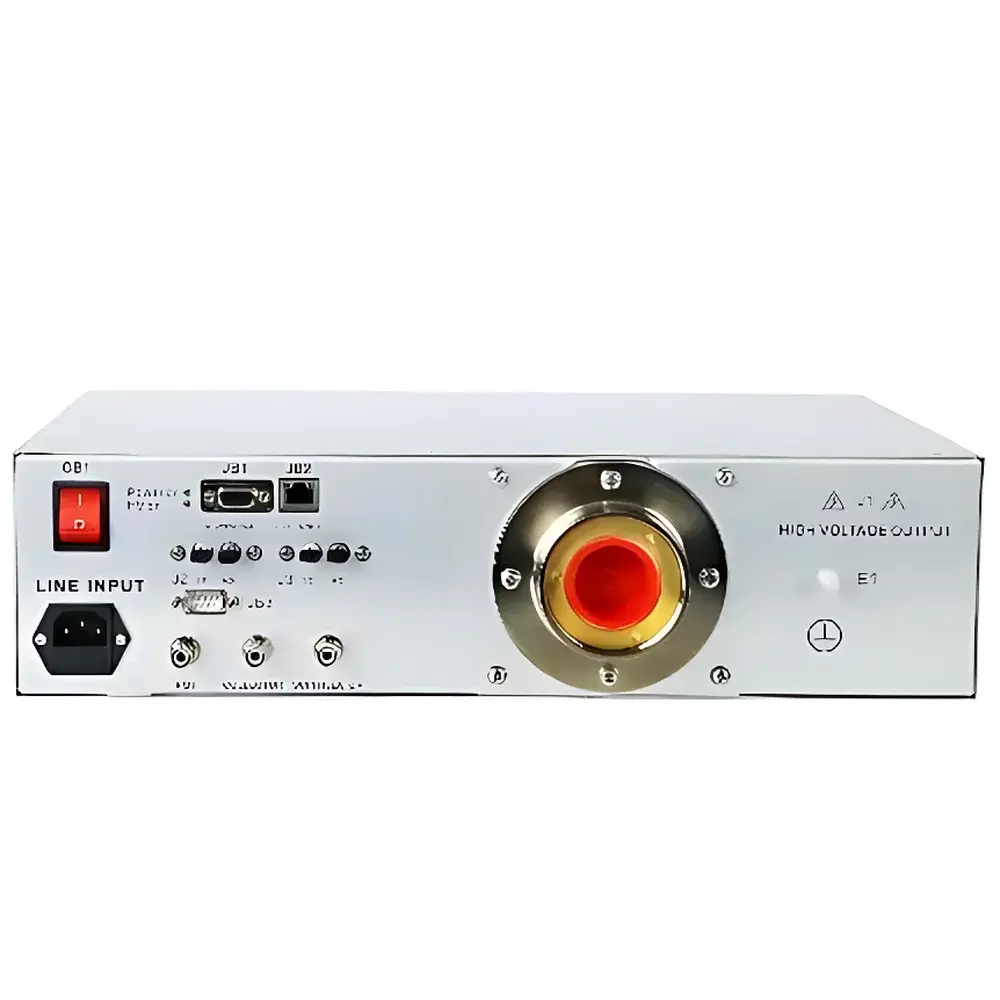
Wisman SEM High-Voltage Power Supply System – 35 kV / 6 W
| Brand | Wisman |
|---|---|
| Model | SEM Series |
| Output Voltage | Up to ±35 kV (configurable per channel) |
| Max. Output Power | 6 W |
| Input | AC 220 V ±5% |
| Ripple | ≤10 ppm (main acceleration supply) |
| Load Regulation | <±100 ppm |
| Line Regulation | <±100 ppm |
| Temp. Coefficient | 100 ppm/°C (acceleration supply) |
| Stability | 10 ppm/3 min (after 1-hr warm-up) |
| BIAS Output | 0 to –2000 V, 0–150 µA |
| Filament Supply | 0–3 A, 1 Ω load |
| Optional Outputs | SCI (0–10 kV), COL (0–400 V), PMT (0–1500 V) |
| Cooling | Forced air (front intake / rear exhaust) |
| Operating Temp. | 0–40 °C |
| Storage Temp. | –40 to +85 °C |
| Humidity | 10–90% RH, non-condensing |
| Weight | 5 kg |
| Compliance | Designed for integration into electron microscopy and mass spectrometry systems per IEC 61010-1, EN 61326-1 (EMC), RoHS |
Overview
The Wisman SEM High-Voltage Power Supply System is a precision-engineered, multi-channel DC high-voltage platform specifically designed for integration into scanning electron microscopes (SEM), electron beam lithography tools, and associated analytical instrumentation—including time-of-flight mass spectrometers (TOF-MS) and secondary electron detectors. Operating on the fundamental principle of electrostatic acceleration and bias control, this system delivers tightly regulated, ultra-low-noise high-voltage outputs across up to six independent channels: primary acceleration voltage (±20 kV to ±35 kV), BIAS (–2000 V), filament current (0–3 A), and optional dedicated supplies for scintillator (SCI), collector (COL), and photomultiplier tube (PMT) subsystems. Its architecture employs zero-current resonant switching and proprietary high-voltage insulation design to achieve exceptional long-term stability, sub-ppm-level ripple suppression, and minimal electromagnetic interference—critical parameters for maintaining beam coherence, signal-to-noise ratio, and spatial resolution in high-magnification imaging and quantitative surface analysis.
Key Features
- Multi-channel, independently regulated HV outputs: Acceleration (±20–35 kV, 200 µA), BIAS (0 to –2000 V, 150 µA), Filament (0–3 A, 1 Ω load), plus configurable SCI (0–10 kV), COL (0–400 V), and PMT (0–1500 V) modules
- Ultra-stable performance: <±100 ppm load and line regulation; ≤10 ppm ripple (acceleration channel); 10 ppm/3 min short-term stability after 1-hour thermal equilibration
- Advanced thermal management: Optimized forced-air cooling with front-intake/rear-exhaust airflow path ensures consistent operation at ambient temperatures up to +40 °C
- High-reliability design: Fully potted modules, reinforced creepage/clearance spacing, and conformal coating compliant with IPC-A-610 Class 2 standards
- Modular scalability: Optional output channels can be added or disabled via firmware configuration—enabling OEM integration flexibility without hardware redesign
- Comprehensive protection suite: Overvoltage, overcurrent, arc detection, and thermal shutdown with latching fault reporting via TTL-compatible status lines
Sample Compatibility & Compliance
This power supply is not a standalone analytical instrument but a critical subsystem engineered for seamless integration into vacuum-based charged-particle instruments. It supports standard SEM column configurations requiring stable acceleration potentials for 1–30 keV electron beams, as well as detector-specific biasing requirements for Everhart-Thornley, in-lens, and STEM detectors. The unit complies with IEC 61010-1 (Safety Requirements for Electrical Equipment for Measurement, Control, and Laboratory Use) and meets EN 61326-1 emission and immunity limits for laboratory environments. While not certified to FDA 21 CFR Part 11 or ISO/IEC 17025, its traceable stability metrics and deterministic response characteristics support GLP-compliant instrument qualification protocols when embedded within validated SEM or MS platforms.
Software & Data Management
The SEM Series operates in analog control mode by default, accepting 0–10 VDC setpoint inputs and providing isolated analog monitoring outputs (0–10 V proportional to voltage/current). Digital interface options include RS-232 or RS-485 (Modbus RTU) for remote configuration and real-time telemetry—supporting integration into LabVIEW, Python-based control suites, or OEM host software. All operational parameters—including voltage setpoints, actual outputs, temperature readings, and fault logs—are timestamped and accessible via serial query. Audit trails are maintained in volatile memory; persistent logging requires external host-side capture. Firmware updates are performed via UART bootloader, with version verification and CRC integrity checks ensuring reproducible deployment across instrument fleets.
Applications
- Electron optical column powering in benchtop and field-emission SEM systems
- Biasing of secondary electron detectors and backscattered electron (BSE) collectors
- Filament current regulation for tungsten and LaB₆ cathodes
- Scintillator high-voltage excitation in YAG-based imaging detectors
- PMT and microchannel plate (MCP) biasing in energy-dispersive X-ray spectroscopy (EDS) and electron backscatter diffraction (EBSD) detectors
- OEM integration into compact TOF-MS ion sources and reflectron acceleration stages
FAQ
Is this power supply compatible with JEOL or Thermo Fisher SEM models?
Yes—when configured to match the original equipment manufacturer’s (OEM) pinout, voltage range, and interlock signaling protocol. Custom cabling and interface boards are available upon request.
Does it support remote programming via Ethernet or USB?
No native Ethernet or USB interface is included; however, RS-232/RS-485 communication enables connection to USB-to-serial or Ethernet-to-serial gateways for networked control.
What is the warranty period and calibration interval?
Wisman provides a 24-month limited warranty. Calibration is recommended annually using NIST-traceable HV meters and verified against internal reference dividers.
Can the acceleration voltage polarity be reversed?
Standard configurations provide negative polarity for electron acceleration; positive polarity variants are available under custom order (model suffix “-P”).
Is CE marking applicable for export to the EU?
Yes—the unit carries CE marking per the Low Voltage Directive (2014/35/EU) and EMC Directive (2014/30/EU), supported by full technical documentation and test reports.



