
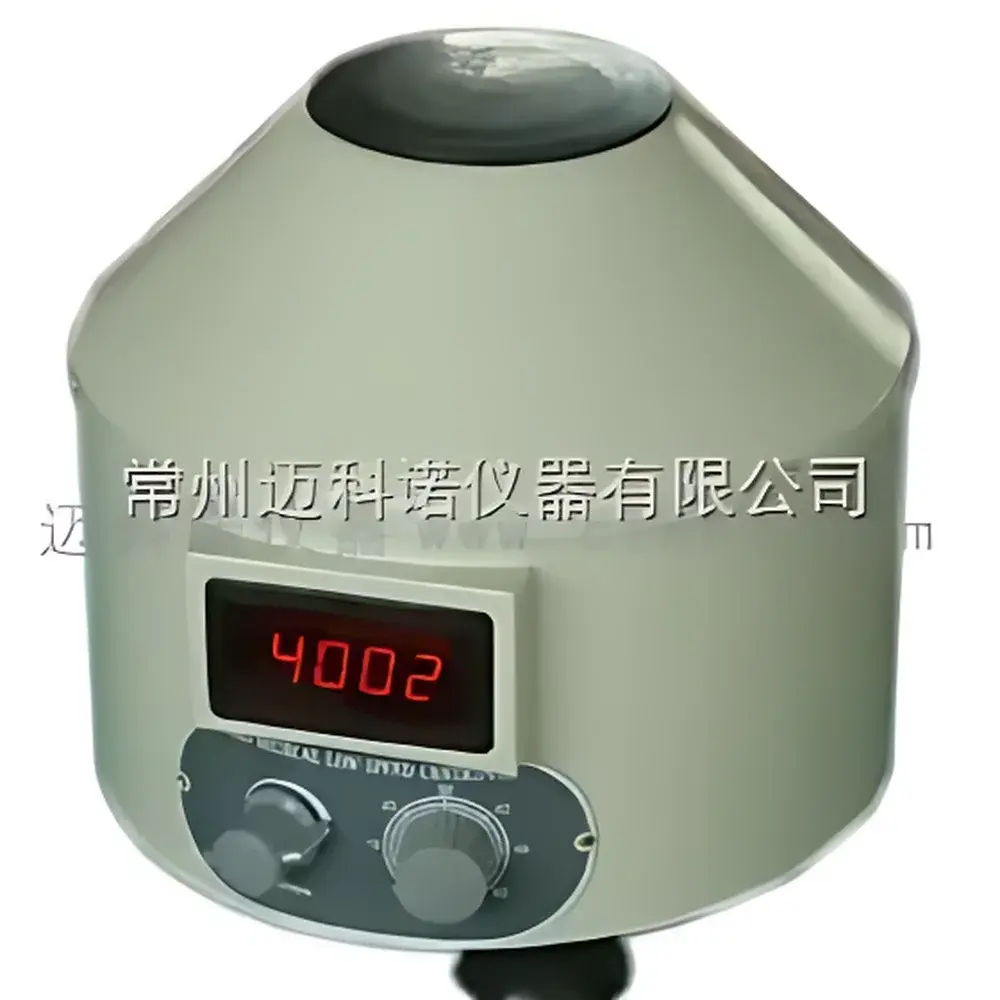
MKN 80-3 Digital Display Electric Centrifuge
| Brand | MKN |
|---|---|
| Model | 80-3 |
| Max Speed | 4000 rpm (digital display) |
| Relative Centrifugal Force (RCF) | 1430 × g |
| Capacity | 6 × 20 mL |
| Timer Range | 0–60 min |
| Noise Level | ≤60 dB(A) |
| Power Supply | AC 220 V, 50 Hz, 2 A |
Overview
The MKN 80-3 Digital Display Electric Centrifuge is a benchtop, general-purpose centrifuge engineered for reliable, repeatable separation of biological and chemical samples in routine laboratory environments. It operates on the principle of sedimentation under controlled rotational acceleration—generating radial force (RCF) to separate components based on density, size, and shape within heterogeneous mixtures. Designed for consistent performance across clinical, biochemical, and educational applications, the unit delivers precise speed control via a continuously variable electronic drive system, eliminating mechanical gear shifts and minimizing mechanical wear. Its compact footprint and low thermal output support continuous operation in temperature-sensitive lab spaces without requiring external cooling or ventilation infrastructure.
Key Features
- Digital RPM and timer display with real-time feedback for accurate process monitoring and reproducible protocol execution.
- Stepless speed regulation from 0 to 4000 rpm, enabling fine-tuned optimization for diverse sample viscosities and particle densities.
- Integrated automatic rotor balancing mechanism that compensates for minor tube mass asymmetry—reducing vibration, extending bearing life, and improving run stability.
- Die-cast aluminum rotor head with precision-machined tube pockets; corrosion-resistant surface treatment ensures long-term dimensional stability and minimizes risk of tube breakage during high-speed operation.
- Thermally optimized motor housing and airflow design limit operational temperature rise—typical surface temperature increase remains below 15 °C after 30 minutes at maximum speed.
- Low-noise operation (≤60 dB[A] at 1 m distance), compliant with ISO 3744 acoustic emission standards for laboratory equipment in shared workspaces.
Sample Compatibility & Compliance
The 80-3 accommodates standard conical-bottom polypropylene or glass centrifuge tubes (up to 20 mL capacity) in a symmetrical 6-position fixed-angle rotor configuration. It supports common clinical workflows including serum/plasma separation from whole blood, precipitate recovery in immunoassay preparation, and cell pellet formation in basic microbiology protocols. The device conforms to IEC 61010-1:2010 safety requirements for electrical equipment used in laboratory settings. While not certified for biosafety level (BSL)-2 or higher containment use, it meets GLP-aligned operational traceability expectations when paired with manual logbook documentation. Rotor geometry and balance tolerances are validated per ISO 21501-4 for particulate-based separation consistency.
Software & Data Management
As a manually operated analog-digital hybrid instrument, the 80-3 does not incorporate embedded firmware, network connectivity, or proprietary software. All operational parameters—including speed setpoint, timer duration, and run completion—are configured directly via front-panel controls and verified through LED-based digital readouts. This architecture eliminates cybersecurity exposure vectors and aligns with FDA 21 CFR Part 11 guidance for instruments where electronic records are not generated. For laboratories requiring audit-ready documentation, external time-stamped video logging or integrated lab information management systems (LIMS) may be deployed to capture start/stop events and operator identity.
Applications
- Routine serum and plasma isolation from anticoagulated whole blood specimens in hospital core labs and point-of-care testing units.
- Preparative centrifugation prior to ELISA, Western blotting, or electrophoresis workflows in academic and industrial biochemistry labs.
- Sedimentation of microbial cultures for viability assays or supernatant harvesting in quality control microbiology.
- Clarification of reagent solutions, dye suspensions, or colloidal dispersions in analytical chemistry and materials science education labs.
- Standardized sample conditioning for subsequent analysis by HPLC, GC-MS, or spectrophotometric methods where particulate interference must be eliminated.
FAQ
What is the maximum relative centrifugal force (RCF) achievable with this model?
The MKN 80-3 achieves a maximum RCF of 1430 × g at its rated speed of 4000 rpm with the standard 6 × 20 mL rotor.
Is rotor calibration required before each use?
No—rotor balance is maintained automatically during operation; however, users must ensure symmetrical tube loading (e.g., even-numbered tubes filled to identical volumes) to prevent destabilization.
Can this centrifuge be used for hazardous or infectious samples?
It is not equipped with sealed rotors or aerosol-tight lids; therefore, it is unsuitable for BSL-2 or higher biosafety applications without supplemental containment measures.
Does the unit support programmable multi-step protocols?
No—this is a single-parameter, single-stage centrifuge with independent speed and timer controls; no stored method memory or ramp/hold functionality is included.
What maintenance intervals are recommended for optimal service life?
Visual inspection of rotor integrity and cleaning of chamber surfaces after each use; full mechanical inspection (bearing play, belt tension if applicable) every 12 months or after 1000 operating hours, whichever occurs first.



