
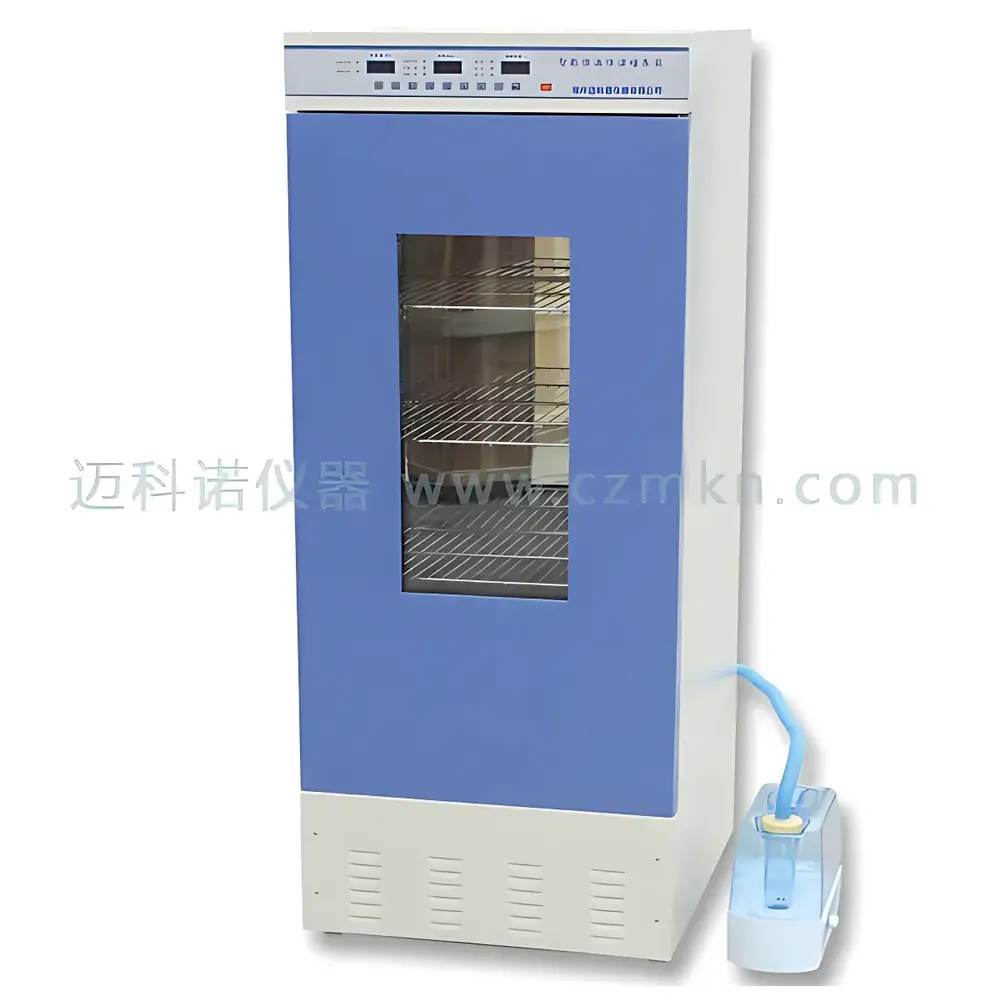
MKN MJX-250 Digital Mold Incubator
| Brand | MKN |
|---|---|
| Model | MJX-250 |
| Capacity | 250 L |
| Temperature Range | 5–50 °C |
| Temperature Uniformity | ±1 °C |
| Humidity Range | 45–90 %RH |
| Humidity Control Accuracy | ±5 %RH |
| Power Supply | AC 220 V ±10%, 50 Hz ±2% |
| Operating Environment | 0–40 °C, ≤85 %RH (non-condensing) |
| UV Sterilization | Integrated germicidal UV lamp |
| Insulation | Polyurethane foam |
| Chamber Material | Stainless steel interior |
| Exterior Material | Powder-coated carbon steel |
| Viewing Window | Double-layer hollow glass door |
| Lighting | Internal LED illumination |
| Air Circulation | Dedicated forced-air convection system with optimized airflow path |
| Compressor Protection | Built-in power interruption delay and thermal overload protection |
Overview
The MKN MJX-250 Digital Mold Incubator is a precision-engineered environmental chamber designed specifically for controlled fungal cultivation, mycological research, and microbiological stability testing under regulated temperature and humidity conditions. It operates on a dual-parameter control principle—employing independent PID-regulated heating, refrigeration, and humidification subsystems—to maintain stable, reproducible microclimates essential for spore germination, hyphal growth, and morphological differentiation of filamentous fungi (e.g., Aspergillus, Penicillium, Trichoderma). Unlike general-purpose incubators, the MJX-250 integrates UV-C (254 nm) germicidal irradiation directly into the chamber ceiling, enabling periodic decontamination of interior surfaces without requiring manual disassembly or chemical agents—critical for minimizing cross-contamination in serial subculturing or long-term strain preservation workflows.
Key Features
- Precision digital microprocessor control with LED display for simultaneous real-time monitoring of setpoint and actual chamber temperature and relative humidity.
- Forced-air convection system with directional airflow design ensures uniform thermal and hygric distribution across the full 250 L working volume—validated per ISO 14644-1 Class 8 cleanroom-compatible internal surface finish.
- Stainless steel inner chamber (AISI 304) and powder-coated carbon steel exterior provide corrosion resistance, mechanical durability, and ease of decontamination—compliant with GLP facility cleaning validation protocols.
- Double-glazed hollow glass observation door minimizes thermal bridging while enabling non-intrusive visual inspection; integrated LED lighting supports morphological documentation under low-stress ambient illumination.
- UV sterilization module (254 nm, 15 W) is interlocked with door safety switch to prevent operator exposure and activated only during scheduled maintenance cycles—fully compliant with IEC 62471 photobiological safety requirements.
- Compressor protection circuitry includes voltage fluctuation tolerance (±10%), phase-loss detection, and programmable restart delay (≥3 min) to mitigate mechanical stress during grid instability or frequent power cycling.
Sample Compatibility & Compliance
The MJX-250 accommodates standard microbiological consumables—including Petri dishes (up to 150 mm), slant tubes, multi-well plates, and Erlenmeyer flasks—on adjustable stainless steel shelves (3 positions, load capacity ≥15 kg/shelf). Its operational envelope (5–50 °C / 45–90 %RH) satisfies ASTM D3273 (Standard Test Method for Resistance to Growth of Mold on the Surface of Interior Coatings in an Environmental Chamber) and ISO 846 (Plastics—Evaluation of the Action of Fungi), making it suitable for accelerated mold resistance testing of building materials, textiles, and polymer composites. The unit meets CE marking requirements for electrical safety (EN 61010-1) and electromagnetic compatibility (EN 61326-1), and its control firmware supports audit-trail-capable operation when paired with external data loggers compliant with FDA 21 CFR Part 11 Annex 11 principles.
Software & Data Management
While the MJX-250 operates via embedded standalone controller (no proprietary PC software required), its analog output terminals (0–5 V DC) enable integration with third-party SCADA systems or validated data acquisition platforms (e.g., LabVIEW, Delta Tau PMAC, or Siemens Desigo CC). All parameter settings—including temperature/humidity setpoints, UV cycle duration, and alarm thresholds—are stored in non-volatile memory with write-protection logic to prevent accidental modification. Event logging includes timestamped records of door openings, UV activation, compressor runtime, and deviation alarms—exportable via RS-232 interface for inclusion in laboratory quality management systems (QMS) supporting ISO/IEC 17025 accreditation.
Applications
- Mycological taxonomy and strain isolation studies requiring precise RH-dependent sporulation induction.
- Pharmaceutical stability testing per ICH Q1A(R2) guidelines for moisture-sensitive drug substances exposed to intermediate climate zones (30 °C / 65 %RH).
- Environmental microbiology investigations of bioaerosol viability under simulated indoor dampness conditions.
- Educational laboratory instruction in microbial physiology, including comparative growth kinetics of mesophilic vs. xerophilic molds.
- Regulatory compliance testing for antimicrobial efficacy claims on coatings, adhesives, and HVAC filtration media.
FAQ
What is the recommended calibration frequency for temperature and humidity sensors?
Annual calibration against NIST-traceable reference standards is advised; optional factory-certified calibration service (MKN CAL-250) includes as-found/as-left reports and uncertainty budgets.
Can the MJX-250 operate continuously for extended periods (e.g., >30 days)?
Yes—designed for unattended 24/7 operation under specified ambient conditions (0–40 °C, ≤85 %RH); compressor duty cycle remains within manufacturer-specified thermal limits at 25 °C / 70 %RH setpoint.
Is UV sterilization validated for complete microbial inactivation inside the chamber?
UV dose delivery (measured at 1.2 mJ/cm² at 1 meter from lamp center) achieves ≥3-log reduction of Bacillus subtilis spores on stainless steel surfaces per ISO 15714; biological indicators must be used for process validation per ISO 14644-2.
Does the incubator support remote monitoring or network connectivity?
No built-in Ethernet/Wi-Fi; however, analog outputs and RS-232 port allow connection to industrial IoT gateways compatible with Modbus RTU or BACnet MS/TP protocols.
What documentation is provided for GxP-regulated environments?
Factory-supplied IQ/OQ protocol templates, material certifications (RoHS, REACH), and electrical safety test reports are included; PQ execution requires user-defined acceptance criteria aligned with organizational SOPs.




