
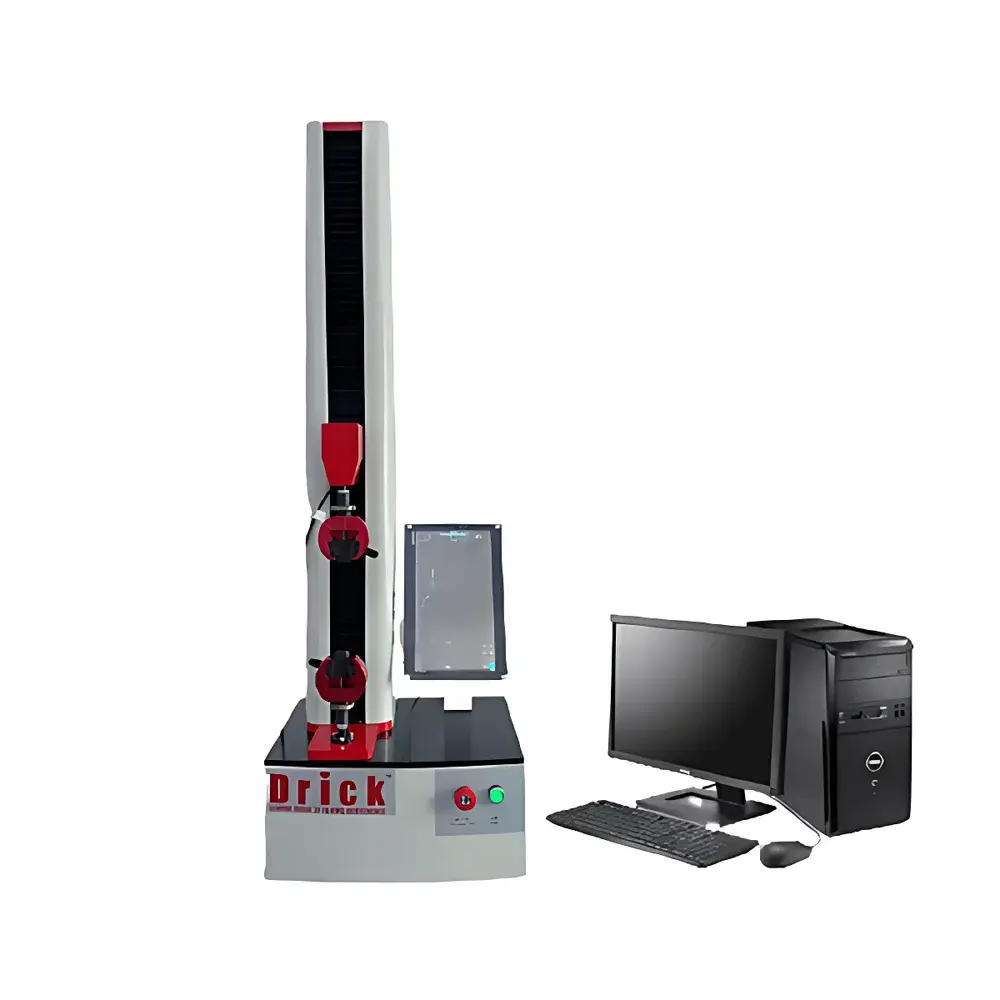
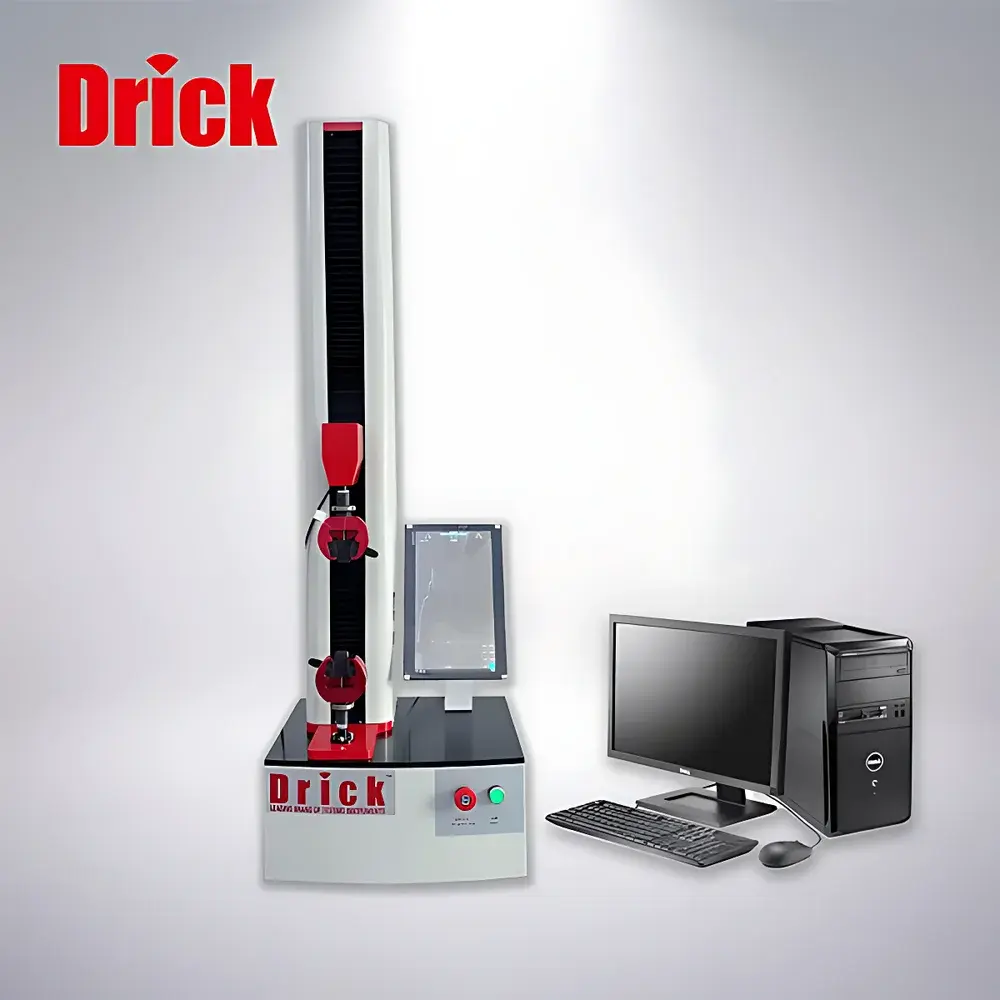
Drick DRK101 Medical Comprehensive Tensile Tester for Masks and Protective Gowns
| Brand | Drick |
|---|---|
| Origin | Shandong, China |
| Manufacturer Type | OEM/ODM Manufacturer |
| Region Classification | Domestic (China) |
| Model | DRK101 |
| Force Capacity | 200 N (Standard), Optional Ranges: 50 N / 100 N / 500 N / 1000 N |
| Accuracy Class | Better than 0.5 |
| Force Resolution | 0.1 N |
| Displacement Resolution | 0.001 mm |
| Test Speed Range | 0.01–500 mm/min (Infinitely Variable) |
| Standard Grip Width | 30 mm |
| Optional Grip Width | 50 mm |
| Standard Stroke | 700 mm |
| Optional Stroke | 400 mm / 1000 mm |
| Clamping Method | Manual (Pneumatic Upgrade Available) |
| Compliance Standards | GB 19082–2009, GB 2626–2019, GB/T 32610–2016, YY/T 0969–2013, YY 0469–2011, GB/T 3923.1–1997, GB 10213–2006 |
Overview
The Drick DRK101 Medical Comprehensive Tensile Tester is a precision-engineered universal testing system designed specifically for mechanical performance evaluation of personal protective equipment (PPE) used in clinical, pharmaceutical, and biomedical manufacturing environments. It operates on the principle of uniaxial tensile loading under controlled displacement or force control modes, adhering to standardized test geometries defined in international textile and medical device regulations. The instrument employs a high-stiffness load frame coupled with a brushless servo motor and precision ground ball screw transmission system—ensuring minimal hysteresis, repeatable crosshead positioning, and long-term calibration stability. Its architecture supports both static and quasi-static mechanical characterization, including tensile strength, elongation at break, yield point detection, and load-holding capability across multiple specimen configurations (e.g., strip, loop, and component-level pull tests). Designed for ISO/IEC 17025-aligned laboratories, the DRK101 delivers traceable, auditable results essential for regulatory submissions and quality assurance workflows in Class I–III medical device production.
Key Features
- Modular force sensor configuration: Standard 200 N load cell with optional ranges (50 N, 100 N, 500 N, 1000 N) enabling optimized signal-to-noise ratio across low-force (e.g., earloop detachment) and high-force (e.g., full-face respirator strap retention) applications.
- High-resolution motion control: 0.001 mm displacement resolution and 0.1 N force resolution, compliant with ASTM E4 and ISO 7500-1 verification requirements for Class 0.5 accuracy.
- Programmable speed profile: Continuous speed adjustment from 0.01 mm/min to 500 mm/min supports both slow-rate compliance testing (e.g., 10 s dwell per GB 2626–2019) and rapid screening protocols.
- Configurable gripping interface: Standard 30 mm parallel jaw clamps with optional 50 mm width and pneumatic actuation upgrade for consistent clamping pressure and reduced operator-induced variability.
- Rigid load frame with 700 mm standard stroke (extendable to 1000 mm) accommodates oversized PPE specimens such as full-length gowns and multi-layer barrier composites without repositioning.
- Fully integrated control software with audit trail functionality, user-level access control, and electronic signature support—designed to meet FDA 21 CFR Part 11 and EU Annex 11 data integrity requirements.
Sample Compatibility & Compliance
The DRK101 is validated for standardized mechanical testing of critical PPE components per globally recognized regulatory frameworks. It directly supports test methods specified in GB 19082–2009 (tensile strength ≥45 N and elongation ≥15% for critical zones of disposable gowns), GB 2626–2019 (respirator valve cap axial pull: 10 N/50 N/150 N; headband retention: 10 N/50 N/150 N; connector integrity: 50 N/250 N), and GB/T 32610–2016 (mask strap strength ≥20 N). Additional compatibility includes YY/T 0969–2013 (earloop bond strength ≥10 N per attachment point), YY 0469–2011 (surgical mask strap performance), GB/T 3923.1–1997 (strip-method fabric tensile testing), and GB 10213–2006 (glove tensile elongation and breaking force). All test routines are pre-programmed with pass/fail logic, automatic limit checking, and real-time deviation alerts aligned with tolerance bands defined in each standard.
Software & Data Management
The DRK101 operates via Drick’s proprietary WinTest Pro v4.x software platform—a Windows-based application built on .NET Framework with SQL Server Express backend. The software enables method-driven test sequencing, multi-channel real-time curve plotting (force vs. displacement, stress vs. strain), and automated report generation in PDF/XLSX formats compliant with GLP/GMP documentation standards. Each test record stores metadata including operator ID, calibration certificate ID, environmental conditions (optional sensor integration), and raw time-series data at ≥100 Hz sampling rate. Audit trails log all user actions—including parameter edits, result overrides, and report exports—with immutable timestamps and digital signatures. Data export supports CSV, XML, and ASTM E1447-compliant formats for third-party LIMS integration.
Applications
- Quantitative evaluation of mask strap anchorage strength and failure mode (adhesive delamination vs. fabric rupture).
- Tensile property mapping of nonwoven laminates used in surgical gowns and isolation drapes.
- Validation of respirator valve cap retention under sustained axial load per GB 2626–2019 Clause 5.6.2.
- Mechanical benchmarking of glove finger crotch elongation and palm tensile resistance.
- Comparative analysis of melt-blown vs. spunbond layer contributions to overall barrier material strength.
- QC release testing for ISO 13485-certified manufacturers requiring documented traceability from raw material receipt to finished device lot release.
FAQ
Does the DRK101 comply with FDA or CE marking requirements for medical device testing equipment?
The DRK101 itself is not a medical device but a Class I laboratory testing instrument. Its hardware design and software architecture conform to essential requirements of IEC 61010-1 (safety) and IEC 62304 (software lifecycle), supporting compliance pathways for end-user medical device manufacturers seeking FDA QSR 21 CFR Part 820 or MDR Annex II conformity assessments.
Can test methods be customized beyond the preloaded national standards?
Yes—WinTest Pro supports user-defined test templates with configurable ramp rates, dwell times, trigger conditions, and pass/fail criteria. Custom methods may be validated internally and archived with version-controlled metadata.
Is third-party calibration certification available?
Drick provides NIST-traceable calibration certificates issued by CNAS-accredited laboratories (ISO/IEC 17025), including full uncertainty budgets per ISO/IEC 17025:2017 Annex A.3.
What maintenance intervals are recommended for long-term accuracy retention?
Annual recalibration is advised; routine verification using certified reference load cells and displacement gauges should be performed daily or per-shift per ISO 9001 internal audit protocols.
How is data security ensured during remote software updates or networked operation?
All firmware and software updates are cryptographically signed. Network deployment requires TLS 1.2+ encrypted channels, and local database encryption (AES-256) is enabled by default.





