
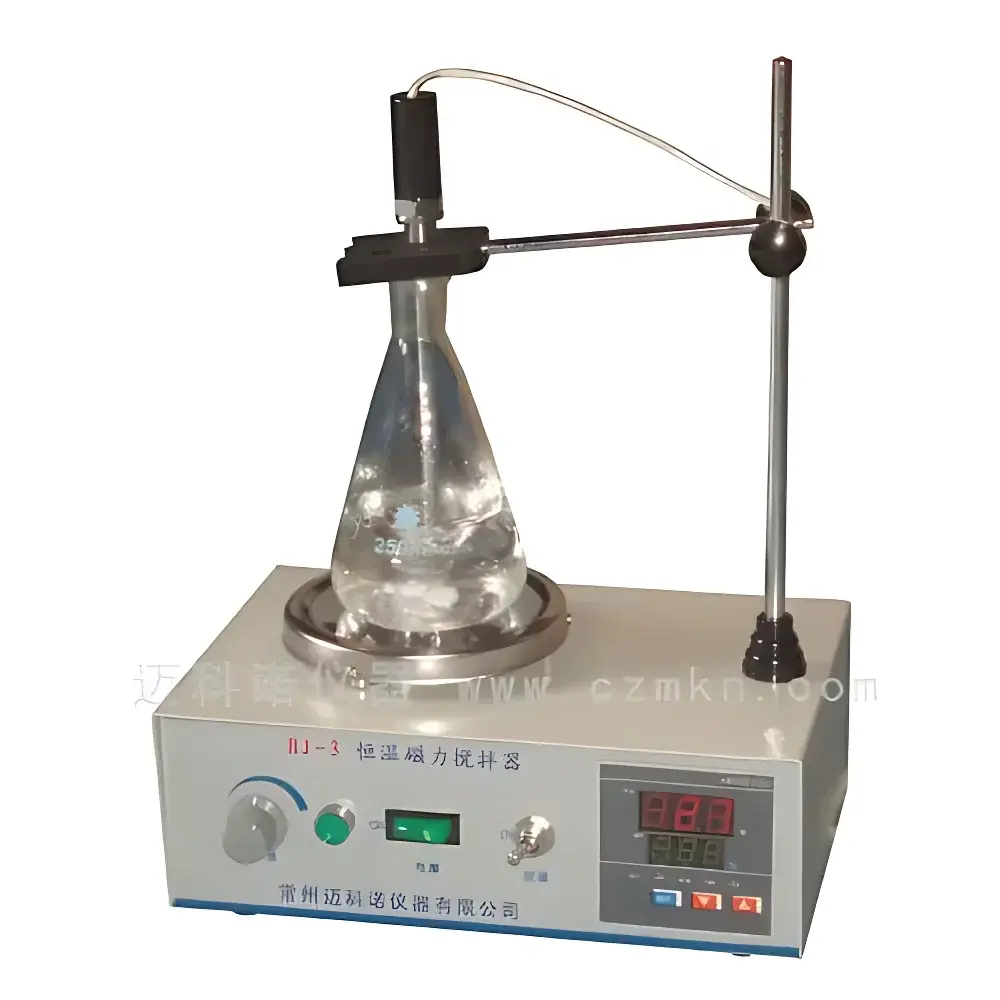
MKN HJ-3 Constant-Temperature Magnetic Stirrer
| Brand | MKN |
|---|---|
| Model | HJ-3 |
| Power Supply | 220 V ±10%, 50 Hz ±2% |
| Max. Working Volume | 3000 mL |
| Speed Range | 0–2400 rpm, stepless adjustment |
| Temperature Control Range | Ambient to 100 °C, digital PID control |
| Heating Plate Material | Stainless steel |
| Stirring Bar Compatibility | Fluoropolymer-coated magnetically driven stir bars |
| Optional Timer | 0–999 min (factory-configurable) |
Overview
The MKN HJ-3 Constant-Temperature Magnetic Stirrer is an engineered laboratory instrument designed for simultaneous precise temperature regulation and homogeneous mixing of liquid samples in sealed or open vessels. It operates on the principle of magnetic coupling—where a rotating permanent magnet beneath the heating plate induces synchronous rotation of a magnetically responsive stirring bar immersed in the sample. This contactless drive mechanism eliminates mechanical shaft seals, enabling contamination-free operation in chemically aggressive or sterile environments. The unit integrates a stainless-steel heating plate with uniform thermal distribution and a digitally controlled PID temperature system, ensuring stable setpoint maintenance within ±0.5 °C across the full 20–3000 mL working volume range. Its brushless DC motor delivers quiet, low-vibration operation with high torque consistency over extended duty cycles—critical for reproducible kinetic studies, dissolution testing, buffer equilibration, and reagent preparation in academic, pharmaceutical, and quality control laboratories.
Key Features
- Brushless DC motor: Ensures long service life, minimal electromagnetic interference, and consistent rotational output without carbon brush wear or commutation noise.
- Digital PID temperature controller: Provides real-time feedback-driven heating with adjustable ramp rates and overshoot suppression; display resolution: 0.1 °C.
- Stainless-steel heating plate: Chemically inert, corrosion-resistant surface with optimized thermal conductivity and mechanical durability for repeated autoclave-compatible cleaning.
- Wide speed range (0–2400 rpm): Stepless electronic adjustment enables fine-tuned control for low-viscosity solvents or high-shear dispersion of suspensions.
- Optional programmable timer (0–999 minutes): Supports unattended operation with automatic power cutoff—compliant with GLP documentation requirements when paired with external audit-log software.
- Fluoropolymer-coated stirring bars: Compatible with aggressive acids, bases, and organic solvents; rated for continuous operation up to 100 °C without coating delamination.
Sample Compatibility & Compliance
The HJ-3 accommodates standard laboratory glassware including beakers, Erlenmeyer flasks, and round-bottom flasks (up to 3 L capacity), with optimal performance observed using borosilicate glass vessels ≥1 mm wall thickness. Its sealed-vessel compatibility supports applications requiring inert atmospheres (e.g., nitrogen-purged reactions) or volatile solvent handling. From a regulatory perspective, the device meets IEC 61010-1:2010 safety standards for electrical equipment used in laboratory environments. While not inherently 21 CFR Part 11 compliant as a standalone unit, its analog control interface allows integration into validated workflows via external data acquisition systems that support electronic signatures and audit trails. It is routinely deployed in accordance with ISO/IEC 17025-accredited testing protocols for solution homogeneity verification and standard reference material preparation.
Software & Data Management
The HJ-3 operates as a stand-alone analog-digital hybrid instrument with no embedded firmware or network connectivity. All operational parameters—including set temperature, actual plate temperature, and rotational speed—are displayed locally on a dual-digit LED screen. For traceable data capture, users may integrate the unit with third-party USB or RS-232 data loggers (e.g., Omega OM-DAQPRO series) to record time-stamped temperature and speed profiles. When used in GxP-regulated settings, such external logging must be qualified per Annex 11 guidelines and accompanied by defined calibration intervals (recommended annually against NIST-traceable thermocouple and tachometer references). No proprietary software is required or supplied.
Applications
- Buffer and reagent preparation requiring strict pH and concentration uniformity prior to HPLC or spectrophotometric analysis.
- Dissolution testing of solid dosage forms per USP , where temperature stability and agitation consistency directly impact release rate accuracy.
- Catalytic reaction monitoring under controlled thermal conditions, especially in synthetic organic chemistry workflows.
- Cell culture media warming and component blending without introducing shear-induced protein denaturation.
- Calibration standard homogenization for viscosity, conductivity, and density reference materials.
- Environmental water sample digestion pretreatment (e.g., EPA Method 3015A) involving acid mixtures at elevated temperatures.
FAQ
Is the HJ-3 suitable for use with corrosive solvents such as concentrated HCl or HF?
Yes—provided fluoropolymer-coated stirring bars are used and glassware integrity is verified. Avoid direct contact between acidic vapors and the stainless-steel plate surface for prolonged durations.
What is the recommended calibration frequency for temperature and speed accuracy?
Annual calibration is advised using traceable references: a calibrated PT100 probe for temperature (±0.3 °C tolerance) and a non-contact optical tachometer for speed verification (±10 rpm at 2400 rpm).
Can the HJ-3 maintain temperature uniformity across a 3 L beaker?
It achieves effective heating and mixing in vessels up to 3 L, though thermal gradients may occur near vessel walls; use of a central-positioned stir bar and moderate speed (800–1200 rpm) improves radial homogeneity.
Does the unit include overload or dry-run protection?
No built-in dry-run detection is present; users must ensure minimum liquid volume (≥20 mL) to prevent localized overheating of the plate surface.
Is the timer function factory-installed or field-upgradable?
The timer is an optional hardware module installed during manufacturing; retrofitting post-purchase is not supported due to PCB-level integration requirements.



