
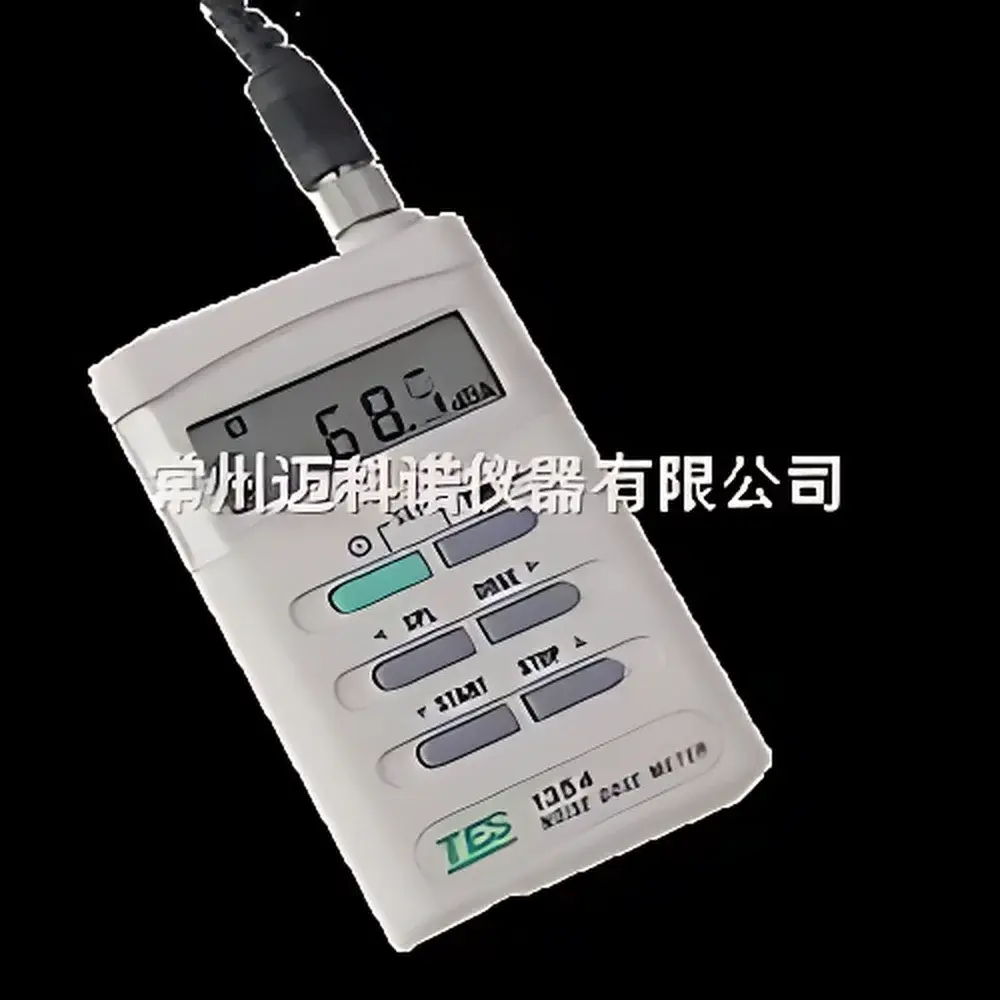
MKN TES-1354/TES-1355 Noise Dosimeter
| Brand | MKN |
|---|---|
| Model | TES-1354/TES-1355 |
| Measurement Range | 70–140 dBA |
| Accuracy | ±1.5 dB (ref. 94 dB @ 1 kHz) |
| Resolution | 0.1 dB |
| Frequency Weighting | A-weighting only |
| Time Weighting | FAST / SLOW selectable |
| Threshold Level | 70–90 dB (1 dB step) |
| Exchange Rate | 3, 4, 5 or 6 dB selectable |
| Dose Range | 0–9999% DOSE |
| Peak Sound Pressure Level | 140 dB |
| Overload Indicator | ≥115 dBA |
| Microphone | 1/2″ omnidirectional pre-polarized condenser |
| Power Supply | 4 × AAA alkaline batteries |
| Battery Life | ~36 hours |
| Dimensions | 106 × 64 × 34 mm |
| Weight | ~350 g (incl. batteries) |
| Compliance | ANSI S1.25-1991 |
| Interface | RS-232 (with 9-pin to 25-pin adapter) |
| Software | Windows-compatible dosimetry analysis software included |
Overview
The MKN TES-1354/TES-1355 Noise Dosimeter is a portable, precision-engineered instrument designed for occupational noise exposure assessment in accordance with OSHA and ISO 9612 methodologies. It operates on the principle of time-integrated sound pressure level measurement, applying standardized A-frequency weighting and user-selectable exchange rates (3–6 dB) to compute percentage noise dose (%DOSE) relative to a defined threshold level. The device conforms to ANSI S1.25-1991 — the American National Standard for Personal Noise Dosimeters — ensuring metrological traceability and regulatory acceptability in workplace health and safety programs. Its compact form factor, extended battery life, and robust mechanical design support continuous field deployment across industrial, construction, transportation, and maintenance environments where real-time personal exposure monitoring is required for compliance with national occupational exposure limits (e.g., 85 dBA TWA over an 8-hour shift).
Key Features
- Compliant personal noise dosimetry per ANSI S1.25-1991, supporting both %DOSE and Time-Weighted Average (TWA) calculation
- User-configurable threshold levels from 70 to 90 dB in 1 dB increments, enabling alignment with site-specific exposure action values (e.g., 80 dB for EU Directive 2003/10/EC or 85 dB for OSHA 1910.95)
- Selectably adjustable exchange rate (3 dB, 4 dB, 5 dB, or 6 dB), permitting flexibility in dose modeling under varying regulatory frameworks
- High-resolution display with 0.1 dB resolution and dynamic range spanning 70–140 dBA, covering typical occupational noise spectra while accommodating transient peak events up to 140 dB
- Dual time-weighting modes (FAST and SLOW) for adaptive response to fluctuating acoustic environments
- Integrated real-time clock and perpetual calendar for timestamped exposure logging and shift-based reporting
- RS-232 serial interface with included cable and 9-pin-to-25-pin adapter for direct data transfer to Windows-based analysis platforms
Sample Compatibility & Compliance
The TES-1354/TES-1355 is intended for use with human-worn configurations—typically mounted on the shoulder or lapel near the ear—and is validated for measurements in free-field conditions with minimal wind or reflective surface interference. Its 1/2″ omnidirectional pre-polarized condenser microphone meets IEC 61094-4 Class 2 specifications for free-field response, ensuring stable sensitivity across the 31.5 Hz–8 kHz operational bandwidth. The instrument satisfies essential requirements for GLP-aligned data acquisition, including non-volatile memory storage of session logs, automatic overload detection at ≥115 dBA, and audible/visual alerting upon threshold exceedance. While not certified to IEC 61252:2017 (the current international standard for personal sound exposure meters), its ANSI S1.25-1991 conformance provides documented equivalence for legacy compliance workflows in North America.
Software & Data Management
The included Windows-compatible dosimetry software enables post-acquisition analysis of exposure datasets, supporting import of time-stamped %DOSE, TWA, Leq, Lmax, and statistical percentile (L10, L50, L90) metrics. Export functions generate CSV and PDF reports compliant with internal audit and regulatory submission requirements. All logged data retains embedded metadata—including operator ID, calibration date, threshold setting, and exchange rate—supporting traceability under ISO/IEC 17025 quality management systems. The software implements basic audit trail functionality (session start/end timestamps, parameter changes), though it does not provide full 21 CFR Part 11-compliant electronic signature or role-based access control.
Applications
- Ongoing compliance monitoring for OSHA 29 CFR 1910.95 and MSHA Part 62 noise regulations
- Baseline exposure assessments during job hazard analyses (JHAs) and process re-engineering initiatives
- Verification of hearing conservation program (HCP) effectiveness through longitudinal worker cohort tracking
- Acoustic validation of engineering controls (e.g., enclosures, mufflers, damping treatments)
- Field verification of noise mapping models and boundary noise predictions
- Training and awareness demonstrations for frontline personnel on noise risk perception
FAQ
Does the TES-1354/TES-1355 support Type 2 or Type 1 microphone calibration per IEC 61672?
No — this instrument utilizes a Class 2-equivalent 1/2″ condenser microphone and is calibrated to meet ANSI S1.25-1991 performance criteria; it is not rated to IEC 61672-1:2013 Class 1 or Class 2 sound level meter specifications.
Can the device store multiple exposure sessions independently?
Yes — internal memory retains up to 32 separate measurement sessions, each with full time-history data, configurable thresholds, and exchange rates.
Is external calibration required before each use?
Field calibration using an accredited acoustic calibrator (e.g., 94 dB or 114 dB at 1 kHz) is recommended prior to each measurement session per ANSI S1.25-1991 Section 5.3.
What is the operating temperature range?
The specified operational range is 0 °C to 40 °C (32 °F to 104 °F) at ≤90% RH non-condensing, consistent with general-purpose industrial instrumentation standards.
Does the unit support real-time audio recording or spectral analysis?
No — the TES-1354/TES-1355 is a broadband integrating dosimeter only; it does not capture raw audio waveforms or perform octave-band or FFT-based frequency analysis.
Related Products







