
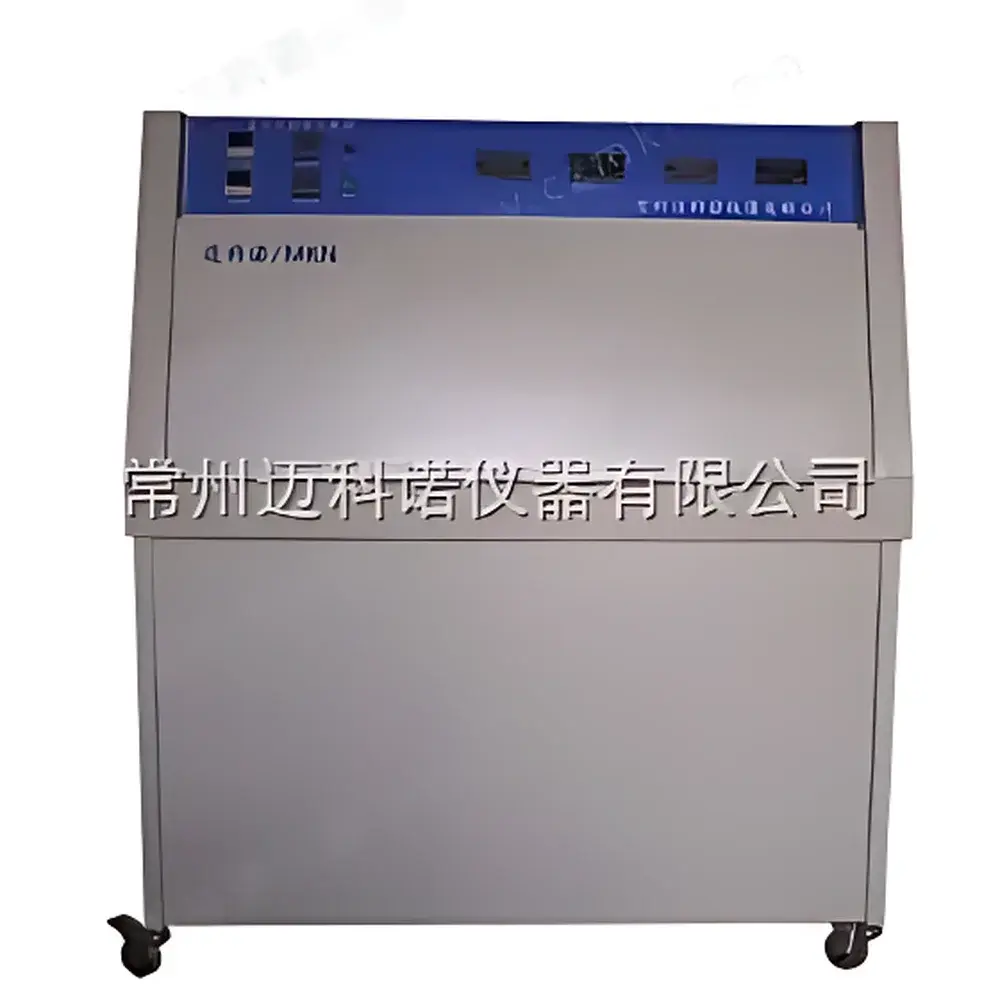
UV Weathering Test Chamber ZN-P
| Origin | Zhejiang, China |
|---|---|
| Manufacturer Type | Authorized Distributor |
| Origin Category | Domestic (China) |
| Model | ZN-P |
| Pricing | Available Upon Request |
Overview
The ZN-P UV Weathering Test Chamber is an engineered environmental simulation system designed to accelerate the evaluation of material degradation under controlled ultraviolet (UV) radiation, temperature, humidity, and condensation cycles. It operates on the principle of fluorescent UV irradiation—specifically replicating the critical 280–400 nm spectral range of natural sunlight—combined with precisely regulated thermal and hygrothermal stress conditions. Unlike broad-spectrum xenon arc or carbon arc testers, this chamber focuses on the photochemical damage mechanisms dominant in UV-driven polymer aging: chain scission, crosslinking, chromophore degradation, and surface oxidation. Its architecture conforms to the fundamental performance verification methodology outlined in GB/T 5170.9—“Verification Methods for Basic Parameters of Environmental Testing Equipment for Electrical and Electronic Products”—ensuring metrological traceability and test repeatability across laboratories and quality control facilities.
Key Features
- Eight high-stability UVA-340 or UVB-313 fluorescent lamps arranged symmetrically on front and rear walls, delivering uniform irradiance distribution across the test area;
- Precise irradiance control via integrated feedback loop; lamp-to-specimen distance fixed at 55 ± 3 mm to ensure consistent radiant exposure per ASTM G154 and ISO 4892-3;
- Temperature regulation range: RT +10°C to 70°C, implemented via balanced heating and cooling (BTHC) technology for minimal thermal overshoot and high stability (±0.5°C);
- Humidity control range: 75–98% RH, achieved through electric-heated steam generation with rapid response and low hysteresis;
- Condensation cycle simulation enabled by controlled cold-wall condensation—mimicking nocturnal dew formation without external water spray;
- Stainless steel 304 specimen rack (standard size: 75 × 150 × 1.5 mm) with corrosion-resistant construction and adjustable orientation for multi-angle exposure studies;
- Integrated safety architecture: leakage current protection, solid-state relay overcurrent cutoff, interlocked lamp chamber door, overtemperature alarm, grounding compliance, and automatic dry-run prevention;
- Control system comprising Fuji Electric high-precision PID temperature/humidity controller and Moeller (now Eaton) programmable logic controller (PLC) for fully automated sequence execution—including UV-on, condensation, dark, and humidification phases.
Sample Compatibility & Compliance
The ZN-P chamber accommodates non-metallic materials including coatings, paints, plastics, elastomers, textiles, adhesives, and composite laminates. Its test protocols align with internationally recognized accelerated weathering standards, including but not limited to ASTM D4329 (fluorescent UV exposure of plastics), ASTM D4587 (coatings), ISO 4892-3 (plastics—fluorescent UV lamps), and JIS D0205 (automotive interior materials). While not certified to IEC 60068-2-5 or MIL-STD-810G by default, its operational parameters satisfy prerequisite conditions for those test methods when configured per respective annexes. The chamber’s internal stainless steel chamber and powder-coated exterior comply with GLP facility requirements for chemical resistance and cleanability.
Software & Data Management
The Fuji controller provides real-time logging of chamber temperature, relative humidity, UV irradiance (when equipped with optional radiometer), and cycle phase status. All data are timestamped and stored onboard for ≥30 days. Optional RS-485/Modbus RTU interface enables integration into centralized LIMS or MES platforms. Audit trail functionality supports 21 CFR Part 11-compliant environments when paired with validated third-party data acquisition software—enabling electronic signatures, user access control, and immutable record retention for QC/QA documentation.
Applications
- Evaluation of UV stabilizer efficacy in polyolefins and PVC formulations;
- Correlation studies between accelerated UV exposure and outdoor field aging of automotive clearcoats;
- Qualification testing of aerospace sealants and radome materials under cyclic UV/humidity stress;
- Pre-screening of photovoltaic encapsulant yellowing resistance (EVA, POE);
- Regulatory submission support for medical device packaging per ISO 11607-1 (aging validation);
- Root cause analysis of premature gloss loss or chalking in architectural coatings.
FAQ
What UV lamp types are supported, and how do they differ in application?
The ZN-P accepts both UVA-340 (peak at 340 nm, best match to solar UV below 360 nm) and UVB-313 (peak at 313 nm, more aggressive, used for rapid screening). Selection depends on test standard requirements and material sensitivity.
Is calibration documentation provided with the unit?
Yes—each shipment includes a factory calibration certificate covering temperature uniformity, humidity accuracy, and lamp alignment verification per GB/T 5170.9 Annex B.
Can the chamber operate unattended for extended cycles?
Yes—fully programmable sequences (up to 999 cycles) with auto-restart after power interruption and built-in fault diagnostics enable 7×24 operation in validated labs.
Does the system meet CE or UL safety directives?
The base configuration complies with IEC 61000-6-2/6-3 (EMC) and IEC 61010-1 (safety). CE marking requires site-specific risk assessment and final assembly verification by authorized EU representative.
What maintenance intervals are recommended for optimal performance?
Lamp replacement every 1600–2000 hours of UV-on time; quartz sleeve cleaning weekly; humidity tank descaling monthly; full sensor recalibration annually or per internal QA schedule.



