
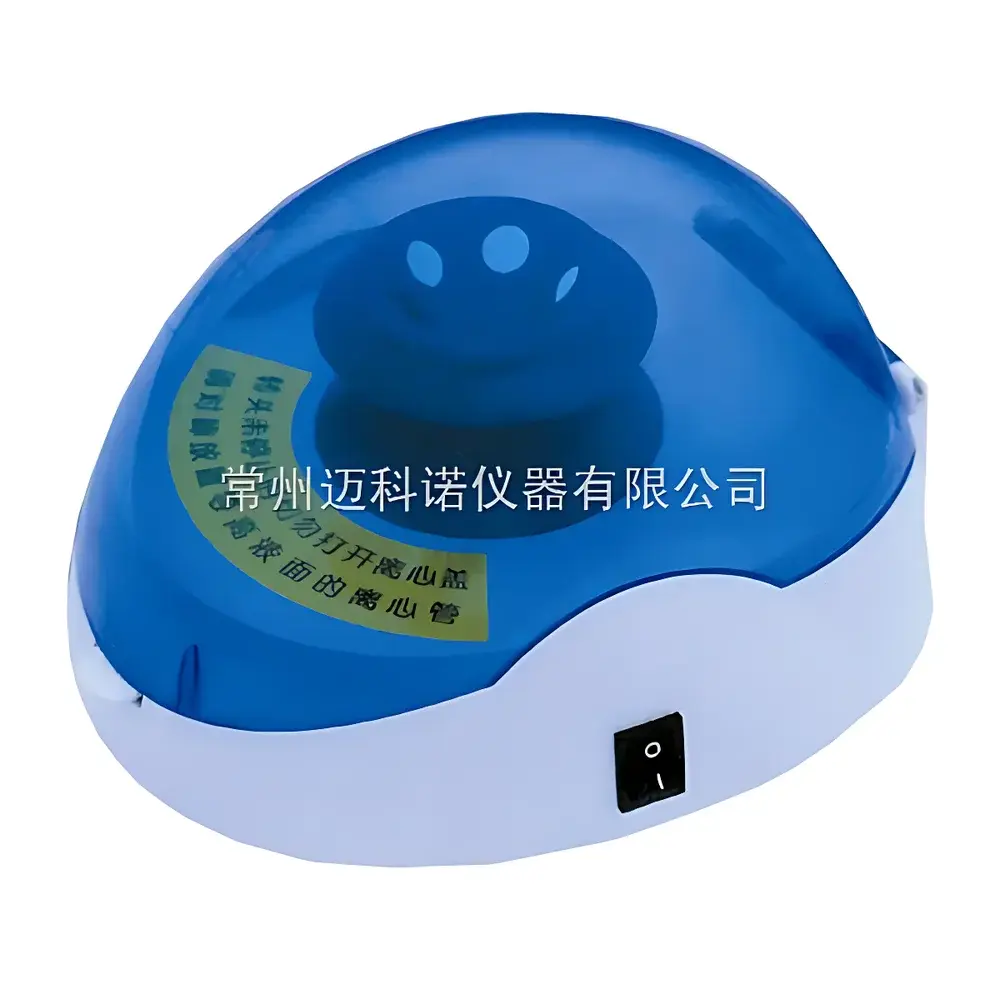
MKN Mini-100 Portable Palm-Sized Centrifuge
| Brand | MKN |
|---|---|
| Model | Mini-100 |
| Rotor Capacity | 6 × 1.5/2.0 mL tubes + dual 8 × 0.2 mL strip rotors |
| Adapters Included | 6 × 0.2 mL, 6 × 0.5 mL |
| Max Speed | 10,000 rpm |
| RCF | 3,250 × g |
| Noise Level | <50 dB(A) |
| Motor Type | Brushless DC Motor |
| Rotor Material | Carbon Fiber |
| Dimensions | Compact palm-sized footprint (typical: 125 × 125 × 140 mm) |
| Weight | ~0.9 kg |
| Power Supply | DC 12 V / 2 A (external adapter included) |
Overview
The MKN Mini-100 Portable Palm-Sized Centrifuge is an ultra-compact, benchtop-free centrifugation solution engineered for rapid microsample processing in resource-constrained or high-throughput laboratory environments. Designed around Couette-flow rotor dynamics and optimized angular acceleration profiles, the Mini-100 delivers reproducible relative centrifugal force (RCF) up to 3,250 × g at 10,000 rpm—sufficient for pelleting cellular debris, precipitating nucleic acids, concentrating PCR reagents, and separating micro-volume immunoassay components. Its brushless DC motor ensures stable rotational inertia with minimal thermal drift, while the carbon fiber rotor provides exceptional tensile strength-to-mass ratio, enabling rapid spin-up (<8 s to full speed) and deceleration without mechanical resonance. Unlike conventional benchtop centrifuges, the Mini-100 operates without internal refrigeration or vacuum systems, making it suitable for ambient-temperature applications where thermal sensitivity is low and portability is critical—such as field-deployable diagnostics, teaching labs, cleanroom glovebox integration, and point-of-care sample prep stations.
Key Features
- True palm-sized form factor (approx. 125 × 125 × 140 mm), weighing under 0.9 kg—designed for single-hand operation and storage in standard lab drawers or transport cases
- Patented acoustic damping architecture incorporating elastomeric rotor suspension and asymmetric housing geometry, achieving sustained operational noise below 50 dB(A) at maximum speed
- Carbon fiber rotor certified for >100,000 cycles at rated speed; compatible with universal 1.5/2.0 mL microtubes and standardized 0.2 mL PCR strip formats
- Dual-rotor configuration: fixed-angle rotor for individual tube processing (6 positions) and interchangeable strip rotor for parallel 8-tube handling (2 × 8-position)
- Integrated safety interlock system with automatic rotor detection and lid-closed verification—compliant with IEC 61010-2-020 (Laboratory Equipment – Particular Requirements for Centrifuges)
- DC-powered operation via external 12 V / 2 A adapter—enabling battery-backed use with optional portable power banks (e.g., USB-C PD to 12 V DC converters)
Sample Compatibility & Compliance
The Mini-100 supports common microvolume consumables including polypropylene 1.5 mL and 2.0 mL conical tubes (Eppendorf-style), 0.2 mL PCR strips (8-well format), and low-retention microtubes. Optional adapters enable secure retention of 0.2 mL and 0.5 mL tubes within the primary rotor. All rotors are autoclavable at 121 °C for 20 minutes (max. 50 cycles), supporting GLP-compliant workflows requiring routine sterilization. The device meets electromagnetic compatibility (EMC) requirements per EN 61326-1 and carries CE marking for Class I electrical safety. While not intended for clinical diagnostic use under ISO 13485, its performance stability aligns with ASTM E2917-21 (Standard Practice for Validation of Centrifuge Performance) for research-grade microcentrifugation tasks.
Software & Data Management
The Mini-100 operates as a standalone electromechanical instrument with no embedded firmware, touchscreen interface, or data logging capability—intentionally minimizing failure modes and calibration dependencies. Speed and run time are set manually via dual rotary dials (rpm and timer: 1–99 seconds, continuous mode). This analog control architecture eliminates software validation overhead, satisfying FDA 21 CFR Part 11 requirements for instruments where electronic records are not generated. For laboratories implementing electronic lab notebooks (ELN), centrifugation parameters are documented manually or via barcode-scanned protocol templates referencing validated SOPs (e.g., “Mini-100_RCF3250_10s_v1.2”).
Applications
- Rapid spin-down of column-based DNA/RNA purification kits prior to elution
- Microcentrifugal separation of cell lysates in proteomics sample prep workflows
- Concentration of viral vectors or exosomes in small-volume suspensions (≤200 µL)
- Removal of air bubbles from viscous reagents (e.g., glycerol stocks, enzyme master mixes)
- Field-deployable nucleic acid extraction in biosurveillance or veterinary mobile labs
- Student laboratory instruction in molecular biology techniques requiring intuitive, low-risk instrumentation
FAQ
Is the Mini-100 suitable for blood separation?
No—it lacks the RCF and rotor geometry required for effective erythrocyte sedimentation; use only for microvolume clarification of clarified lysates or reagent preparation.
Can the rotor be balanced manually if one tube is missing?
Yes—the carbon fiber rotor tolerates single-tube operation at ≤8,000 rpm; however, full-load symmetry is recommended for optimal bearing longevity and noise performance.
Does the device require periodic calibration?
No—speed accuracy is factory-trimmed via motor encoder feedback and remains stable over 5+ years of typical use; no recalibration interval is specified.
Is the Mini-100 compatible with hazardous solvents?
The housing and rotor are chemically resistant to ethanol, isopropanol, and dilute acids/bases; avoid prolonged exposure to chlorinated hydrocarbons or strong oxidizers.
What is the expected service life under daily use?
Rated for ≥20,000 operating hours with routine visual inspection of rotor threads and bearing smoothness every 6 months.



