
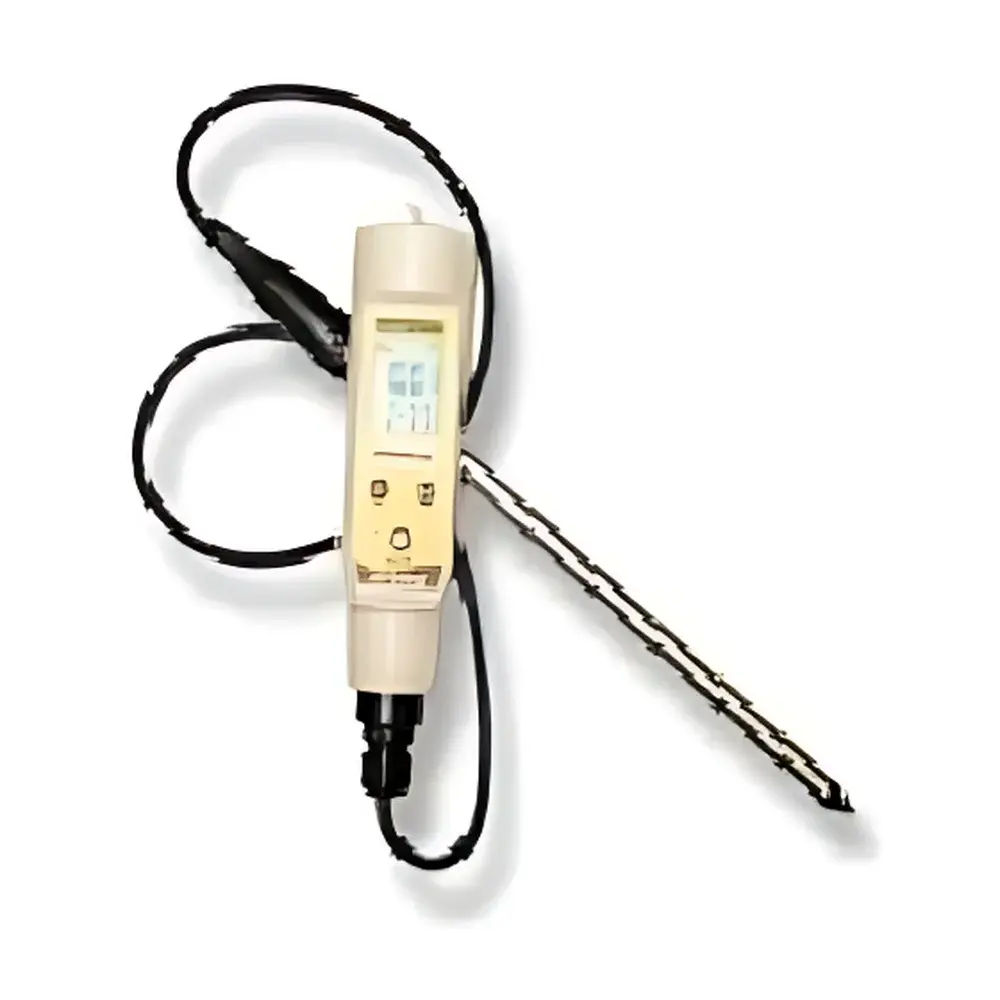
Spectrum Technologies EC 450 Portable Soil Electrical Conductivity Meter
| Brand | Spectrum Technologies |
|---|---|
| Model | EC 450 |
| Origin | USA |
| Measurement Range | 0–200 mS/cm (EC), −10 to +110 °C (Temperature), 0–50 ppt (Salinity) |
| Accuracy | ±1% (EC & Salinity), ±0.5 °C (Temperature) |
| Data Storage | 4,096 records (1,488 with GPS enabled) |
| Display | Backlit LCD |
| Connectivity | USB & RS-232 |
| Battery Life | ~500 hours |
| Ingress Protection | IP67 |
| Standard Electrode Length | 20 cm (60 cm optional) |
| Calibration Solution | 2.76 mS/cm standard included |
Overview
The Spectrum Technologies EC 450 Portable Soil Electrical Conductivity Meter is a field-deployable, direct-insertion instrument engineered for rapid, in-situ measurement of electrical conductivity (EC), temperature, and derived salinity in soils, aqueous solutions, and organic media. It operates on the principle of two-electrode AC conductivity measurement—applying a low-frequency alternating current across a stainless-steel electrode pair and calculating conductance based on Ohm’s law, corrected for cell geometry and temperature. Unlike traditional lab-based methods requiring soil extraction, drying, saturation paste preparation, and extract analysis, the EC 450 enables real-time profiling without sample disturbance or preprocessing. Its design prioritizes operational robustness in variable environmental conditions—supporting precision agriculture workflows, salinity mapping in arid and coastal zones, irrigation water quality screening, and ecological site assessments where spatial resolution and temporal repeatability are critical.
Key Features
- Integrated data logger with 4,096-point memory capacity (reduced to 1,488 points when GPS synchronization is active); supports timestamped, location-tagged measurements for georeferenced soil surveys.
- IP67-rated enclosure ensures full dust ingress protection and resistance to temporary immersion—validated for use in rain, high-humidity greenhouses, and muddy field conditions.
- Dual-output display: backlit LCD shows simultaneous EC (mS/cm), temperature (°C), and salinity (ppt) readings; units auto-scale within defined ranges to prevent overflow errors.
- Modular probe architecture: standard 20 cm stainless-steel electrode rod optimized for topsoil (0–30 cm depth); optional 60 cm probe available for deeper profile characterization in orchards, vineyards, or vadose zone studies.
- Onboard temperature compensation (NTC thermistor) applies automatic linear correction per ASTM D1125 and ISO 7888 standards, referenced to 25 °C.
- Low-power electronics enable >500 hours of continuous operation on four AA alkaline batteries—no external power source required during extended transect surveys.
Sample Compatibility & Compliance
The EC 450 is validated for direct insertion into mineral soils (sandy, loamy, clayey), hydroponic nutrient solutions, surface and groundwater, compost leachates, and manure slurries—with no dilution or filtration needed. It complies with core performance criteria outlined in ASTM D2777 (Standard Practice for Determination of Precision and Bias of Applicable Test Methods), and its calibration traceability aligns with NIST-traceable 2.76 mS/cm KCl reference solution (included). The device meets CE marking requirements for electromagnetic compatibility (EN 61326-1) and environmental testing (IEC 60529 for IP67). While not certified for GLP/GMP-regulated release testing, its audit-ready data export (CSV via USB/RS-232) and fixed calibration protocol support QA/QC documentation under ISO/IEC 17025-accredited laboratory frameworks.
Software & Data Management
Data retrieval is facilitated through Spectrum Technologies’ proprietary PC software (Windows-compatible), which imports time-stamped, multi-parameter datasets and generates XY scatter plots, contour maps (when paired with GPS coordinates), and summary statistics (mean, SD, min/max per transect). Export options include CSV, Excel (.xlsx), and PDF report templates compliant with internal SOPs. The firmware enforces immutable data logging—no post-acquisition editing permitted—to uphold data integrity. USB and RS-232 interfaces allow integration into custom SCADA or LIMS environments via ASCII serial commands (documented in the technical manual), supporting automated ingestion into farm management platforms such as Climate FieldView or Granular.
Applications
- High-resolution salinity mapping for irrigation scheduling and drainage design in semi-arid croplands.
- Routine monitoring of greenhouse substrate EC to prevent nutrient lockout or phytotoxicity in ornamental and vegetable production.
- Pre- and post-remediation assessment of salt-affected soils in brownfield redevelopment projects.
- Field validation of satellite-derived EC proxies (e.g., EM38 or drone-mounted EM sensors).
- Water quality screening at intake points, tailwater ditches, and constructed wetlands—measuring both EC and thermal stability in real time.
- Educational use in university soil physics and environmental science labs for teaching conductivity–porosity–saturation relationships.
FAQ
How does the EC 450 compensate for temperature effects on conductivity readings?
It incorporates a built-in NTC thermistor that continuously measures probe temperature and applies a linear temperature coefficient (β = 2.14 %/°C) to normalize all EC values to 25 °C, per ASTM D1125 guidelines.
Can the EC 450 measure EC in saturated paste extracts?
No—it is designed exclusively for direct, in-situ measurement. For saturated paste EC (e.g., USDA NRCS protocols), laboratory analysis using a benchtop conductivity meter remains required.
Is the 60 cm probe compatible with the same handheld unit and firmware?
Yes—the extended probe uses identical electrical interface and calibration constants; no hardware or software modification is needed.
Does the device meet FDA 21 CFR Part 11 requirements for electronic records?
No—it lacks user authentication, electronic signatures, and audit trail functionality; it is intended for field screening—not regulated clinical or pharmaceutical applications.
What maintenance is required between field deployments?
Rinse electrodes with deionized water after each use; inspect O-rings for compression set; store with protective cap installed; recalibrate quarterly or after 200 insertions using the supplied 2.76 mS/cm standard.







