
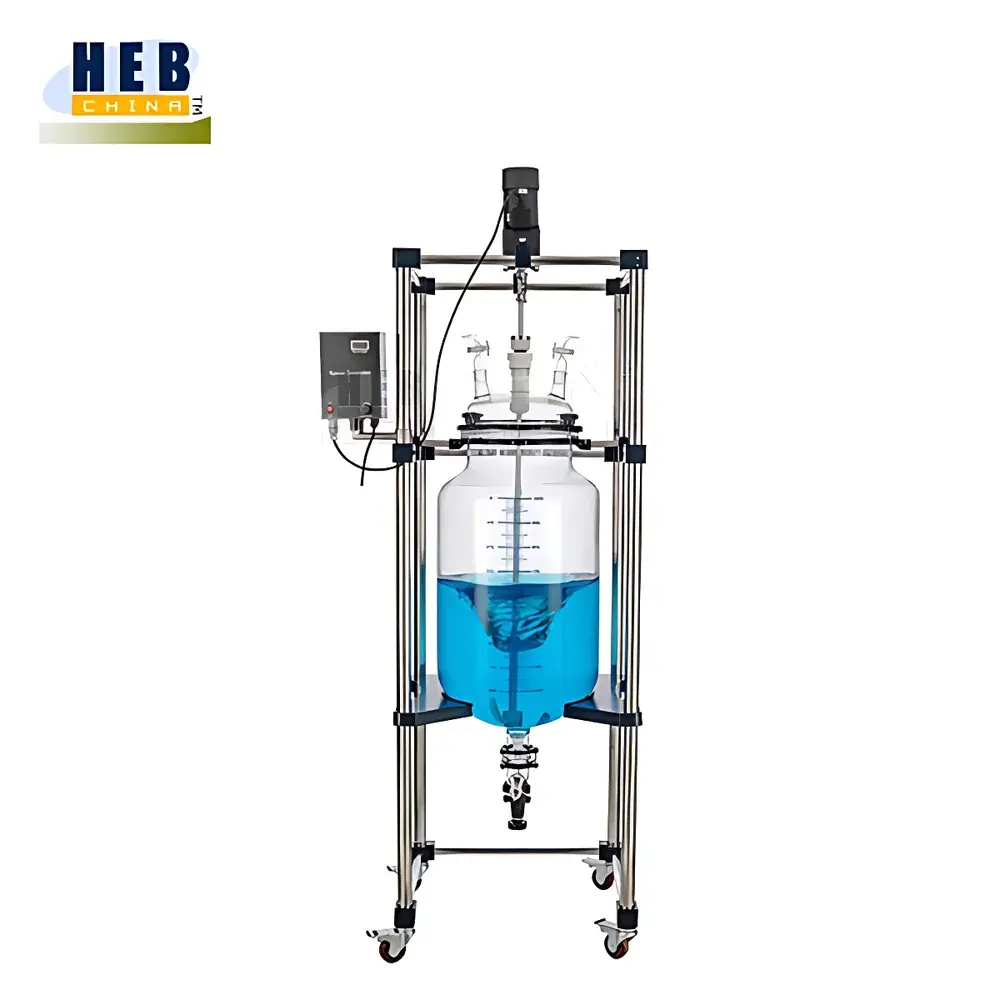
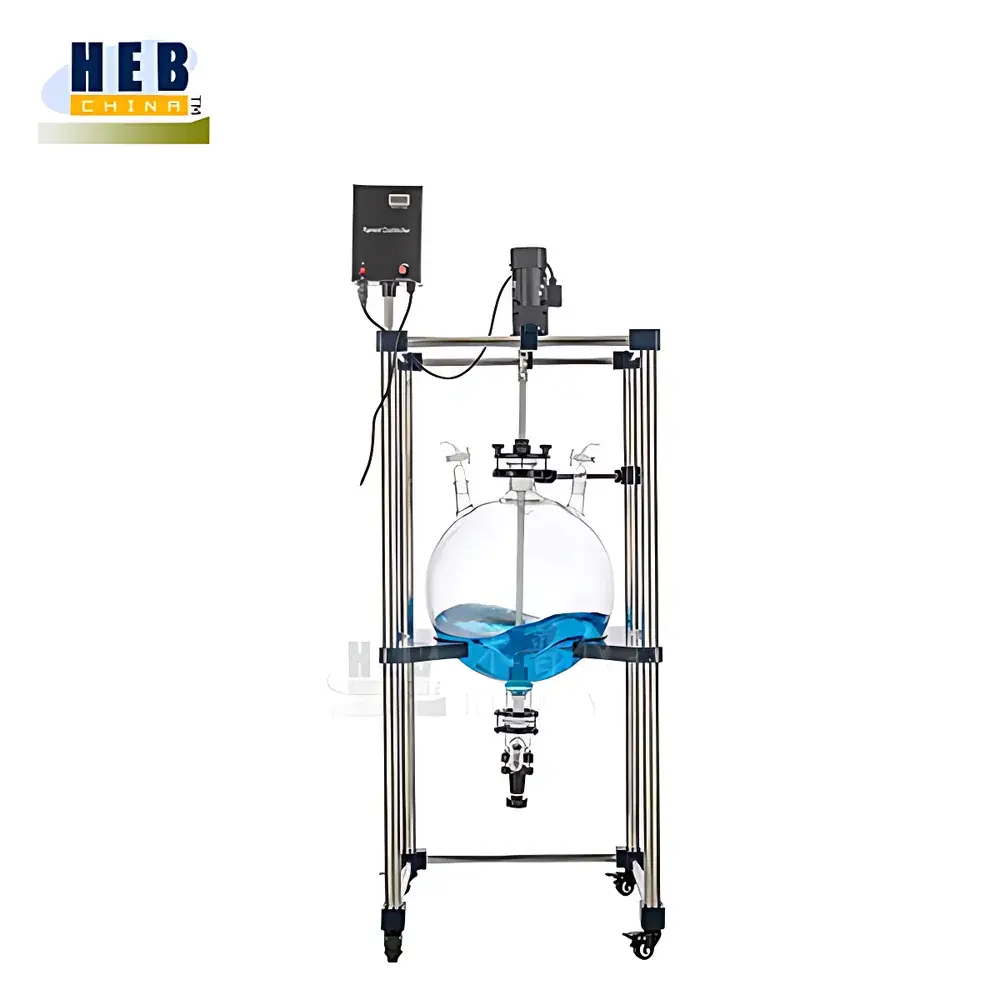
Jihepu FY-50L Cylindrical Glass Separatory Reactor
| Brand | Jihepu |
|---|---|
| Origin | Shandong, China |
| Model | FY-50L Cylindrical |
| Capacity | 50 L |
| Vessel Material | High-borosilicate glass (3.3 expansion coefficient) + PTFE |
| Working Pressure | Low-pressure operation |
| Vacuum Level | 0.098 MPa |
| Stirring Speed Range | 0–450 rpm |
| Motor Power | 120 W |
| Voltage/Frequency | 220 V / 50 Hz |
| Overall Dimensions (W×D×H) | 650 × 720 × 1870 mm |
| Net Weight | 51 kg |
| Transport Package | Wooden crate, 1680 × 620 × 650 mm, 82 kg |
Overview
The Jihepu FY-50L Cylindrical Glass Separatory Reactor is a bench-to-pilot-scale laboratory reactor engineered for controlled liquid–liquid extraction, phase separation, and batch synthesis under ambient or reduced pressure conditions. Its core operational principle combines mechanical agitation with gravity-driven stratification: a low-speed, high-torque stirrer homogenizes immiscible phases during reaction; upon cessation of stirring, density-differentiated layers separate by sedimentation; and subsequent layer-specific discharge is achieved via a side-mounted, PTFE-lined glass valve assembly. Designed around ASTM E2877-compliant borosilicate glass 3.3 construction, the unit ensures chemical inertness toward organic solvents, strong acids, and alkalis—making it suitable for pharmaceutical intermediate synthesis, fine chemical purification, and solvent recovery workflows where material compatibility and visual process monitoring are critical.
Key Features
- High-integrity vessel body fabricated from borosilicate glass 3.3 (linear thermal expansion coefficient: 3.3 × 10⁻⁶ K⁻¹), certified to ISO 3585 standards for thermal shock resistance and hydrolytic stability.
- Full-contact wetted parts—including stirrer shaft, impeller blades, valves, and sealing surfaces—constructed from 316 stainless steel sheathed in virgin PTFE or molded PTFE components, eliminating metallic leaching and ensuring USP Class VI compliance for extractables profiling.
- Modular three-neck lid configuration: central Φ50 mm stirring port, dual 34/40 standard taper joints (one for feed, one for venting or inert gas inlet), and integrated vacuum/pressure gauge port.
- Low-noise, frequency-controlled AC motor (120 W) with digital RPM display and precision potentiometer adjustment, delivering stable torque output across 0–450 rpm without slippage or thermal drift.
- Ceramic bearing-supported mechanical seal assembly prevents particulate generation from shaft wear, supporting long-term operation under continuous agitation cycles.
- Asymmetric crescent-shaped impeller (stainless steel core + PTFE-coated blades, 190 mm span) optimized for gentle yet effective mixing of viscous or density-mismatched phases without emulsification.
- Side-exit PTFE-glass discharge valve (Φ80 mm flange, Φ33 mm orifice) with angled outlet (34 mm ID, 350 mm above floor level) enabling residue-free, layer-selective drainage without vessel tilting or manual siphoning.
- Mobile frame built from anodized aluminum uprights and 304 stainless steel cross-bracing, fitted with four locking casters (two swivel, two rigid) for repositioning within fume hoods or between synthesis stations.
Sample Compatibility & Compliance
The FY-50L reactor accommodates aqueous–organic, acid–base, and polymer–solvent systems typical in API purification, catalyst recovery, and natural product isolation. Its all-glass/PTFE fluid path meets ISO 17025 traceability requirements for calibration of volumetric discharge and supports GLP-aligned documentation of batch records. The system operates safely at ≤0.098 MPa vacuum (equivalent to ~20 mbar abs), compatible with rotary evaporation integration and inert atmosphere purging (N₂ or Ar). Electrical safety conforms to IEC 61010-1:2010 for laboratory equipment, including overcurrent protection via resettable thermal fuse and grounding continuity verification.
Software & Data Management
This analog-controlled reactor does not incorporate embedded firmware or digital data logging. However, its standardized electrical interface (220 V / 50 Hz) allows seamless integration with external process controllers, programmable logic controllers (PLCs), or third-party SCADA systems via 4–20 mA analog output modules (optional add-on). RPM setpoint and real-time speed are displayed on an LED panel for operator verification, satisfying FDA 21 CFR Part 11 requirements for audit-ready manual entry when paired with electronic lab notebook (ELN) documentation protocols.
Applications
- Multi-stage liquid–liquid extraction of alkaloids, flavonoids, or metal complexes from botanical or mineral feeds.
- In situ quenching and phase separation following Grignard, Friedel–Crafts, or esterification reactions.
- Controlled crystallization seeding and mother liquor decantation in small-molecule polymorph screening.
- Solvent recycling loops involving azeotropic distillate collection and aqueous phase return.
- Batch-wise purification of biocatalytic reaction mixtures prior to chromatographic polishing.
FAQ
Is the reactor suitable for exothermic reactions requiring temperature control?
No integrated heating/cooling jacket is provided; however, the cylindrical glass body accepts external silicone oil baths or circulating chillers via clamping fixtures (not included). Maximum recommended operating temperature is 150 °C under atmospheric conditions.
Can the unit be validated for GMP manufacturing environments?
While designed for R&D and pilot-scale use, its material certifications (glass 3.3, PTFE USP Class VI), traceable vendor documentation, and absence of lubricants or elastomers in the process stream support IQ/OQ protocol development per Annex 15 guidelines.
What maintenance intervals are recommended for the mechanical seal and ceramic bearings?
Under normal usage (≤4 hrs/day, non-abrasive media), inspect seal integrity and bearing play every 500 operating hours; replace PTFE components annually or after exposure to halogenated solvents.
Does the side-discharge valve allow quantitative transfer of the bottom layer only?
Yes—the valve’s linear actuation mechanism and calibrated orifice geometry enable selective discharge of the denser phase while retaining the upper layer, with residual hold-up volume <15 mL as verified by water displacement testing.



