
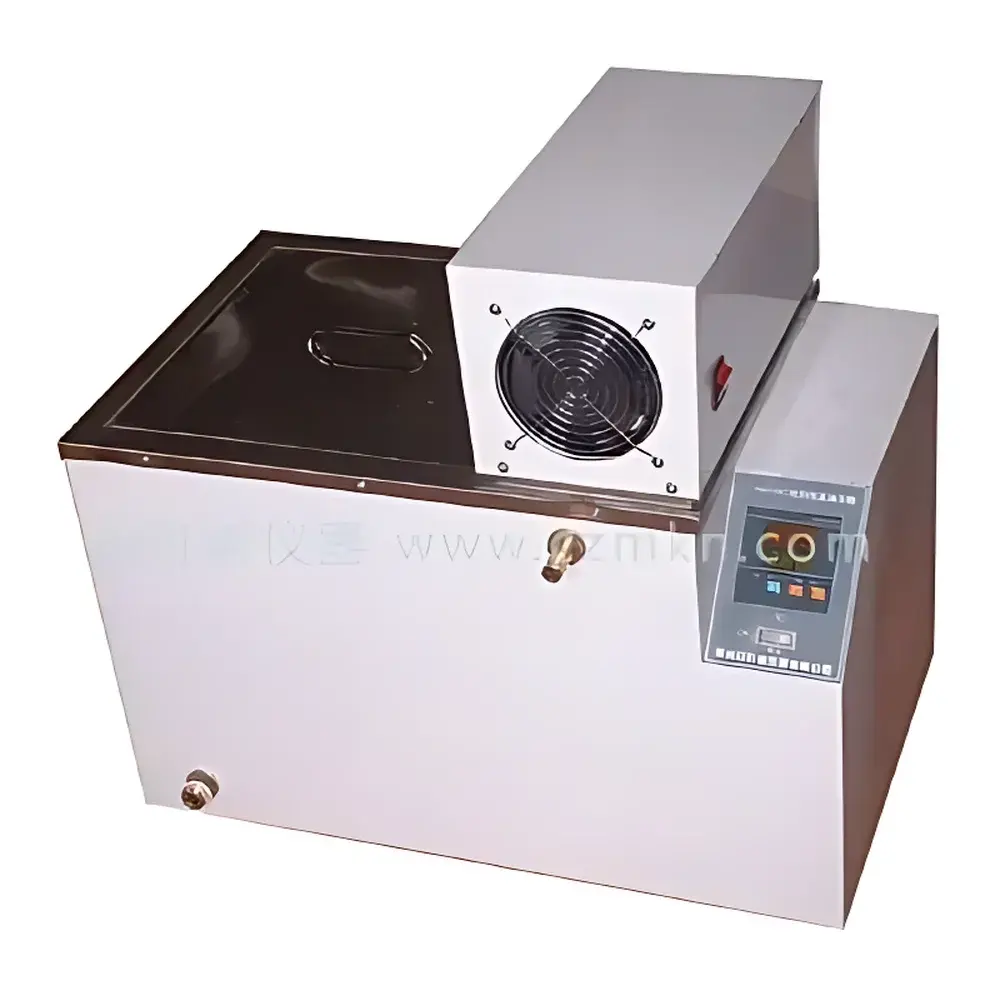
MKN HH-SC Digital Display Super Constant-Temperature Oil Bath
| Brand | MKN |
|---|---|
| Model | HH-SC |
| Type | Oil Bath Circulator |
| Power Supply | 220 V, 50 Hz |
| Heating Power | 2000 W |
| Temperature Range | Ambient to 300 °C (with internal circulation) |
| Temperature Stability | ≤ ±0.5 °C |
| Temperature Uniformity | ≤ ±1.0 °C |
| Chamber Dimensions | 28 × 28 × 30 cm (W × D × H) |
| Construction | Stainless Steel 304 Tank |
| Display | LED Digital Readout |
| Heating Method | Far-Infrared Heating Element |
| Thermal Equilibration Time | Short (Typical <15 min to setpoint at mid-range) |
| Compliance | Designed for general laboratory use under ISO/IEC 17025-aligned environments |
Overview
The MKN HH-SC Digital Display Super Constant-Temperature Oil Bath is a precision thermal management instrument engineered for stable, uniform, and repeatable heating of samples immersed in heat-transfer media—primarily silicone oil, mineral oil, or other high-boiling-point fluids. Unlike water baths limited to 100 °C, this unit employs far-infrared heating technology combined with an internal circulation system to achieve and maintain temperatures up to 300 °C with minimal spatial and temporal deviation. Its operational principle relies on convective thermal equilibrium within a sealed stainless steel 304 bath chamber, where temperature feedback is continuously monitored via a high-stability platinum resistance sensor (PT100-class equivalent), processed through dual-integration A/D conversion circuitry, and regulated by proportional-integral (PI) control logic. The result is a thermally robust platform suitable for applications requiring extended dwell times at elevated temperatures without evaporative loss or thermal gradient-induced artifacts.
Key Features
- Stainless steel 304 construction ensures long-term corrosion resistance against oxidizing oils and repeated thermal cycling.
- Digital LED display provides real-time readout of setpoint and actual bath temperature with 0.1 °C resolution.
- Internal circulation pump enhances thermal homogeneity across the entire working volume (28 × 28 × 30 cm), minimizing axial and radial temperature gradients.
- Far-infrared heating element delivers rapid thermal response and reduced surface hot-spot formation compared to conventional resistive coils.
- Temperature stability of ≤ ±0.5 °C and uniformity of ≤ ±1.0 °C meet routine calibration and process validation requirements for QC laboratories.
- Thermal equilibration time is optimized for efficiency—typically under 15 minutes when ramping from ambient to 200 °C with standard oil fill levels.
- Over-temperature protection circuitry automatically deactivates heating if sensor fault or runaway condition is detected.
Sample Compatibility & Compliance
The HH-SC accommodates standard laboratory glassware including round-bottom flasks (up to 2 L), condenser assemblies, extraction thimbles, and immersion probes. Its open-bath design allows direct access for stirring rods, thermocouple insertion, or reflux setups. While not certified to IEC 61010-1 for hazardous area use, the unit complies with general safety provisions for Class II, Pollution Degree 2 laboratory environments. It supports GLP/GMP-aligned workflows through traceable temperature monitoring and reproducible setpoint execution—though it does not include built-in audit trail or 21 CFR Part 11-compliant electronic signature functionality. Users performing ASTM D92 (Cleveland Open Cup), ISO 3104 (kinematic viscosity), or USP <645> (water conductivity testing at elevated T) may deploy this bath as a validated auxiliary heating source when paired with external calibrated reference thermometers.
Software & Data Management
The HH-SC operates as a standalone analog-digital hybrid controller with no embedded firmware-based data logging or PC connectivity. All operation is manual: users set temperature via front-panel keypad, monitor real-time values on the LED display, and record observations externally. For laboratories requiring documentation, integration with third-party data acquisition systems is feasible using optional analog output (0–5 V or 4–20 mA, configurable via service mode) or digital RS-485 Modbus RTU interface (available on upgraded firmware versions—contact MKN technical support for compatibility verification). No proprietary software is supplied; however, the device is compatible with common SCADA platforms and LabVIEW-compatible DAQ modules when configured per manufacturer’s communication protocol specifications.
Applications
- Controlled-temperature reflux and distillation of high-boiling organic solvents (e.g., DMF, ethylene glycol, diphenyl ether).
- Pre-heating and thermal conditioning of viscometers, density meters, and rheological sample holders prior to measurement.
- Accelerated stability testing of pharmaceutical excipients and polymer melts under ISO 11357-3 thermal protocols.
- Drying and solvent removal from moisture-sensitive catalysts or nanomaterial dispersions.
- Calibration of thermocouples, RTDs, and infrared pyrometers across the 50–300 °C range using NIST-traceable reference standards.
- Enzyme denaturation studies and protein thermal shift assays requiring precise, oil-mediated heating profiles.
FAQ
What types of heat-transfer fluids are compatible with the HH-SC oil bath?
Silicone oils (e.g., Dow Corning 200 Fluid series), white mineral oils, and polyethylene glycols (PEG-400) are commonly used. Avoid halogenated or low-flash-point fluids; consult fluid SDS for maximum operating temperature limits.
Can the HH-SC be used as a dry block heater with aluminum blocks?
No—it is designed exclusively for liquid-phase thermal transfer. Dry block operation risks overheating, sensor drift, and voiding the warranty.
Is the internal circulation pump adjustable or bypassable?
The pump operates continuously during heating mode and cannot be disabled; its flow rate is fixed to ensure consistent thermal uniformity.
Does the unit include a calibration certificate?
Factory calibration is performed at 100 °C and 200 °C using traceable references, but a formal ISO/IEC 17025 calibration certificate is available upon request at additional cost.
What maintenance is required for long-term reliability?
Annual inspection of heater element integrity, cleaning of oil residue from tank walls with isopropanol, and verification of sensor response time using a secondary reference thermometer are recommended.



