
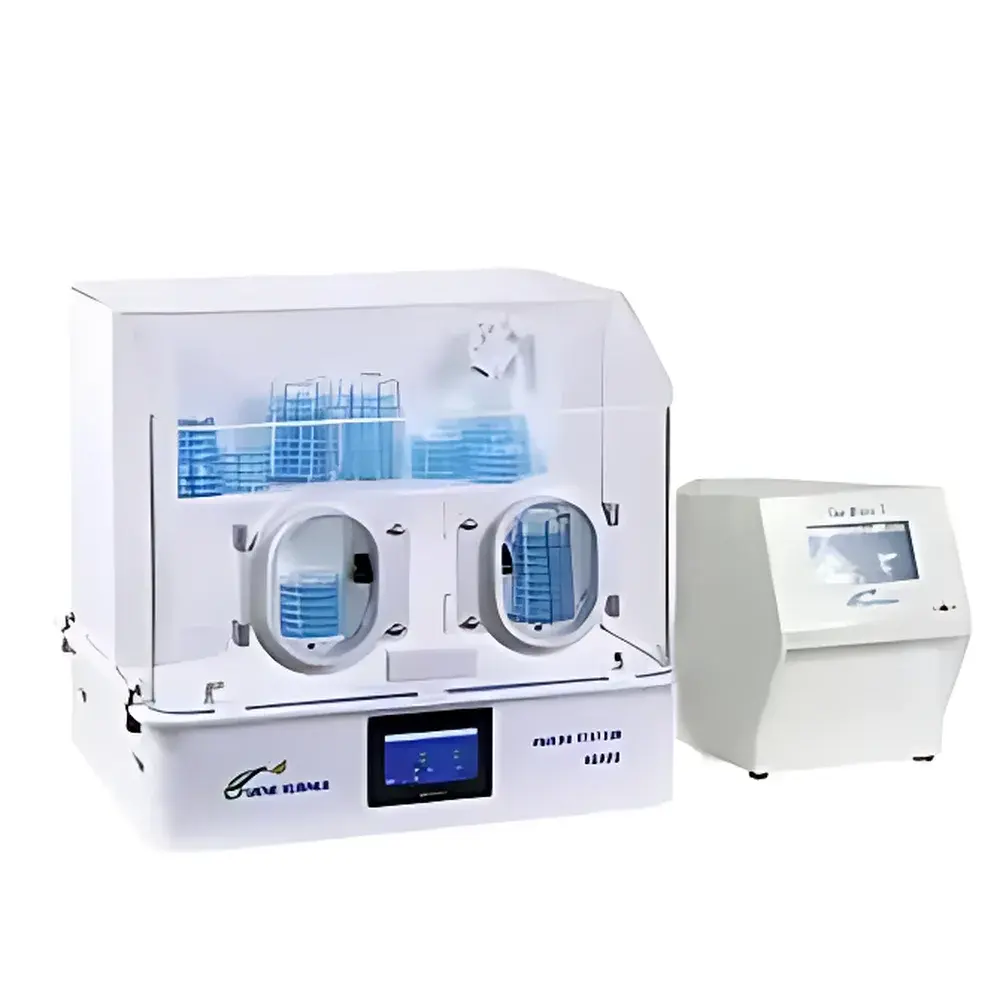
GeneScience AG400plus Anaerobic Workstation
| Brand | GeneScience |
|---|---|
| Origin | USA |
| Model | AG400plus |
| Incubation Temperature Range | Ambient +3°C to 52°C |
| Temperature Uniformity & Stability | ±0.3°C (PID-controlled) |
| Humidity Control | Up to <90% RH |
| Chamber Capacity | 400 × 90 mm Petri Dishes (operational mode), 500 × 90 mm Dishes (pure culture mode), 80 × 250 mL Erlenmeyer Flasks |
| Operating Chamber Dimensions | 770 × 680 × 610 mm (L×W×H) |
| External Dimensions | 860 × 760 × 830 mm (L×W×H) |
| Weight | ~85 kg |
| Gas Supply Options | Single-gas (10% H₂ + 10% CO₂ + 80% N₂) or Dual-gas (N₂ + premixed anaerobic gas) |
| Gas Consumption | ~10 m³ lasts ~30 weeks (dual-gas), ~22 weeks (single-gas) |
| O₂ Detection Limit | <5 ppm (Pd catalyst, 4-year service life) |
| Oxygen Control Range | 0–10% (anaerobic to microaerophilic) |
| Humidity Management | Automated digital humidity control |
| Access Modes | Airlock transfer (20 plates/batch) or seal-and-reseal rapid transfer (<10 s recovery) |
| Safety Features | Low-pressure alarm, over-temperature cutoff, leak detection with time-stamped logging, dry-type pressure relief valve |
| Ergonomics | Lift-off acrylic lid (10 mm thickness), bare-hand operation compatible, foot-switch vacuum/N₂ control, integrated power outlets |
| Optional | Anaerobic indicator pump, top-mounted fluorescent lighting module |
Overview
The GeneScience AG400plus Anaerobic Workstation is an integrated, high-efficiency environment control system engineered for precise cultivation and handling of obligate anaerobes and microaerophiles under strictly controlled atmospheric conditions. Utilizing a closed-chamber architecture with dual-gas or single-gas supply pathways, the system maintains oxygen concentrations below 5 ppm via a long-life palladium catalyst—eliminating the need for routine catalyst reactivation while ensuring consistent anaerobic integrity over extended operational cycles. Its unified workspace design integrates both operator manipulation and sample incubation within a single chamber, reducing gas consumption and minimizing spatial footprint without compromising throughput. The workstation operates across a thermally stable range from ambient +3°C to 52°C, with ±0.3°C uniformity achieved through a responsive PID-based temperature regulation system. All critical environmental parameters—including O₂ concentration, internal pressure, humidity, and gas exchange timing—are continuously monitored and digitally logged, supporting traceability requirements in GLP- and GMP-aligned laboratories.
Key Features
- Monolithic 10 mm thick acrylic construction offering optical clarity, thermal insulation, and chemical resistance to common decontamination agents
- Lift-off chamber lid design enabling unobstructed access for large instrumentation placement or deep-cleaning protocols; includes built-in power outlets
- Intelligent PLC-driven control interface with full-color touchscreen, enabling programmable gas sequencing, humidity setpoint adjustment, and real-time parameter visualization
- Dual operational transfer modes: airlock-based batch loading (up to 20 × 90 mm Petri dishes per cycle) and rapid-seal transfer (<10 s anaerobic recovery post-insertion)
- Automated humidity management system preventing desiccation of agar-based media during prolonged incubation
- Dry-type pressure relief valve maintaining positive internal pressure while safeguarding against uncontrolled gas leakage
- Integrated leak-detection algorithm that timestamps vacuum draw intervals and triggers visual/audible alerts upon deviation from baseline performance
- Foot-actuated vacuum and nitrogen purge controls, minimizing hand contact and preserving glove integrity
- Onboard hydrogen sulfide and volatile fatty acid scrubbing system to neutralize metabolic inhibitors known to suppress anaerobe growth
Sample Compatibility & Compliance
The AG400plus accommodates standard microbiological consumables including 90 mm Petri dishes (400 in operational mode, 500 in static culture configuration), 250 mL Erlenmeyer flasks (80 units), and custom-sized culture vessels up to 610 mm height. Its chamber geometry supports compatibility with common benchtop instruments such as colony pickers, automated streakers, and handheld microscopes. From a regulatory standpoint, the system’s digital logging capabilities—including timestamped O₂ readings, pressure events, and humidity profiles—align with data integrity expectations outlined in FDA 21 CFR Part 11 when paired with appropriate audit trail configuration. While not certified to ISO 13485 or CE-IVD out-of-the-box, its design principles conform to ISO 14644-1 Class 5 cleanroom practices when operated in conjunction with validated surface disinfection protocols. It meets ASTM E2612 standards for anaerobic environment verification and supports USP & CLSI guidelines for anaerobic susceptibility testing workflows.
Software & Data Management
The embedded control firmware provides non-volatile storage of up to 30 days of continuous environmental logs, exportable via USB to CSV format for external analysis. No proprietary software installation is required on host PCs—data files are human-readable and compatible with Excel, Python pandas, or laboratory information management systems (LIMS). Alarm history includes severity tagging (warning vs. critical), event duration, and automatic correlation with concurrent gas usage metrics. Optional remote monitoring integration is available through Modbus TCP/IP protocol for centralized facility-wide environmental oversight. All parameter changes are recorded with user ID (if enabled), timestamp, and pre-/post-value deltas—fulfilling core ALCOA+ data governance criteria (Attributable, Legible, Contemporaneous, Original, Accurate, Complete, Consistent, Enduring, Available).
Applications
- Clinical microbiology: Isolation and identification of Clostridioides difficile, Bacteroides spp., Fusobacterium nucleatum, and other fastidious anaerobes from stool, wound, and blood cultures
- Pharmaceutical QC: Anaerobic stability testing of oral solid dosage forms and excipients under simulated gastrointestinal conditions
- Gut microbiome research: Cultivation of strict anaerobes for metagenomic strain isolation, functional screening, and biobanking
- Food safety testing: Enumeration of spoilage-associated anaerobes (e.g., Clostridium botulinum) in low-acid canned goods and vacuum-packed meats
- Veterinary diagnostics: Culture of equine and bovine rumen isolates requiring sub-1% O₂ environments
- Environmental microbiology: Enrichment of sulfate-reducing bacteria (SRB) and methanogens from sediment or wastewater samples
FAQ
What gas mixtures are compatible with the AG400plus?
The system supports either a single pre-mixed gas (10% H₂ + 10% CO₂ + 80% N₂) or dual-gas configuration using separate N₂ and anaerobic gas cylinders. Hydrogen concentration remains fixed at 10% in all configurations to ensure optimal catalytic O₂ removal.
How frequently must the palladium catalyst be replaced?
Under normal operating conditions and with proper gas purity (≤5 ppm O₂ inlet), the catalyst maintains <5 ppm internal O₂ for up to four years without regeneration or replacement.
Can the workstation support microaerophilic culture conditions?
Yes—the O₂ setpoint is adjustable from 0% to 10%, allowing controlled microaerophilic environments suitable for Helicobacter pylori, Campylobacter jejuni, and Streptococcus pneumoniae.
Is the humidity control system capable of maintaining saturated conditions?
No—the system regulates relative humidity to a maximum of <90% RH to prevent condensation while avoiding agar desiccation; it does not generate steam or achieve 100% saturation.
Does the AG400plus include validation documentation?
Factory-installed IQ/OQ documentation packages are available upon request, including temperature mapping reports, O₂ sensor calibration certificates, and leak test protocols compliant with ISO 14644-3 Annex B.
Related Products




