
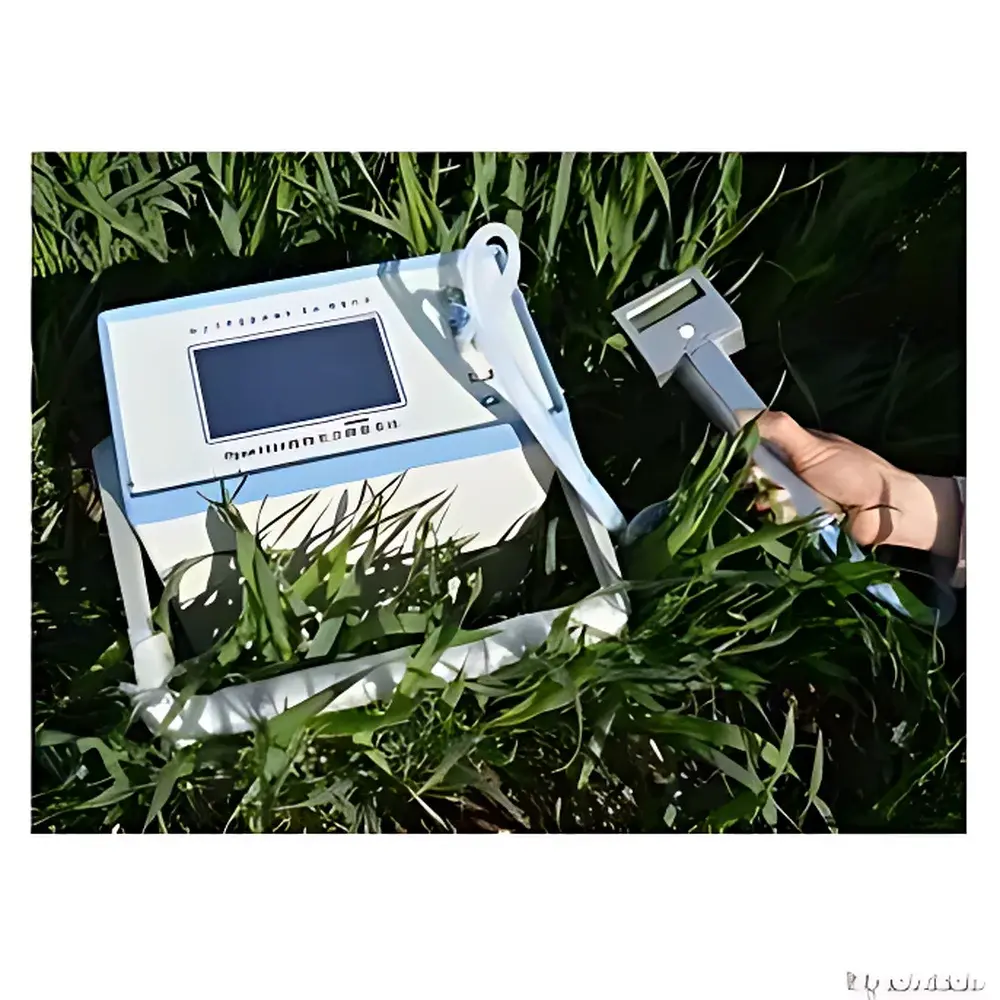
Tlyon Tlyon-1024 Portable Photosynthesis Measurement System
| Brand | Tlyon |
|---|---|
| Model | Tlyon-1024 |
| Origin | Sichuan, China |
| CO₂ Analysis | NDIR, 0–10,000 ppm (μmol·mol⁻¹), Resolution: 0.1 ppm |
| CO₂ Accuracy | ±0.5 ppm (0–3,000 ppm) |
| Leaf Temperature Sensor | Pt100 RTD, Range: −20–60 °C, Accuracy: ±0.2 °C |
| Chamber Temperature Sensor | Heraeus digital thermistor, Range: −20–80 °C, Accuracy: ±0.2 °C |
| Relative Humidity Sensor | Swiss-made capacitive sensor, Range: 0–100% RH, Accuracy: ≤±1% RH |
| PAR Sensor | Calibrated silicon photodiode with 400–700 nm bandpass filter, Range: 0–3,000 μmol·m⁻²·s⁻¹, Accuracy: <±1 μmol·m⁻²·s⁻¹ |
| Flow Control | Adjustable micro-flowmeter, Max flow: 1.5 L·min⁻¹, Accuracy: ±1% (0.2–1 L·min⁻¹: ±0.2%) |
| Data Storage | Internal flash memory (unlimited capacity) |
| Display | 5″ TFT color touchscreen, 800×480 resolution |
| Dimensions | 255×255×110 mm |
| Weight | 3.8 kg (main unit) |
| Leaf chamber options | Type I (25×25 mm), Type II (55×20 mm), Type III (65×10 mm, standard) |
| Power | Rechargeable Li-ion battery, >12 h continuous operation |
| Operating Environment | −20–60 °C, 0–100% RH (non-condensing) |
Overview
The Tlyon Tlyon-1024 Portable Photosynthesis Measurement System is a field-deployable, open-system gas exchange analyzer engineered for quantitative assessment of plant physiological responses under natural or semi-controlled conditions. It operates on the principle of non-dispersive infrared (NDIR) absorption spectroscopy to measure real-time CO₂ differentials across a leaf chamber, coupled with simultaneous monitoring of photosynthetically active radiation (PAR), temperature gradients (air and leaf), relative humidity, atmospheric pressure, and volumetric flow rate. These inputs enable first-principles calculation of net photosynthetic rate (An), transpiration rate (E), stomatal conductance (gs), intercellular CO₂ concentration (Ci), and intrinsic water-use efficiency (WUEi). Designed as a direct evolution of the Tlyon-1020 platform, the Tlyon-1024 integrates a Windows-based embedded OS and high-brightness resistive touchscreen interface to support dynamic curve generation—including An vs. [CO₂], An vs. temperature, and An vs. PAR—enabling rapid in situ characterization of photosynthetic capacity, thermal optima, and light saturation kinetics.
Key Features
- Stable dual-wavelength NDIR CO₂ sensor with integrated temperature compensation and barometric pressure correction, minimizing drift across diurnal temperature fluctuations and elevation gradients.
- Multi-parameter synchronization: Simultaneous acquisition of CO₂ flux, PAR (400–700 nm), leaf and chamber temperature, relative humidity, atmospheric pressure, and mass flow—ensuring thermodynamic consistency in gas exchange calculations.
- Modular leaf chamber system with three standardized configurations (Type I: 25×25 mm; Type II: 55×20 mm; Type III: 65×10 mm) optimized for broadleaf, needle, grass, and small-canopy species—enabling reproducible measurements across diverse morphologies without recalibration.
- Embedded Windows OS with intuitive touch-driven UI, supporting real-time graphical display of up to four concurrent parameter trends and automatic curve fitting for response-surface analysis.
- Robust field architecture: IP54-rated enclosure, wide operating range (−20 to 60 °C, 0–100% RH), and 12-hour battery endurance—validated for extended deployments in agricultural plots, forest understories, alpine meadows, and arid ecosystems.
- Onboard data logging with unlimited flash storage and dual export pathways (USB 2.0 and optional Bluetooth/Wi-Fi)—compatible with post-acquisition processing in MATLAB, R, or Python-based plant physiology toolkits.
Sample Compatibility & Compliance
The Tlyon-1024 accommodates intact, attached leaves from herbaceous crops (e.g., wheat, maize, soybean), woody perennials (e.g., apple, poplar), and non-vascular plants (e.g., mosses, lichens) via its interchangeable leaf chambers. Its low-flow design (<1.5 L·min⁻¹) minimizes boundary layer disturbance while maintaining sufficient signal-to-noise ratio for sub-micromol·m⁻²·s⁻¹ flux resolution. The system conforms to core methodological standards referenced in ISO 11737-1 (sterility validation of measurement interfaces), ASTM E2912-13 (environmental sensor calibration protocols), and FAO Irrigation and Drainage Paper No. 56 (evapotranspiration modeling conventions). While not certified for GLP/GMP-regulated trials, its audit-ready data structure—including timestamped metadata, sensor diagnostics, and user-defined annotation fields—supports traceability requirements for peer-reviewed ecological and agronomic studies.
Software & Data Management
The embedded Windows CE application provides guided workflow navigation with context-sensitive prompts and error-flagging for out-of-range inputs (e.g., condensation risk, PAR saturation, flow instability). All raw sensor outputs and derived physiological indices are stored with millisecond-level timestamps and associated environmental metadata. Exported CSV files include column headers compliant with the Plant Phenomics Data Standard (PPDS v2.1), facilitating interoperability with Crop Ontology (CO) and MIAPPE-compliant repositories. Optional GPS integration enables georeferenced time-series alignment with satellite-derived LAI or NDVI layers. No proprietary software license is required for data visualization or statistical modeling—standard spreadsheet or open-source scientific computing environments suffice for downstream analysis.
Applications
- Agronomic phenotyping: High-throughput screening of drought tolerance, heat resilience, and nitrogen-use efficiency across breeding populations under field conditions.
- Ecosystem carbon flux modeling: Ground-truthing eddy-covariance tower data by quantifying species-specific An/gs responses to microclimatic drivers.
- Ecophysiological research: Determining thermal optima (Topt) and activation energies (Ea) of Rubisco carboxylation via temperature-response curves.
- Urban forestry assessment: Evaluating stomatal behavior and WUEi of street trees exposed to elevated CO₂, ozone, and particulate stressors.
- Climate change experiments: Monitoring acclimation dynamics in Free-Air CO₂ Enrichment (FACE) or warming chamber treatments.
- Post-harvest physiology: Quantifying respiratory CO₂ efflux and water loss kinetics in fruits, vegetables, and cut flowers during cold chain transit.
FAQ
What calibration procedures are required before field deployment?
The CO₂ sensor is factory-calibrated using NIST-traceable standards; users perform zero-point verification with ambient air or CO₂-free gas prior to each measurement session. Temperature and humidity sensors include built-in self-diagnostic routines and require no routine recalibration under normal operating conditions.
Can the Tlyon-1024 operate in high-humidity tropical environments?
Yes—the system includes anti-condensation algorithms that monitor dew point differentials and dynamically adjust chamber ventilation to prevent lens fogging or sensor wetting. The humidity sensor maintains accuracy up to 100% RH at temperatures ≥15 °C.
Is it possible to export data directly into R or Python for statistical modeling?
Yes—CSV exports contain tab-delimited, header-annotated columns compatible with base R read.csv() and pandas.read_csv(), enabling immediate integration into linear mixed-effects models, generalized additive models (GAMs), or machine learning pipelines.
Does the instrument meet FDA 21 CFR Part 11 requirements for electronic records?
No—the Tlyon-1024 is designed for research-grade environmental physiology, not regulated clinical or pharmaceutical applications. It does not implement electronic signatures, audit trails, or role-based access control required under Part 11.
How is leaf area measured when using non-standard chamber geometries?
Users input leaf area manually via touchscreen keypad or import pre-measured values from external image analysis tools (e.g., ImageJ with LeafArea plugin); the system applies this value consistently across all flux calculations without geometric assumptions.



