
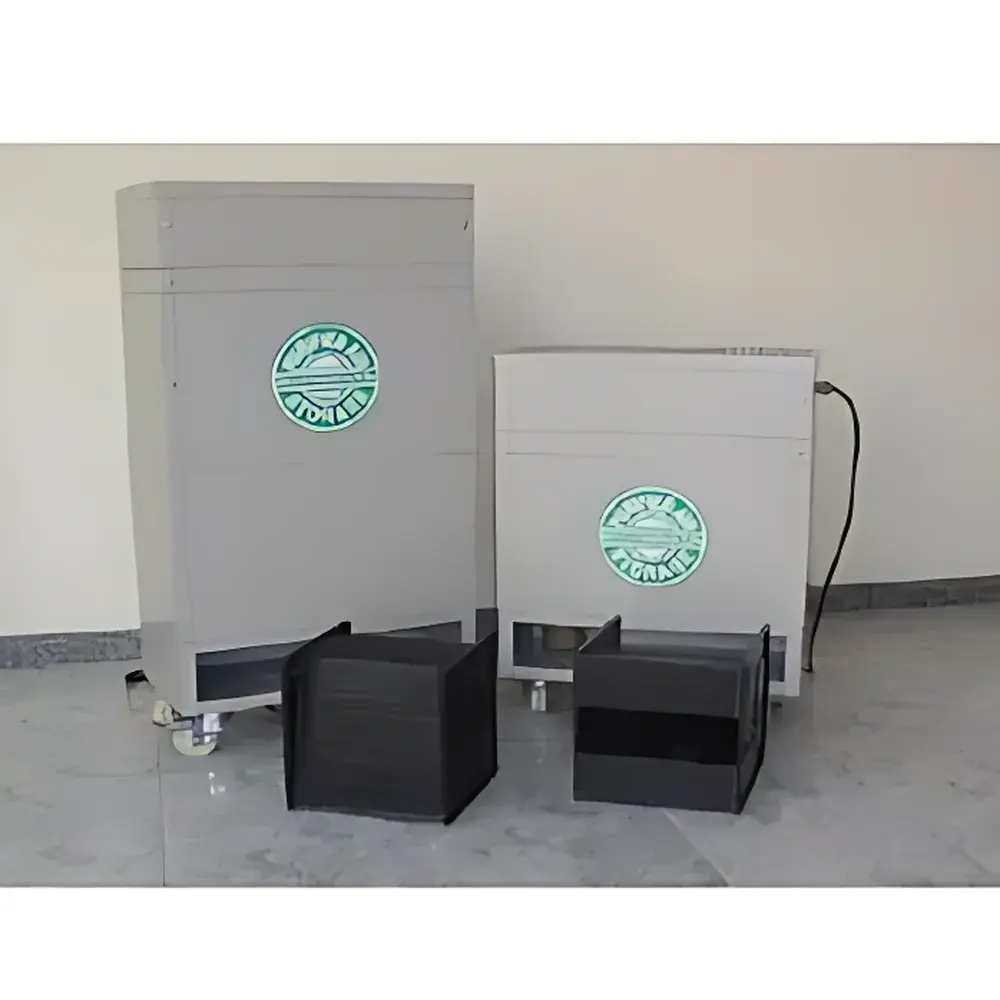
BION ETH-850 Ethylene Scrubber for Controlled Atmosphere Storage
| Brand | BION |
|---|---|
| Origin | Spain |
| Model | ETH-850 |
| Airflow | 850 m³/h |
| Power | 124 W (ETH V850/1) or 248 W (ETH V850/2) |
| Dimensions (W×D×H) | 326 mm × 133 mm × 850 mm |
| Weight | 12–24 kg |
| Filter Type | PP + KMnO₄-based BI-ON granules |
| Granule Capacity | 1.2–2.6 kg |
| Voltage | 230 V AC, 50/60 Hz |
| Certifications | CE, RoHS-compliant |
| Construction | Stainless steel housing (AISI 304) |
| Mounting Options | Wall-mounted or mobile trolley configuration |
| Operating Temperature Range | 0–25 °C |
| Relative Humidity Limit | ≤90% RH (non-condensing) |
Overview
The BION ETH-850 Ethylene Scrubber is an engineered air purification system designed specifically for controlled atmosphere (CA) storage environments in the fresh produce supply chain. It operates on the principle of catalytic oxidative adsorption—using potassium permanganate (KMnO₄)-impregnated BI-ON granules to irreversibly oxidize ethylene (C₂H₄) into ethylene glycol and manganese dioxide, thereby eliminating this endogenous plant hormone at source. Unlike passive filtration or ozone-based systems, the ETH-850 delivers continuous, chemical-free removal without generating secondary volatile compounds or altering O₂/CO₂ balance. Its stainless-steel construction, low-power consumption, and modular airflow design make it suitable for integration into cold rooms, ripening chambers, distribution hubs, and retail backrooms where maintaining postharvest quality—firmness, color stability, shelf life, and microbial safety—is operationally critical.
Key Features
- High-efficiency ethylene removal: Achieves >90% C₂H₄ reduction within standard CA storage conditions (0–10 ppm initial concentration), validated per ISO 11337:2021 guidelines for postharvest gas analysis.
- BI-ON granular media: Single-use, food-grade KMnO₄ composite with inert polypropylene support; certified non-residual, non-leaching, and compliant with EU Regulation (EC) No 1935/2004 for materials in contact with organic produce.
- Dual configuration options: ETH V850/1 (124 W, 850 m³/h, 12 kg unit) and ETH V850/2 (248 W, 850 m³/h, 24 kg unit) accommodate varying room volumes and air exchange requirements.
- Robust mechanical architecture: AISI 304 stainless steel chassis ensures corrosion resistance in high-humidity refrigerated environments; IP54-rated enclosure protects internal components from condensation and particulate ingress.
- Flexible deployment: Supports wall-mounting for space-constrained facilities or mobile trolley integration for multi-room rotation—ideal for shared logistics centers serving multiple retailers.
- Energy-efficient operation: Optimized axial fan design meets IEC 60034-30-1 IE3 efficiency class; average power draw remains stable across ambient temperatures from 0 °C to 25 °C.
Sample Compatibility & Compliance
The ETH-850 is validated for use with climacteric fruits (e.g., apples, pears, tomatoes, bananas, avocados) and vegetables (e.g., broccoli, leafy greens, cucumbers) stored under standard CA protocols (2–5% O₂, 1–5% CO₂, 0–2 °C). BI-ON granules are classified as “processing aid” under FDA 21 CFR §170.3(o)(24) and do not require premarket approval for indirect food contact. The system conforms to EN 12102-1:2017 (refrigerated equipment safety), EN 60335-1:2012+A11:2014 (household and similar electrical appliances), and carries CE marking for EMC and LVD directives. Documentation includes full traceability of granule batch certificates, material safety data sheets (MSDS), and factory calibration records—all available for GLP/GMP audit readiness.
Software & Data Management
The ETH-850 operates as a standalone hardware unit without embedded firmware or cloud connectivity. However, its timed cycling logic (1h-on/1h-off, 2h-on/2h-off, 4h-on/4h-off) is programmable via external industrial timers compatible with DIN-rail mounting. Users may integrate runtime logs with existing facility SCADA or CMMS platforms using dry-contact relay outputs (NO/NC, 250 V AC/5 A max). For validation purposes, BION provides a standardized test protocol—including recommended ethylene challenge gas concentrations (1–10 ppm), sampling intervals (T₀, T₁₅, T₃₀, T₆₀), and GC-FID verification methodology aligned with ASTM D5198-20. All operational parameters are documented in accordance with ISO/IEC 17025:2017 clause 7.7 for measurement traceability.
Applications
- Retail cold chain: Extends display-life of pre-packed produce in supermarket backrooms by suppressing senescence-related softening and yellowing.
- Distribution centers: Mitigates cross-contamination of ethylene between mixed-load shipments (e.g., apples stored adjacent to lettuce).
- Export quarantine compliance: Supports phytosanitary requirements for ethylene-sensitive commodities entering markets with strict CA import regulations (e.g., Japan MAFF, South Korea MFDS).
- Organic certification maintenance: Enables ethylene control without synthetic inhibitors (e.g., 1-MCP), preserving organic status per USDA NOP §205.605(a)(11) and EU Reg. (EU) 2018/848 Annex II.
- Research applications: Used in postharvest physiology labs to isolate ethylene effects on respiration rate, antioxidant enzyme activity, and cell wall hydrolase expression.
FAQ
How often must BI-ON granules be replaced?
Granule service life depends on ambient ethylene load and runtime. Under typical CA storage (≤5 ppm C₂H₄, 16 h/day operation), 1.2 kg of BI-ON lasts ~4–6 weeks. Replacement is indicated when effluent ethylene exceeds 0.2 ppm (measured via portable photoacoustic sensor).
Can the ETH-850 be used in nitrogen-flushed packaging environments?
Yes—the unit contains no oxygen-dependent components and functions effectively in low-O₂ (<1%) atmospheres. It does not consume O₂ or generate CO₂, preserving modified atmosphere integrity.
Is third-party validation data available for performance claims?
BION provides application reports from independent trials conducted at IFERC (Italy), Agri-Food and Biosciences Institute (UK), and the Fresh Produce Association of the Americas (FPAA) Technical Working Group—available under NDA upon request.
Does the system require annual recalibration?
No. As a passive adsorption device with no sensors or feedback loops, the ETH-850 has no calibration requirement. Performance verification is conducted via external ethylene monitoring per user-defined SOPs.
What safety certifications apply to the stainless-steel housing?
The AISI 304 enclosure complies with EN 10088-1:2014 for corrosion resistance and EN 10027-1:2017 for material designation; weld integrity is verified per ISO 5817-B level.



