
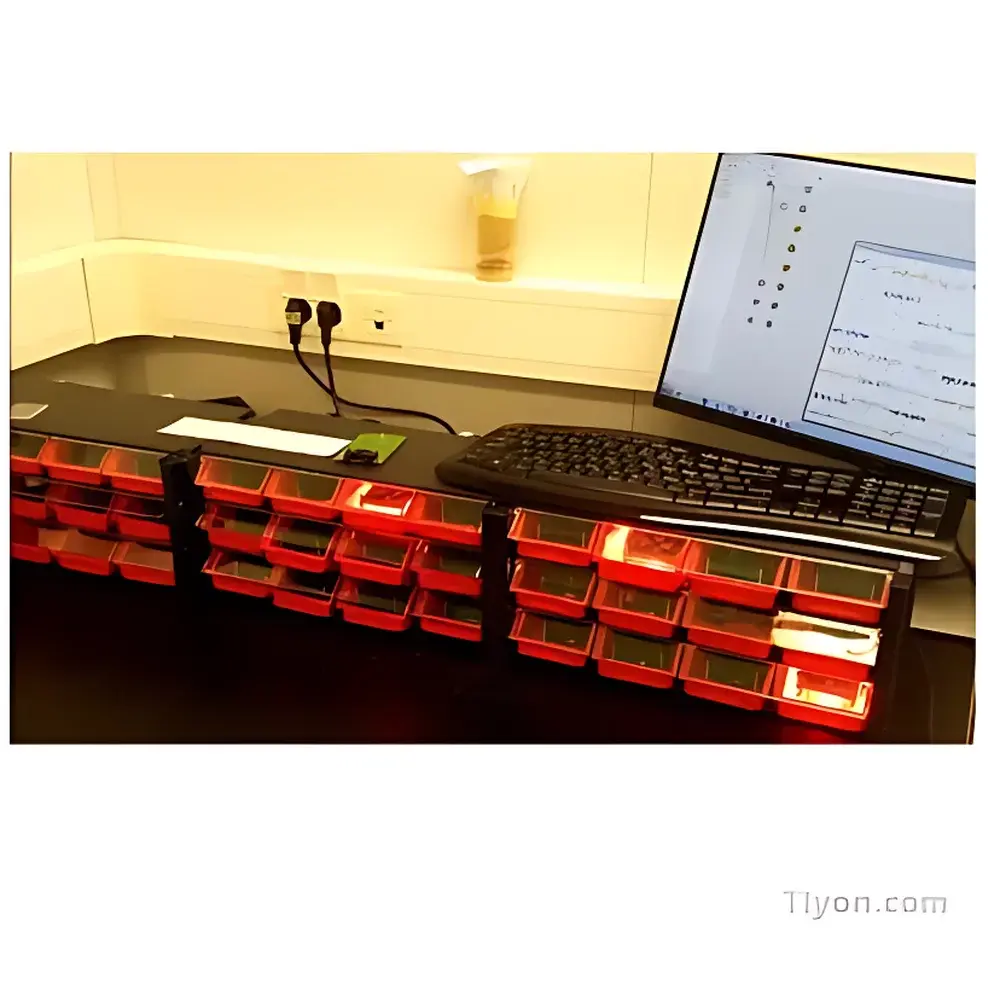
optoPAD Drosophila Feeding Behavior Monitoring System
| Origin | Imported |
|---|---|
| Manufacturer Type | Authorized Distributor |
| Model | optoPAD |
| Price Range | USD 14,000 – 70,000 |
Overview
The optoPAD Drosophila Feeding Behavior Monitoring System is a closed-loop, optogenetics-integrated platform engineered for precise spatiotemporal control and real-time quantification of feeding behavior in Drosophila melanogaster. Unlike conventional behavioral assays that rely on post-hoc analysis or static sensory stimulation, optoPAD operates on a capacitive touch-sensing architecture—derived from the validated flyPAD platform—and synchronizes neural perturbation with behavioral detection at millisecond resolution. Its core principle leverages the intrinsic electrical property of insect proboscis contact: when a fly touches liquid or semi-solid food placed on a conductive substrate, minute capacitance shifts are detected across up to 64 independent channels. These signals are timestamped and immediately routed to trigger customizable light pulses (e.g., 532 nm green or 470 nm blue) via integrated LED arrays, enabling conditional optogenetic activation or silencing of genetically targeted neurons *only* upon feeding initiation. This closed-loop design eliminates temporal ambiguity between stimulus delivery and behavioral engagement—a critical limitation in open-loop paradigms—and ensures that neural manipulation occurs exclusively during active ingestion, thereby isolating causal neural-behavioral relationships with high internal validity.
Key Features
- 64-channel high-resolution capacitive sensing array supporting parallel monitoring of up to 40 flies per assay plate
- Real-time, sub-10-ms latency feedback loop integrating feeding detection with programmable LED illumination (405–635 nm range, adjustable intensity and pulse width)
- Fully automated data acquisition and event annotation: each proboscis contact, duration, frequency, and inter-contact interval is logged with microsecond precision
- Modular hardware architecture compatible with standard Drosophila behavioral chambers (e.g., 96-well plates, custom arenas) and common optogenetic driver lines (e.g., UAS-ChR2, UAS-GtACR1, UAS-NpHR)
- Open-source firmware and Python-based control interface enabling protocol customization, integration with third-party electrophysiology or imaging systems, and compliance-ready audit trails
Sample Compatibility & Compliance
The optoPAD system is validated for use with adult Drosophila melanogaster (both sexes), including wild-type (Canton-S, w1118) and transgenic strains expressing light-sensitive opsins under tissue-specific promoters (e.g., Gr5a-GAL4 for sweet-sensing neurons; Gr66a-GAL4 for bitter-sensing neurons; R48B04-GAL4 for central jump circuitry). It supports aqueous, sucrose-, yeast-, or agar-based food formulations without signal interference. All hardware components comply with IEC 61000-6-3 (EMC emission standards) and IEC 62471 (photobiological safety for LED sources). Data acquisition workflows support GLP-compliant metadata tagging, time-stamped operator logs, and export formats compatible with FDA 21 CFR Part 11–aligned LIMS environments when deployed with validated software configurations.
Software & Data Management
The optoPAD Control Suite provides a cross-platform (Windows/macOS/Linux) GUI for experiment configuration, live monitoring, and offline analysis. Raw capacitance traces and LED trigger timestamps are stored in HDF5 format with embedded schema definitions (NIEM-compliant), ensuring long-term data integrity and interoperability. Built-in analysis modules compute feeding microstructure metrics—including bout initiation rate, mean bout duration, total intake volume (calibrated via conductivity-to-volume conversion), and pause ratio—and generate publication-ready plots (matplotlib/Plotly backends). Export options include CSV, MATLAB .mat, and FAIR-aligned JSON-LD metadata packages. The software architecture supports optional integration with FlyBase ID mapping, Janelia GAL4 expression databases, and automated synchronization with synchronized calcium imaging (e.g., GCaMP) or electrophysiological recordings.
Applications
- Causal dissection of gustatory circuit function: e.g., testing necessity/sufficiency of specific neuron populations in taste valence assignment or satiety signaling
- Studying decision-making dynamics under competing motivational states (hunger vs. aversion) with temporally resolved neural intervention
- Quantifying neurodegenerative or metabolic disease phenotypes (e.g., Parkinson’s models, insulin-signaling mutants) through feeding microstructure biomarkers
- Validating pharmacological agents targeting feeding-related neuromodulators (e.g., dopamine, serotonin, neuropeptide F) with behaviorally gated dosing logic
- High-throughput screening of genetic or RNAi-mediated perturbations affecting sensorimotor integration during consummatory behavior
FAQ
How does optoPAD differ from standard flyPAD?
optoPAD extends flyPAD’s capacitive feeding detection with real-time, behavior-triggered optogenetic stimulation—enabling closed-loop experiments where light delivery is contingent on proboscis contact, not pre-programmed timing.
Can optoPAD be used with non-Drosophila species?
While optimized for D. melanogaster, the system’s sensitivity and spatial resolution have been empirically validated for Aedes aegypti larvae and Tribolium castaneum adults; adaptation for other small arthropods requires calibration of capacitance thresholds and LED coupling geometry.
Is source code and hardware schematics available?
Yes—optoPAD firmware (Arduino/C++), PCB design files (KiCad), and control software are released under BSD-3-Clause license via GitHub and the associated publication’s supplementary repository.
What level of technical expertise is required for setup?
Basic molecular genetics and Drosophila husbandry experience is sufficient; full operational training (including calibration, strain validation, and troubleshooting) is provided with system deployment.
Does optoPAD support long-term chronic experiments?
Yes—hardware includes temperature- and humidity-stabilized arena enclosures, and software supports multi-day continuous recording with automatic file rotation, disk usage monitoring, and power-failure recovery protocols.




