
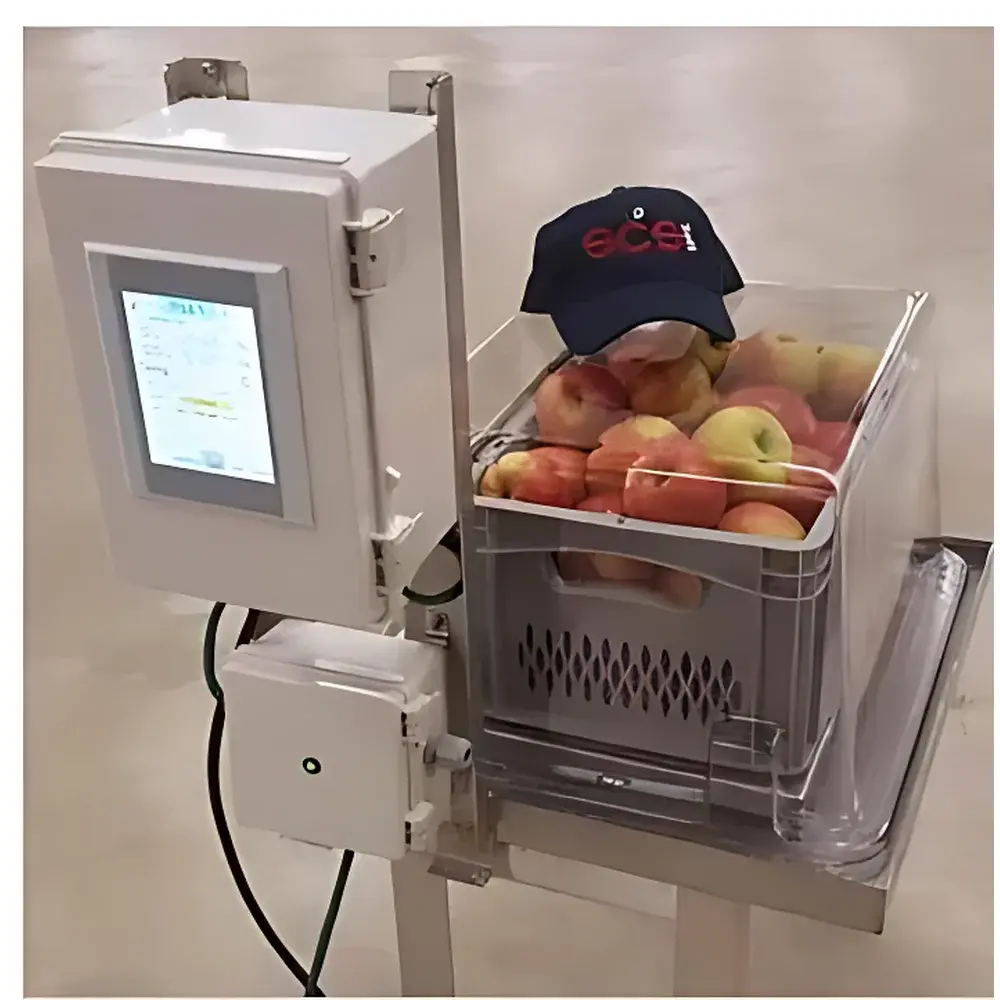
SCS LabPod Mini Controlled Atmosphere Postharvest Monitoring System
| Brand | SCS |
|---|---|
| Origin | United Kingdom |
| Manufacturer Type | Authorized Distributor |
| Origin Category | Imported |
| Model | LabPod Mini |
| Price Range | USD 27,000 – 68,000 (FOB UK) |
| Capacity | 10 kg (22 lb) per unit |
| Gas Sensors | Electrochemical O₂ and NDIR CO₂, ±0.1% FS accuracy |
| Temperature Range | 0–30 °C, ±0.2 °C control stability |
| Control Valves | Solenoid-driven, N₂ / ambient air / CO₂ selective supply |
| Data Logging | Internal SD card + Ethernet/USB export to CSV/Excel |
| System Scalability | 1–32 units per central touchscreen panel |
| Compliance | Designed for ISO 8583, ASTM D4710, and EN 13697-compliant postharvest protocol execution |
| Software | LabPod Control Suite v3.2 with audit trail, user-level access control, and FDA 21 CFR Part 11–ready optional module |
Overview
The SCS LabPod Mini Controlled Atmosphere Postharvest Monitoring System is an engineered platform for precise, real-time quantification of respiratory physiology in horticultural commodities under dynamically regulated gas environments. Based on the principle of closed-system respirometry, it measures oxygen consumption and carbon dioxide evolution rates—enabling calculation of respiratory quotient (RQ = CO₂/O₂) and metabolic activity trends over time. Unlike static CA chambers, the LabPod Mini implements active gas modulation via proportional solenoid valves, allowing programmable transitions between target atmospheres (e.g., 1.5% O₂ / 5% CO₂ → 3% O₂ / 2% CO₂) while maintaining thermal stability within ±0.2 °C. Its water-sealed, stainless-steel–based enclosure ensures leak integrity (<0.5 mL/min at 1 kPa differential), critical for low-flow respiration kinetics where minute gas fluxes must be resolved without background drift.
Key Features
- Modular, self-contained monitoring units: Each LabPod Mini operates as an independent CA micro-chamber with integrated electrochemical O₂ and non-dispersive infrared (NDIR) CO₂ sensors calibrated traceably to NIST standards.
- Dynamic atmosphere regulation: Onboard microprocessor controls sequential injection of nitrogen, ambient air, and CO₂ to achieve and sustain user-defined gas setpoints—without external gas mixing manifolds or manual intervention.
- Automated respiration analytics: Scheduled gas sampling cycles (configurable from 15 min to 24 h intervals) trigger high-resolution analysis; RQ and respiration rate (µL CO₂·g⁻¹·h⁻¹, µL O₂·g⁻¹·h⁻¹) are computed in real time and logged with timestamped metadata.
- Low-power environmental homogenization: A 1.2 W axial fan circulates headspace gas at <0.1 m/s velocity—sufficient to eliminate stratification without inducing mechanical stress or moisture loss in delicate produce.
- Scalable architecture: Central touchscreen panel supports up to 32 LabPod Minis concurrently; mixed deployments with standard LabPod units are fully interoperable under unified firmware control.
- FDA 21 CFR Part 11–ready software option: Includes electronic signatures, role-based permissions, and immutable audit trails for GLP/GMP-aligned validation studies.
Sample Compatibility & Compliance
The LabPod Mini accommodates whole fruits (e.g., apples, pears, kiwifruit), vegetables (e.g., broccoli, lettuce, sweet peppers), and cut produce within its 10 kg capacity chamber (305 × 406 mm footprint). Its inert stainless-steel base and food-grade acrylic lid meet EC 1935/2004 requirements for indirect food contact. The system supports test protocols aligned with ISO 8583 (sensory evaluation environments), ASTM D4710 (respiratory heat generation in perishables), and EN 13697 (chemical disinfectant efficacy testing under modified atmospheres). All sensor calibrations are documented per ISO/IEC 17025, and factory certificates include uncertainty budgets referenced to primary gas standards.
Software & Data Management
LabPod Control Suite v3.2 provides a browser-accessible interface for remote configuration, real-time dashboarding, and retrospective analysis. Raw sensor outputs (O₂ %, CO₂ %, °C), derived metrics (RQ, respiration rate), and actuator status (valve open/close duration, fan duty cycle) are stored locally on industrial-grade SD cards with 12-month retention at 1-min resolution. Export formats include CSV, Excel (.xlsx), and XML for integration into LIMS or statistical platforms (e.g., JMP, R, Python pandas). Data integrity safeguards include cyclic redundancy checks (CRC32), write-protection locks, and configurable auto-backup to network shares via SMB/CIFS.
Applications
- Validation of 1-MCP (1-methylcyclopropene) treatment efficacy across cultivars and storage durations.
- Optimization of CA parameters for new cultivars during pre-commercial shelf-life trials.
- Quantifying energy metabolism shifts during chilling injury or senescence onset.
- Comparative assessment of packaging film permeability under dynamic O₂/CO₂ gradients.
- Supporting regulatory submissions requiring respiration-derived stability data (e.g., USDA APHIS phytosanitary certification, EFSA novel food dossiers).
- Academic research in plant physiology, postharvest biochemistry, and controlled-environment agriculture modeling.
FAQ
Can the LabPod Mini operate unattended for extended periods?**
Yes—fully autonomous operation is supported for up to 30 days with uninterrupted power and local data logging; remote monitoring via Ethernet or optional cellular gateway enables off-site oversight.
Is calibration traceable to international standards?**
All O₂ and CO₂ sensors ship with NIST-traceable calibration certificates; field recalibration kits (certified gas standards) are available through SCS UK service centers.
How is temperature uniformity maintained inside the chamber?**
A Peltier-cooled aluminum thermal mass beneath the stainless-steel base provides conductive stabilization; combined with low-velocity airflow, it achieves ±0.2 °C spatial uniformity across the 10 kg sample volume.
Does the system comply with Good Laboratory Practice (GLP) requirements?**
With the optional 21 CFR Part 11 module enabled, the LabPod Mini meets core GLP criteria—including user authentication, change control logs, and electronic record retention—for contract research organizations and regulatory testing labs.
Can I integrate LabPod Mini data with my existing LIMS?**
Yes—CSV/Excel exports are structured for direct ingestion; RESTful API access (available under enterprise license) permits programmatic queries and automated report generation.







