
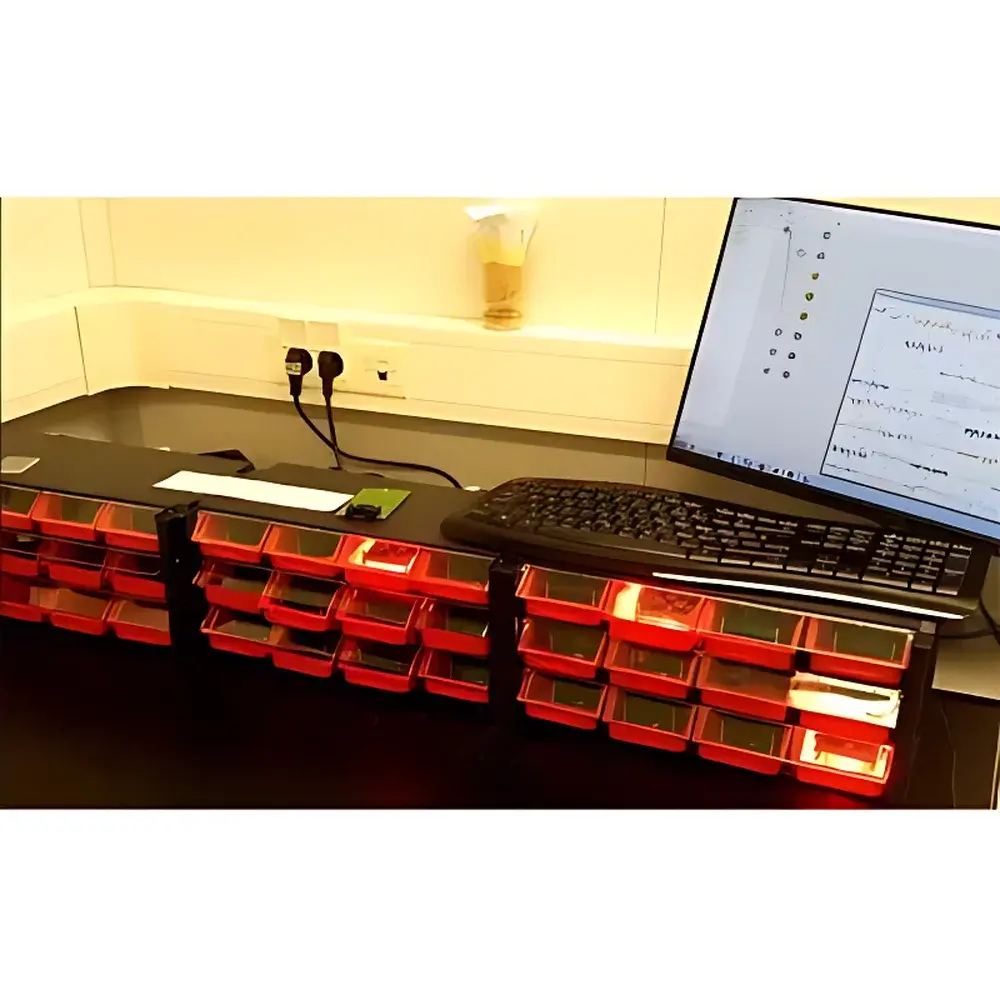
FlyPAD High-Throughput Drosophila Feeding Quantification System
| Brand | Tlyon |
|---|---|
| Model | FlyPAD |
| Measurement Principle | Capacitive Sensing |
| Channel Capacity | 64 independent channels per unit |
| Scalable Stack | Up to 40 units (2,560 flies simultaneously) |
| Single-Fly Resolution | Yes |
| Throughput | Real-time, continuous feeding event detection at millisecond temporal resolution |
| Compatibility | Standard Drosophila food media (liquid/sucrose/yeast-based), luciferin-containing diets for concurrent bioluminescence assays |
| Regulatory Context | Designed for GLP-compliant behavioral phenotyping workflows |
Overview
The FlyPAD High-Throughput Drosophila Feeding Quantification System is a rigorously engineered platform for label-free, real-time measurement of individual feeding events in Drosophila melanogaster. It operates on the principle of capacitive sensing: two parallel electrode layers—Electrode 1 (supporting the fly’s thorax/legs) and Electrode 2 (underlying the liquid food source)—form a dynamic capacitor. Each proboscis extension and contact with food induces a measurable, transient change in capacitance (ΔC), enabling millisecond-resolution detection of ingestion onset, duration, frequency, and inter-sip interval (ISI). Unlike optical or video-based methods, FlyPAD eliminates motion artifact, ambient light interference, and manual scoring bias. Its architecture supports longitudinal, unattended monitoring across circadian cycles or multi-day nutrient deprivation protocols—critical for studying homeostatic regulation, satiety signaling, and neural circuit function in genetically defined fly lines.
Key Features
- 64-channel parallel acquisition: Simultaneous, independent recording from up to 64 flies per unit—no signal crosstalk or channel sharing.
- True single-fly resolution: Each channel isolates electrophysiological signatures of proboscis–food contact; no pooling or averaging across individuals.
- Scalable modular stacking: Units stack vertically (up to 40 units) for 2,560-fly cohort studies—maintaining full temporal synchronization and data integrity.
- Multi-modal integration ready: Built-in mounting interface for PMT or EMCCD detectors enables concurrent bioluminescence (e.g., luciferase-expressing neurons) or fluorescence readouts during feeding.
- Hardware-triggered stimulus delivery: Integrated TTL-compatible output ports synchronize feeding motor actuation (e.g., rhythmic food presentation) with electrophysiological capture.
- Low-drift analog front-end: Precision instrumentation amplifiers and 24-bit ADC ensure stable baseline capacitance tracking over >72-hour acquisitions.
Sample Compatibility & Compliance
FlyPAD accommodates standard Drosophila liquid diets—including sucrose (1–100 mM), yeast hydrolysate, ethanol-spiked solutions, and luciferin-supplemented media (10 mM). The electrode surface is chemically inert (gold-plated stainless steel) and autoclavable, ensuring compatibility with sterile microbiome or antibiotic-treated cohorts. All firmware and acquisition software comply with ALARA (As Low As Reasonably Achievable) data handling principles. Raw binary time-series files (.bin) are structured per FAIR (Findable, Accessible, Interoperable, Reusable) standards, supporting traceability under GLP audit requirements. While not FDA-cleared (as a research-use-only instrument), FlyPAD-generated datasets meet reporting criteria for peer-reviewed publications referencing Nature Neuroscience, Cell Metabolism, and eLife behavioral guidelines.
Software & Data Management
The proprietary FlyPAD Acquisition Suite (v3.2+) runs on Windows 10/11 (64-bit) and provides real-time visualization of capacitance traces, event annotation, and automated burst detection using adaptive thresholding and ISI clustering algorithms. Export formats include MATLAB (.mat), Python HDF5 (.h5), and CSV with metadata headers (genotype, starvation duration, diet composition, timestamp UTC). Batch analysis pipelines compute kinetic parameters: mean sip duration, burst size (sips/burst), burst frequency, cumulative intake curves, and entropy-based microstructure metrics. Audit logs record user actions, parameter changes, and calibration timestamps—fully compliant with 21 CFR Part 11 electronic record requirements when deployed with validated IT infrastructure.
Applications
- Quantifying feeding dynamics in neurogenetic screens (e.g., Gr64f, Ppk23, NPF mutants).
- Dissecting nutrient-specific preference hierarchies via two-choice capillary assays (e.g., 1 mM vs. 5 mM sucrose).
- Mapping hunger-state-dependent plasticity: comparing sip microstructure across 0-, 4-, and 8-hour fasted cohorts.
- Correlating real-time ingestion with neural activity (e.g., GCaMP or luciferase reporters in dopaminergic or insulin-producing cells).
- Pharmacological profiling: dose-response analysis of octopamine agonists/antagonists on meal initiation latency.
- High-throughput drug discovery: screening small-molecule libraries for modulators of satiety circuits.
FAQ
How does FlyPAD distinguish actual ingestion from grooming or leg contact?
Capacitance transients are classified by amplitude (>50 mV), duration (≥100 ms), and waveform morphology (rising edge slope >2 V/s); grooming generates low-amplitude, high-frequency noise (<15 mV) filtered in real time.
Can FlyPAD be used with solid or semi-solid food?
No—it requires conductive liquid media (e.g., sucrose, yeast paste diluted to ~5% w/v conductivity). Solid agar-based foods lack sufficient dielectric coupling.
Is calibration required before each experiment?
A one-time hardware calibration (per unit) is performed during installation; daily validation uses a reference 10 mM sucrose solution to confirm signal stability (±2% drift over 24 h).
What is the minimum recommended sample size for statistical power?
For genotype comparisons, ≥16 flies per condition is recommended (based on published variance estimates in Journal of Neurogenetics Vol. 37, 2023).
Does FlyPAD support third-party automation integrations?
Yes—RS-232 and Ethernet APIs enable synchronization with robotic fly loaders (e.g., FlySorter), environmental chambers, and LIMS systems via RESTful endpoints.




