
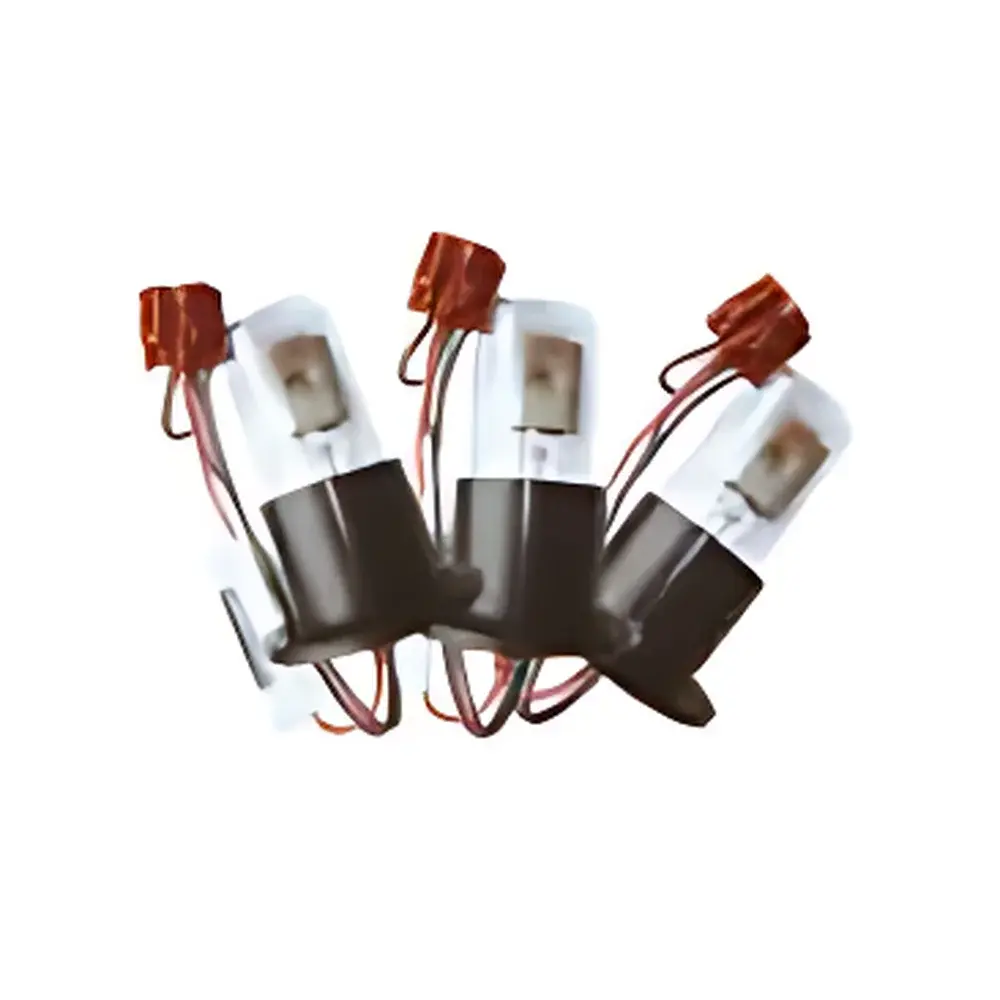
Tritium Lamp Series
| Brand | ZHONGKEHUIFEN |
|---|---|
| Origin | Beijing, China |
| Manufacturer Type | Authorized Distributor |
| Model Series | Tritium Lamp Series |
| Pricing | Available Upon Request |
Overview
The Tritium Lamp Series is a family of sealed, low-intensity ultraviolet (UV) light sources designed for wavelength calibration and baseline stability verification in UV-Vis and HPLC-UV detection systems. Unlike deuterium or xenon arc lamps, tritium-based excitation sources operate via beta decay-induced phosphor luminescence—emitting a stable, narrow-band spectral output centered at approximately 365 nm (±5 nm), with secondary peaks near 436 nm and 546 nm. This intrinsic radioluminescent mechanism eliminates the need for electrical power input, thermal stabilization, or warm-up time, making the series particularly suited for reference-grade calibration in chromatographic detectors, spectrophotometers, and optical alignment tools where long-term drift minimization and operational simplicity are critical.
Key Features
- Radioluminescent emission: No external power supply, no heat generation, zero electromagnetic interference (EMI)
- Stable spectral output over >10-year operational lifetime (typical half-life of tritium: 12.32 years)
- Hermetically sealed borosilicate glass envelope with integrated phosphor coating (ZnS:Ag or similar)
- Uniform spatial intensity distribution optimized for optical path integration in flow cells and detector slits
- Compliant with IEC 61010-1 for safety in laboratory equipment; fully encapsulated to prevent tritium leakage under normal handling conditions
- Available in standardized mounting configurations (e.g., SMA905, FC/PC, and custom OEM flanges) for direct integration into UV absorbance detectors
Sample Compatibility & Compliance
The Tritium Lamp Series is not a sample-contacting device and requires no consumables or reagents. It serves exclusively as a passive, non-invasive optical reference source. Units conform to national and international regulatory frameworks governing radioactive materials in analytical instrumentation: GB 18871–2002 (China’s Basic Standards for Radiation Protection), IAEA Safety Standards Series No. SSG-29, and EU Directive 2013/59/Euratom. Each lamp is individually certified with activity ≤ 1.85 GBq (50 mCi), well below the exemption threshold defined in IAEA RS-G-1.9. Documentation includes full traceable calibration certificates (NIST-traceable spectral centroid verification), radiation safety data sheets (RSDS), and transport compliance per ADR/RID Class 7 packaging specifications.
Software & Data Management
As a hardware-only calibration standard, the Tritium Lamp Series does not interface with software or require driver installation. However, it is routinely employed in instrument qualification protocols governed by 21 CFR Part 11-compliant chromatography data systems (CDS) such as Thermo Chromeleon, Agilent OpenLab CDS, and Waters Empower. Its use is documented within system suitability test (SST) records—including wavelength accuracy verification per USP , EP 2.2.25, and JP 2.05—and supports GLP/GMP audit trails when logged alongside detector performance reports. Laboratories may integrate lamp verification events into preventive maintenance schedules using configurable calendar-based alerts in validated CDS environments.
Applications
- Wavelength accuracy validation of UV-Vis diode array detectors (DAD) and variable-wavelength detectors (VWD) in HPLC and UHPLC systems
- Baseline noise assessment and photometric linearity verification across extended run times
- Inter-instrument comparability studies during method transfer between laboratories
- Reference source for optical alignment of monochromators, grating positions, and beam splitters
- Supporting ISO/IEC 17025 accreditation requirements for measurement uncertainty estimation in UV absorbance quantification
- Calibration anchor for portable spectrometers used in field-deployable QC labs
FAQ
Is special licensing required to purchase or operate these tritium lamps?
Yes—end users must hold a valid radioactive material license issued by their national regulatory authority (e.g., NRC in the U.S., CNSC in Canada, or MEE in China). ZHONGKEHUIFEN provides full technical documentation to support license applications.
Can the lamp be used continuously without degradation?
Output intensity decays predictably per tritium half-life (12.32 years); typical usable service life exceeds 8–10 years at ≥90% initial intensity. No sudden failure modes occur.
How is spectral output verified prior to shipment?
Each unit undergoes spectral centroid measurement using a calibrated CCD-based spectroradiometer traceable to NIM (National Institute of Metrology, China), with certificate of conformance included.
Are replacement lamps supplied with updated calibration data?
Yes—every replacement lamp ships with a unique serial-numbered calibration report reflecting its measured peak wavelength and integrated irradiance at 365 nm.
What safety precautions apply during disposal?
End-of-life units must be returned to authorized radioactive waste handlers or ZHONGKEHUIFEN’s take-back program in accordance with local regulations; landfill disposal is strictly prohibited.
Related Products





