
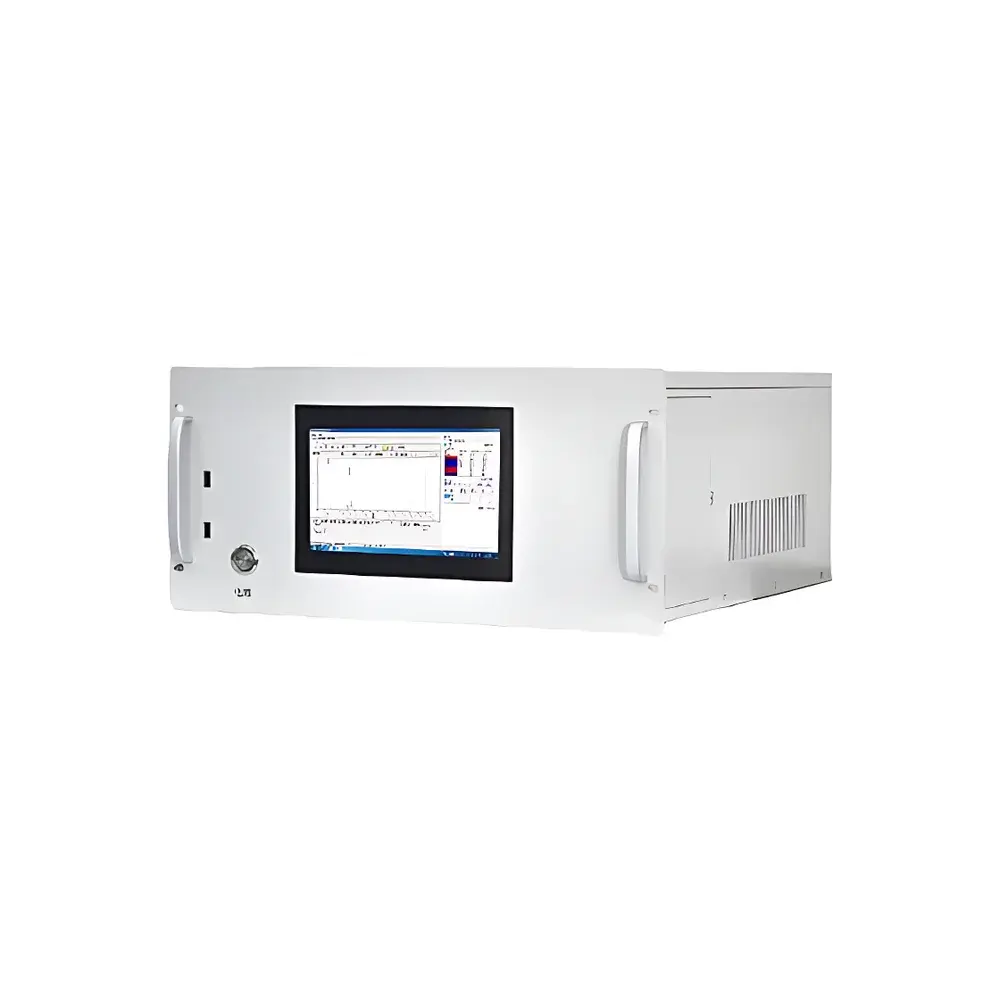
ZHONGKEHUIFEN NBGC-60 Online VOCs Gas Chromatograph
| Brand | ZHONGKEHUIFEN |
|---|---|
| Origin | Beijing, China |
| Model | NBGC-60 |
| Instrument Type | Laboratory GC for Online VOC Monitoring |
| Temperature Control Range | Ambient + 3°C to 450°C |
| Oven Ramp Rate | 0.1–40°C/min |
| Cool-down Time | ~8 min (450°C → 50°C) |
| Carrier Gas Flow Range & Control | 0–1200 mL/min |
| Carrier Gas Pressure Range & Control | 0–970 kPa |
| Injector Max Temp | 450°C |
| Injector Pressure Setting Range | 0–970 kPa |
| Injector Total Flow Setting Range | 0–1200 mL/min |
| Detection | FID with auto-ignition and 10⁷ linear dynamic range |
| EPC Precision | ±0.01 psi |
| Temp Control Accuracy | ±0.1°C |
| LOD | Methane ≤0.1 ppm, NMHC ≤0.05 ppm, Benzene ≤0.1 ppm |
| Measurement Cycle | <2 min (NMHC), <5 min (NMHC + BTEX) |
| Repeatability (RSD) | ≤3% |
| Measurement Range | NMHC 0–10/100/1000/10000 ppm |
| Output Interfaces | RS485 (standard), optional RS232 / 4–20 mA / RJ45 Ethernet |
| Power | 220 VAC ±5%, 50/60 Hz |
| Max Power Consumption | 900 W |
| Avg | ~150 W |
| Dimensions | 19″ rack-mount, 5U or 6U |
Overview
The ZHONGKEHUIFEN NBGC-60 Online VOCs Gas Chromatograph is a dedicated laboratory-grade gas chromatographic system engineered for continuous, unattended monitoring of volatile organic compounds (VOCs) in ambient air, stack emissions, and industrial boundary environments. It operates on the principle of capillary gas chromatography coupled with flame ionization detection (GC-FID), incorporating center-cutting and back-flush techniques to achieve selective separation and quantification of methane, non-methane hydrocarbons (NMHC), and aromatic compounds—including benzene, toluene, ethylbenzene, and xylenes (BTEX)—in compliance with Chinese environmental standard HJ/T 38–1999. The system features a thermally stabilized oven capable of precise temperature programming from ambient +3°C to 450°C, enabling rapid thermal desorption, sharp peak resolution, and minimal carryover (<60 s at 180°C). Its architecture supports long-term operational stability in fixed-site installations, with integrated safety protocols including gas-loss shutdown, power-failure recovery, and real-time fault diagnostics.
Key Features
- Center-cut and back-flush configuration optimized for NMHC and BTEX speciation per HJ/T 38–1999, eliminating co-elution interference and reducing analysis cycle time
- FID detector with automated ignition sequence and extended linear dynamic range (10⁷), ensuring accurate quantification across low-ppm and high-ppm concentration levels
- Electronic Pressure Control (EPC) modules for carrier gas (N₂ or He), hydrogen, and air—delivering pressure regulation precision of ±0.01 psi and flow reproducibility better than ±0.5% RSD
- Robust thermal management: oven ramp rates adjustable from 0.1 to 40°C/min; cool-down from 450°C to 50°C completed in approximately 8 minutes
- Self-diagnostic startup routine, real-time leak detection, and configurable alarm thresholds for pressure, temperature, and signal integrity
- Rack-mountable 19″ chassis (5U or 6U), designed for integration into centralized environmental monitoring stations or distributed industrial emission networks
Sample Compatibility & Compliance
The NBGC-60 accepts gaseous samples directly via heated sampling lines (up to 180°C), supporting both ambient air (via active sampling or diffusion inlet) and ducted industrial effluents. It is validated for NMHC and benzene measurement with demonstrated limits of detection (LOD) of ≤0.05 ppm and ≤0.1 ppm, respectively, and measurement repeatability (RSD) ≤3% under controlled calibration conditions. The instrument meets functional requirements aligned with ISO 8573-1 (compressed air purity), ASTM D6348 (gaseous VOC analysis by GC-FID), and US EPA Method 25A equivalents for total hydrocarbon quantification. While not certified under FDA 21 CFR Part 11 or EU Annex 11 out-of-the-box, its data logging architecture supports audit-trail-ready configurations when deployed with compliant third-party SCADA or LIMS interfaces.
Software & Data Management
The NBGC-60 operates with embedded firmware supporting scheduled run sequences, method parameter storage, and real-time chromatogram visualization via local display or remote terminal. Raw analog/digital signals are digitized at ≥10 kHz sampling rate and timestamped with millisecond precision. Standard RS485 Modbus RTU output enables seamless integration with PLCs, DCS systems, or cloud-based environmental dashboards. Optional communication modules provide RS232 serial, isolated 4–20 mA analog outputs (for NMHC or benzene channels), and TCP/IP Ethernet (RJ45) for HTTP/JSON or MQTT-based telemetry. All calibration events, maintenance logs, and alarm records are stored internally with cyclic overwrite protection and exportable CSV functionality—supporting GLP-aligned record retention practices.
Applications
- Continuous ambient air quality monitoring at urban background stations, roadside sites, and industrial park perimeters
- Stack emission compliance testing for petrochemical refineries, coating application facilities (automotive, aerospace), and flexographic printing operations
- Process off-gas characterization in pharmaceutical synthesis, fine chemical manufacturing, and composite material production
- Research-grade VOC profiling in atmospheric chemistry laboratories, particularly for NMHC/BTEX source apportionment studies
- Mobile monitoring platforms where compact 19″ form factor and low average power draw (~150 W) enable battery-backed or solar-assisted deployment
FAQ
Does the NBGC-60 support fully automated unattended operation for 7×24 monitoring?
Yes—it includes programmable start/stop cycles, auto-calibration triggers, and fail-safe recovery after power interruption or carrier gas depletion.
What column configuration is used for simultaneous NMHC and BTEX analysis?
A dual-column setup is employed: a PLOT Al₂O₃/KCl capillary column for C₁–C₆ hydrocarbons and a DB-624 or equivalent mid-polarity column for aromatic separation, with valve switching governed by center-cut/back-flush timing logic.
Is the system compatible with external calibration gas standards?
Yes—integrated multi-point calibration capability supports certified gas mixtures (e.g., CH₄/NMHC in air, benzene in nitrogen) with user-defined span concentrations and frequency.
Can raw chromatographic data be exported for third-party processing?
Yes—peak tables, baseline-subtracted chromatograms, and metadata (retention times, integration parameters, detector response) are exportable in ASCII and CSV formats via USB or network interface.
What maintenance intervals are recommended for sustained accuracy?
FID jet cleaning and detector alignment every 3 months; column bake-out weekly; EPC filter replacement every 6 months; full system performance verification annually per ISO/IEC 17025 guidelines.



