
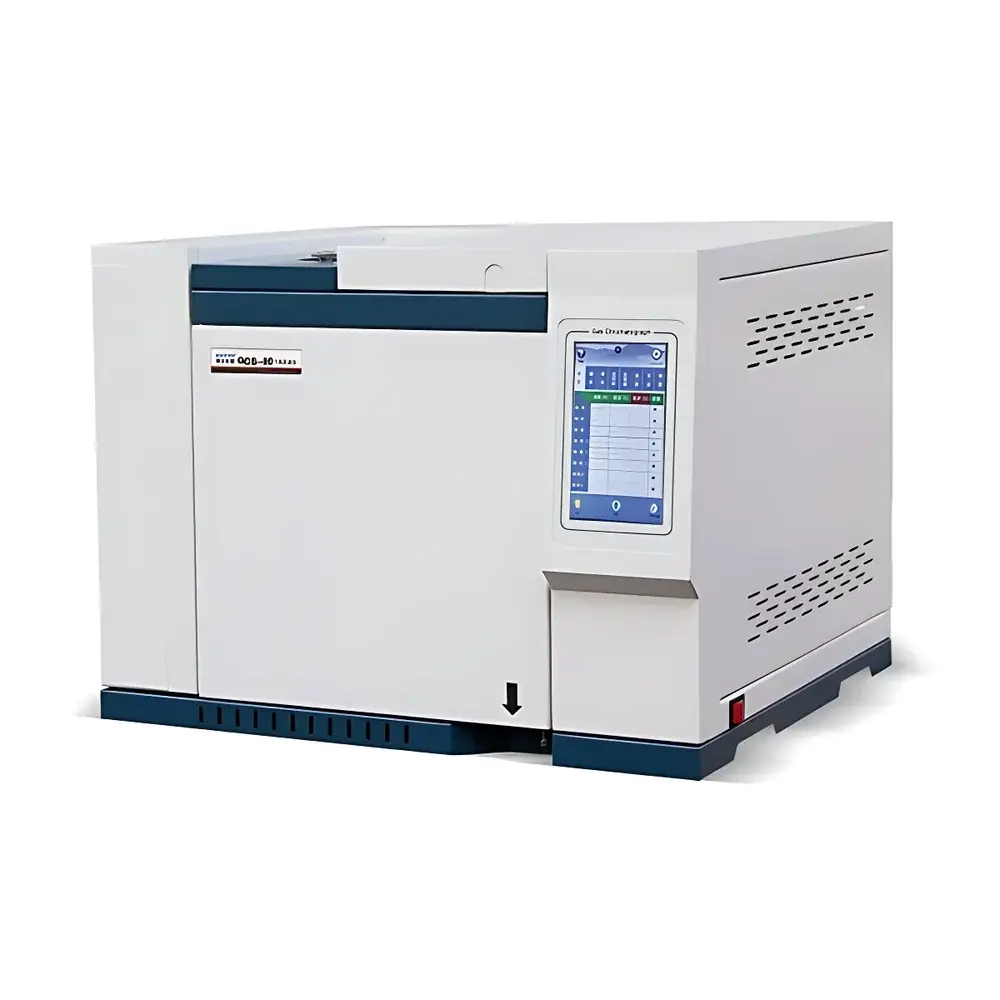
Zhongkehuifen GCS-90 Laboratory Micro-Sulfur Analyzer
| Brand | Zhongkehuifen |
|---|---|
| Origin | Shandong, China |
| Model | GCS-90 |
| Instrument Type | Laboratory Gas Chromatograph |
| Application Field | Petroleum & Petrochemical Industry |
| Temperature Control Range | Ambient +5°C to 450°C |
| Max. Ramp Rate | 80°C/min |
| Cooling Rate | 450°C to 50°C in <5 min |
| Carrier Gas Flow Range & Control | 0–1000 mL/min, control resolution 0.01 mL/min |
| Carrier Gas Pressure Range & Control | 0–100 psi, control resolution 0.001 psi |
| Injector Max. Operating Temperature | 450°C |
| Injector Pressure Setting Range | 0–100 psi |
| Injector Total Flow Setting Range | 0–1000 mL/min |
| Detector | Flame Photometric Detector (FPD) |
| Sulfur LOD (COS) | 0.02 ppm |
| Dynamic Range | 10³ |
| Power Supply | 220 V, 50 Hz |
| Ambient Operating Conditions | 15–35°C, 5–95% RH |
| Temperature Setpoint Accuracy | ±0.01°C |
| Max. Programmable Temperature Steps | 16 (expandable) |
| Column Configuration | Multi-valve, multi-column, center-cutting GC architecture |
| Data Interface | 10/100M adaptive Ethernet with embedded TCP/IP stack |
| Display | 7-inch resistive touchscreen LCD (bilingual UI: English/Chinese) |
| Software | Dedicated sulfur-species workstation supporting up to 253 GC units, Modbus RTU server for DCS integration |
| Fluidic Path | All-PEEK flow path with passivated surfaces and zero-dead-volume fittings |
Overview
The Zhongkehuifen GCS-90 Laboratory Micro-Sulfur Analyzer is a dedicated gas chromatographic system engineered for trace-level sulfur speciation in gaseous and liquid hydrocarbon matrices. It integrates flame photometric detection (FPD) — a well-established, element-selective technique based on chemiluminescent emission from excited sulfur monoxide (SO*) radicals formed during post-column combustion — with high-resolution capillary column separation. Unlike generic GC-FPD configurations, the GCS-90 employs a purpose-built fluidic architecture optimized for sulfur compound integrity: all-wetted surfaces are constructed from passivated PEEK, and zero-dead-volume fittings minimize adsorptive losses of reactive species such as H₂S, COS, mercaptans, sulfides, disulfides, and CS₂. This design directly addresses a critical challenge in sulfur analysis—adsorption-induced bias—and ensures quantitative recovery across the full volatility and polarity range of sulfur-containing analytes. The instrument supports both offline batch analysis and online coupling with catalytic reactors via standardized pneumatic interfaces, enabling real-time monitoring of sulfur breakthrough, catalyst deactivation kinetics, and reaction selectivity in R&D environments.
Key Features
- Passivated all-PEEK flow path with zero-dead-volume connections to suppress surface adsorption of labile sulfur compounds
- Multi-valve, multi-column configuration with center-cutting capability for simultaneous separation and detection of >12 sulfur species in a single injection
- High-precision temperature control: oven ramp rate up to 80°C/min, cooling from 450°C to 50°C in under 5 minutes, setpoint accuracy ±0.01°C
- Advanced carrier gas management: dual independent control of pressure (0–100 psi, 0.001 psi resolution) and total flow (0–1000 mL/min, 0.01 mL/min resolution)
- 7-inch resistive touchscreen display with bilingual (English/Chinese) graphical user interface and local instrument control
- Embedded 10/100M Ethernet interface with full TCP/IP stack for remote operation, data streaming, and integration into laboratory networks
- Modbus RTU server built into the sulfur-specific workstation, enabling seamless data export to DCS or SCADA systems without third-party gateways
Sample Compatibility & Compliance
The GCS-90 accommodates direct injection of permanent gases (e.g., refinery off-gas, syngas), liquefied petroleum gas (LPG), naphtha, diesel fractions, and aqueous extracts. Sample introduction supports split/splitless, cold-on-column, and gas-tight syringe modes. Its FPD complies with ASTM D5292 (sulfur in gasoline by GC-FPD), ISO 20846 (petroleum products — determination of sulfur content — GC-FPD method), and aligns with USP and ICH Q3D elemental impurity screening requirements for sulfur-bearing residuals. While not pre-certified for 21 CFR Part 11, the workstation supports audit-trail-enabled user authentication, electronic signatures, and version-controlled method storage — features configurable to meet GLP and internal GMP-aligned validation protocols.
Software & Data Management
The proprietary sulfur analysis workstation provides full instrument control, peak integration, calibration curve generation (linear, quadratic, or weighted), and speciated quantification using internal standard or external standard methods. It supports concurrent operation of up to 253 GC units on a single network segment, with centralized method deployment and result aggregation. Raw chromatograms and processed reports are stored in vendor-neutral formats (CSV, CDF, PDF). The integrated Modbus RTU server publishes real-time concentration values, retention times, and status flags (e.g., detector gain, column head pressure, valve position) over RS-485, facilitating automated process feedback loops in pilot-scale reactor studies. Data backups and firmware updates are managed via secure HTTP(S) endpoints.
Applications
- Catalyst evaluation: measurement of H₂S/COS breakthrough profiles during hydrodesulfurization (HDS) testing
- Fuel quality assurance: quantification of total sulfur and individual sulfur species in gasoline, jet fuel, and marine distillates per ISO 20846 and ASTM D7039
- Process gas monitoring: real-time analysis of Claus tail gas, amine stripper overheads, and sour water stripper effluents
- Environmental research: speciation of volatile organic sulfur compounds (VOSCs) in biogas and landfill emissions
- Pharmaceutical excipient screening: detection of residual sulfur contaminants in solvents and active pharmaceutical ingredients (APIs)
FAQ
What sulfur compounds can the GCS-90 reliably quantify?
The system is validated for H₂S, COS, CS₂, methanethiol, ethanethiol, dimethyl sulfide, diethyl sulfide, methyl ethyl sulfide, dimethyl disulfide, and diethyl disulfide — with method-specific calibration ranges spanning 0.02 ppm to 10,000 ppm.
Is the instrument compatible with ASTM D5292 or ISO 20846?
Yes — its thermal programming, column selection, and FPD operating parameters are aligned with the instrumental requirements of both standards; full compliance requires lab-specific method validation per ISO/IEC 17025.
Can the GCS-90 operate unattended for extended periods?
It supports automated sequence runs with up to 16 temperature program steps, programmable valve switching, and event-triggered actions (e.g., auto-shutdown on pressure loss); continuous operation beyond 72 hours is feasible with scheduled maintenance intervals.
Does the workstation support LIMS integration?
Yes — via CSV export, ODBC-compliant database connectors, and RESTful API endpoints for result ingestion into laboratory information management systems.
What maintenance is required for sustained FPD performance?
Routine maintenance includes weekly hydrogen/air flow verification, quarterly quartz jet cleaning, biannual PM of the photomultiplier tube alignment and dark-current calibration, and annual replacement of the optical filter and combustion chamber liner.




