
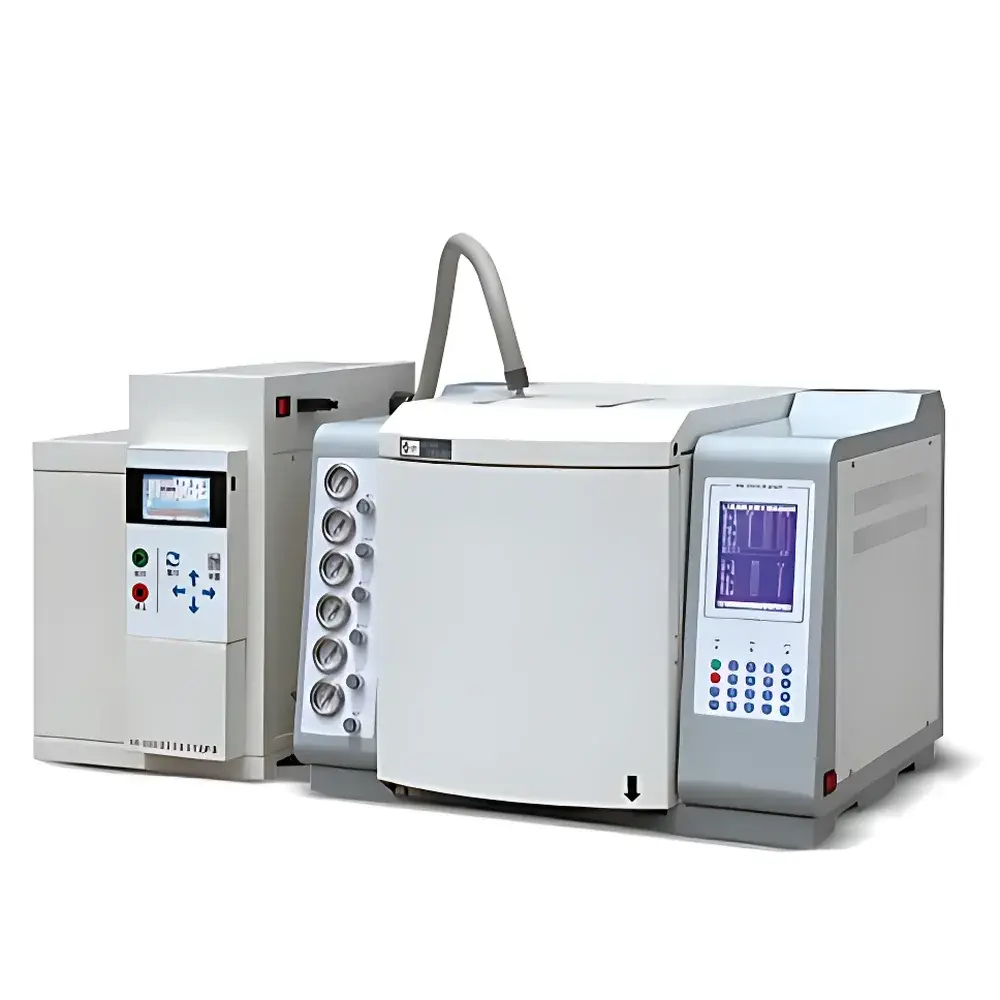
Zhongkehuifen GC-7820 Dedicated Water Quality Gas Chromatograph
| Brand | Zhongkehuifen |
|---|---|
| Origin | Beijing, China |
| Manufacturer Type | Authorized Distributor |
| Country of Origin | China |
| Model | GC-7820 Dedicated Water Quality Gas Chromatograph |
| Instrument Type | Laboratory-Based Water Quality Analyzer |
| Operating Display | 192×64 Dot-Matrix LCD with Chinese/English Interface |
| Temperature Control Range | Ambient +3 °C to 450 °C (0.1 °C increment, ±0.1 °C accuracy) |
| Programmable Temperature Ramp | 16-stage, 0.1–40 °C/min |
| Detector Options | FID, TCD, ECD, FPD, NPD |
| ECD Detection Limit | ≤1×10⁻¹⁴ g/mL (γ-HCH) |
| FID Detection Limit | <2×10⁻¹² g/s (n-hexadecane) |
| Linearity | >10⁴ (ECD), >10⁷ (FID) |
| Column Oven Dimensions | 300×280×180 mm |
| External Surface Temperature at 300 °C Operation | ≤40 °C |
| Communication Interface | Ethernet (IEEE 802.3) |
| Dimensions (W×D×H) | 660×560×480 mm |
Overview
The Zhongkehuifen GC-7820 Dedicated Water Quality Gas Chromatograph is a laboratory-grade analytical system engineered for precise, reproducible quantification of volatile and semi-volatile organic compounds (VOCs/SVOCs) in aqueous environmental matrices. Based on gas chromatography coupled with selective detection—primarily electron capture detection (ECD) for halogenated hydrocarbons—the instrument implements core principles of partition equilibrium (e.g., headspace analysis) and chromatographic separation under controlled thermal and flow dynamics. Its design complies with internationally recognized methodologies for water quality testing, including EPA Method 502.2, ISO 10301, and ASTM D5845, enabling regulatory-grade compliance for monitoring trihalomethanes (THMs), haloacetic acids (HAAs), chlorinated solvents, and other priority pollutants in drinking water, wastewater, and surface water samples.
Key Features
- Integrated Ethernet connectivity supporting remote instrument control, real-time status monitoring, firmware updates, and secure data transmission over LAN/WAN environments.
- Microprocessor-based digital temperature control with ±0.1 °C stability across the oven, injector, and detector zones—critical for retention time reproducibility and quantitative accuracy.
- Dual-column compensation architecture minimizes baseline drift during programmed temperature ramping and suppresses background noise, enhancing signal-to-noise ratio and lowering method detection limits (MDLs).
- Modular, tool-free maintenance design: single-hand replacement of septa, liners, jets, and detector components; full detector or inlet module removal with one wrench.
- Expandable detection capability: simultaneous installation of two independent detectors (e.g., ECD + FID) and dual inlet systems (split/splitless capillary + packed column), supporting multi-analyte workflows without hardware reconfiguration.
- Electronic Pressure Control (EPC) and Air Flow Control (AFC) ensure precise, digitally set carrier gas pressure and flow rates—automatically calculated from user-entered column dimensions—and enable leak diagnostics, automatic gas source switching, and audible/visual fault alerts.
- Intelligent back-door airflow modulation reduces post-run equilibration time by up to 40%, accelerating sample throughput in high-volume laboratories.
Sample Compatibility & Compliance
The GC-7820 is validated for use with standard aqueous sample preparation techniques including static/dynamic headspace, purge-and-trap, and direct aqueous injection (with appropriate solvent venting). It supports analysis of regulated contaminants such as chloroform, carbon tetrachloride, bromodichloromethane, dibromochloromethane, and 1,2-dichloroethane per U.S. EPA, EU Drinking Water Directive (98/83/EC), and China’s GB 5749-2022 standards. The system meets GLP requirements for audit-ready operation, with optional software modules providing 21 CFR Part 11-compliant electronic signatures, audit trails, and data integrity safeguards. All mechanical and thermal specifications adhere to IEC 61010-1 safety standards for laboratory equipment.
Software & Data Management
The proprietary chromatography data system (CDS) provides unified control of acquisition, processing, reporting, and reprocessing functions through an intuitive graphical interface. Built-in self-diagnostic routines perform pre-run hardware checks—including detector filament continuity, valve sequencing, and EPC pressure validation—and display actionable error codes. Data files are stored in vendor-neutral formats (e.g., .cdf) compatible with third-party LIMS and statistical analysis platforms. Automated calibration curve generation includes linear/non-linear regression, forced-zero intercept options, and correlation coefficient validation (r ≥ 0.995 required). Audit logs record all user actions, parameter changes, and instrument events with timestamps and operator IDs.
Applications
- Regulatory monitoring of disinfection by-products (DBPs) in municipal drinking water supplies.
- Compliance testing for industrial effluent discharge permits (e.g., NPDES, GB 8978-1996).
- Groundwater contamination assessment at brownfield sites and landfill leachate plumes.
- Method development and validation for emerging contaminants including PFAS precursors and volatile nitrosamines.
- Quality assurance/quality control (QA/QC) in certified environmental testing laboratories accredited to ISO/IEC 17025.
FAQ
Is the GC-7820 compliant with U.S. EPA methods for drinking water analysis?
Yes—it is fully compatible with EPA Methods 502.2 (halogenated organics), 524.4 (purgeables), and 624 (VOCs), when configured with ECD/FID and appropriate headspace or purge-and-trap accessories.
Can the instrument be integrated into an existing LIMS environment?
Yes—via Ethernet-based API support and standardized data export (CSV, XML, .cdf), enabling bidirectional communication with major LIMS platforms including LabWare, STARLIMS, and Thermo Fisher SampleManager.
What maintenance intervals are recommended for routine operation?
Daily: leak check, baseline verification; Weekly: inlet liner cleaning, septum replacement; Quarterly: detector cleaning and EPC calibration; Annually: full system performance qualification (SPQ) per ASTM D3612.
Does the system support unattended overnight analysis?
Yes—the autosampler-ready configuration (optional) combined with power-fail recovery, auto-restart after interruption, and scheduled shutdown ensures robust 24/7 operation.
Is method transfer possible from other GC platforms?
Yes—retention time indexing, universal method templates, and column database integration simplify migration from Agilent, Shimadzu, or Thermo instruments while preserving chromatographic fidelity and quantitation accuracy.
Related Products







