
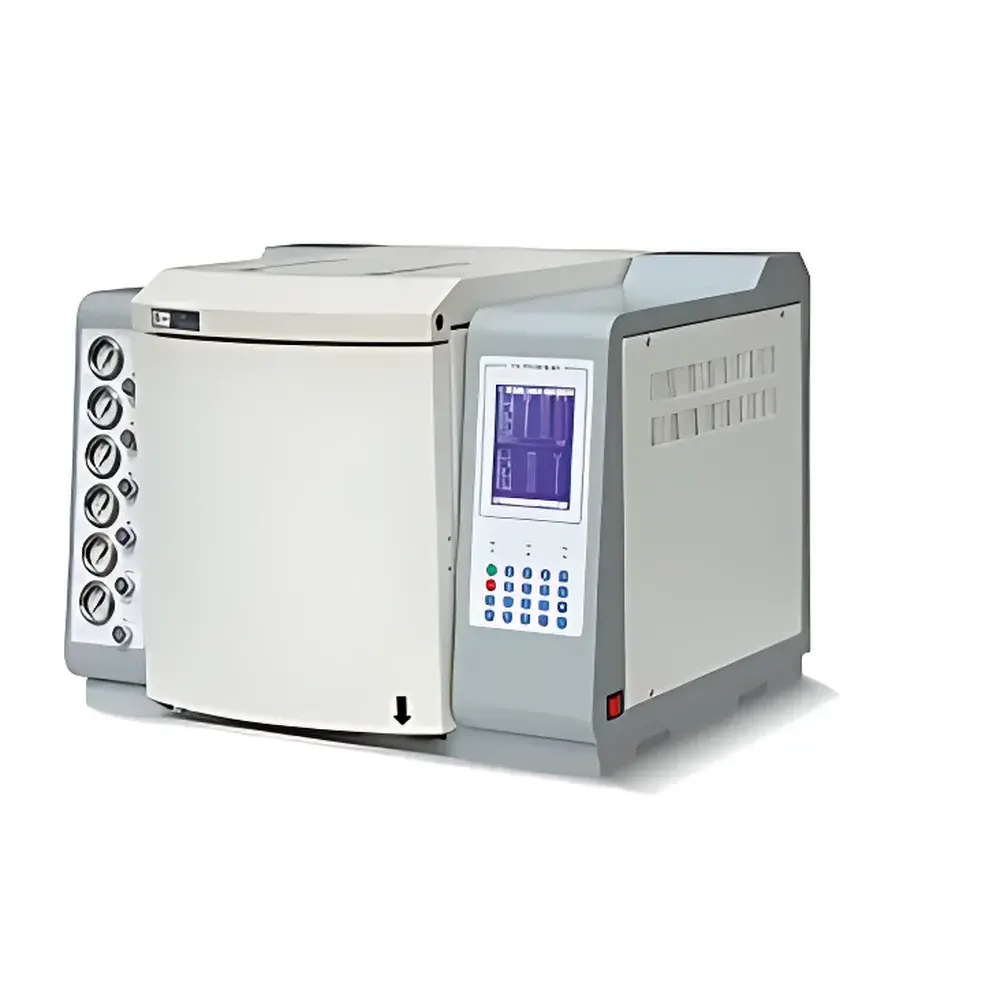
Zhongkehuifen GC-7820 Power Transformer Oil-Specific Gas Chromatograph
| Brand | Zhongkehuifen |
|---|---|
| Origin | Beijing, China |
| Instrument Type | Laboratory Gas Chromatograph |
| Application Field | Power Industry (Transformer Oil Dissolved Gas Analysis) |
| Temperature Control Range | Ambient + 3 °C to 450 °C |
| Oven Ramp Rate | 0.1–40 °C/min |
| Cooling Rate | ~8 min (450 °C → 50 °C) |
| Carrier Gas Flow Range & Control | 0–1200 mL/min |
| Carrier Gas Pressure Range & Control | 0–970 kPa |
| Injector Maximum Operating Temperature | 450 °C |
| Injector Pressure Setting Range | 0–970 kPa |
| Injector Total Flow Setting Range | 0–1200 mL/min |
| Detector | TCD (with automatic bridge current cutoff on carrier gas failure) |
| Column | Dedicated anti-fouling composite column for transformer oil analysis |
| Data Interface | Ethernet-enabled, remote control & diagnostics supported |
| Display | 5.7-inch LCD, bilingual (English/Chinese), 13-line interface |
| Self-Diagnostic System | Comprehensive power-on diagnostics, fault code display, power-loss parameter retention, keypad lock, and EMI suppression |
Overview
The Zhongkehuifen GC-7820 Power Transformer Oil-Specific Gas Chromatograph is a purpose-engineered laboratory gas chromatograph designed exclusively for dissolved gas analysis (DGA) in insulating mineral oils used in high-voltage power transformers. It operates on the principle of capillary or packed-column gas chromatography with thermal conductivity detection (TCD), optimized for the quantitative determination of key fault gases—hydrogen (H₂), methane (CH₄), ethane (C₂H₆), ethylene (C₂H₄), acetylene (C₂H₂), carbon monoxide (CO), and carbon dioxide (CO₂)—at sub-ppm (μL/L) concentration levels in oil matrices. The system complies with internationally recognized DGA standards including IEC 60567 (Guidelines for the sampling and analysis of gases dissolved in electrical oils) and ASTM D3612 (Standard Test Methods for Analysis of Gases Dissolved in Electrical Insulating Oil). Its integrated hardware architecture, robust temperature management, and oil-specific column chemistry ensure high reproducibility, long-term baseline stability, and resistance to hydrocarbon matrix fouling—critical attributes for routine compliance testing in utility laboratories and third-party calibration centers.
Key Features
- Engineered oven temperature control with ±0.1 °C precision across a range of ambient +3 °C to 450 °C, enabling precise method development for complex hydrocarbon separation.
- TCD detector with automatic bridge current cutoff upon carrier gas pressure loss or flow interruption—prevents thermal damage to the tungsten-rhenium filament under fault conditions.
- Dedicated anti-fouling composite chromatographic column, pre-conditioned and validated for transformer oil extracts; significantly extends column lifetime and reduces maintenance frequency compared to generic capillary columns.
- Full microprocessor-based control system with Ethernet connectivity, supporting remote instrument monitoring, firmware updates, and secure data transfer over LAN/WAN environments.
- 5.7-inch high-contrast LCD display with dual-language (English/Chinese) menu navigation and real-time parameter visualization—designed for intuitive operation by lab technicians with varying technical backgrounds.
- Comprehensive self-diagnostic suite: power-on system check, fault-code logging, non-volatile memory for method and calibration parameters during power interruption, and electromagnetic interference (EMI)-hardened circuitry for stable operation in electrically noisy substation environments.
Sample Compatibility & Compliance
The GC-7820 is validated for use with standard oil sampling protocols per IEC 60599 and ASTM D3612 Type C (headspace extraction). It accepts 1 mL oil samples subjected to controlled degassing via the included dedicated shaker unit, ensuring consistent headspace equilibration prior to gas injection. All fluidic pathways—including injector, column, and detector—are constructed from inert, passivated stainless steel to minimize adsorption of polar decomposition products. The system supports full audit trail functionality when paired with compliant chromatography data systems (CDS), meeting GLP documentation requirements and aligning with FDA 21 CFR Part 11 principles for electronic records and signatures where local regulatory frameworks apply. Routine performance verification follows ASTM D6299 (Standard Practice for Applying Statistical Quality Assurance) using certified reference gas mixtures traceable to NIST SRMs.
Software & Data Management
The bundled Power System Dedicated Workstation software provides turnkey DGA reporting compliant with IEEE C57.104 and IEC 60599 interpretation guidelines. It automates peak integration, calibration curve generation (linear and quadratic), gas concentration calculation using partition coefficients (Ki), and fault diagnosis via Duval Triangle, Rogers Ratios, and Doernenburg methods. Raw data files are stored in vendor-neutral formats (e.g., .cdf or .csv) and support export to LIMS platforms via ODBC or RESTful API integration. Audit trails record all user actions—including method edits, calibration events, and report approvals—with timestamps and operator IDs. Data integrity safeguards include write-protection of archived runs, role-based access control, and configurable retention policies aligned with ISO/IEC 17025 laboratory accreditation requirements.
Applications
- Routine dissolved gas analysis (DGA) for predictive maintenance of power transformers, reactors, and tap changers.
- Commissioning and acceptance testing of new or refurbished units per IEEE C57.12.90 and IEC 60076-3.
- Root cause analysis of thermal faults (>700 °C), partial discharge, and arcing events through C₂H₂/C₂H₄ and CH₄/H₂ ratio trending.
- Monitoring oil aging via CO/CO₂ evolution and oxidation byproduct profiling.
- Supporting forensic investigations following transformer failures or unexpected shutdowns.
- Calibration and proficiency testing in accredited electrical equipment testing laboratories.
FAQ
What detection limit can be achieved for acetylene (C₂H₂) in transformer oil?
Typical minimum detectable concentration is ≤0.5 μL/L under standard 1 mL headspace injection conditions, subject to column efficiency, detector sensitivity tuning, and sample preparation consistency.
Is the GC-7820 compatible with ASTM D3612 Type A (direct injection) methodology?
No—the instrument is configured and validated exclusively for Type C (headspace extraction); direct liquid injection is not supported due to its specialized injector design and column loading constraints.
Does the system meet cybersecurity requirements for network-connected lab instruments?
Yes—Ethernet communication supports configurable firewall rules, TLS-encrypted data transmission, and segregated VLAN deployment; firmware updates require authenticated digital signatures.
Can the instrument be operated without the dedicated workstation software?
Basic instrument control (oven temp, flow, detector settings) is possible via front-panel interface, but quantitative DGA reporting, diagnostic algorithms, and regulatory-compliant data archiving require the licensed workstation software.
What maintenance intervals are recommended for the TCD and column?
TCD filament inspection and baseline validation every 6 months; column reconditioning or replacement every 12–18 months depending on sample throughput and oil contamination level—documented in the provided Maintenance Log Template.





