
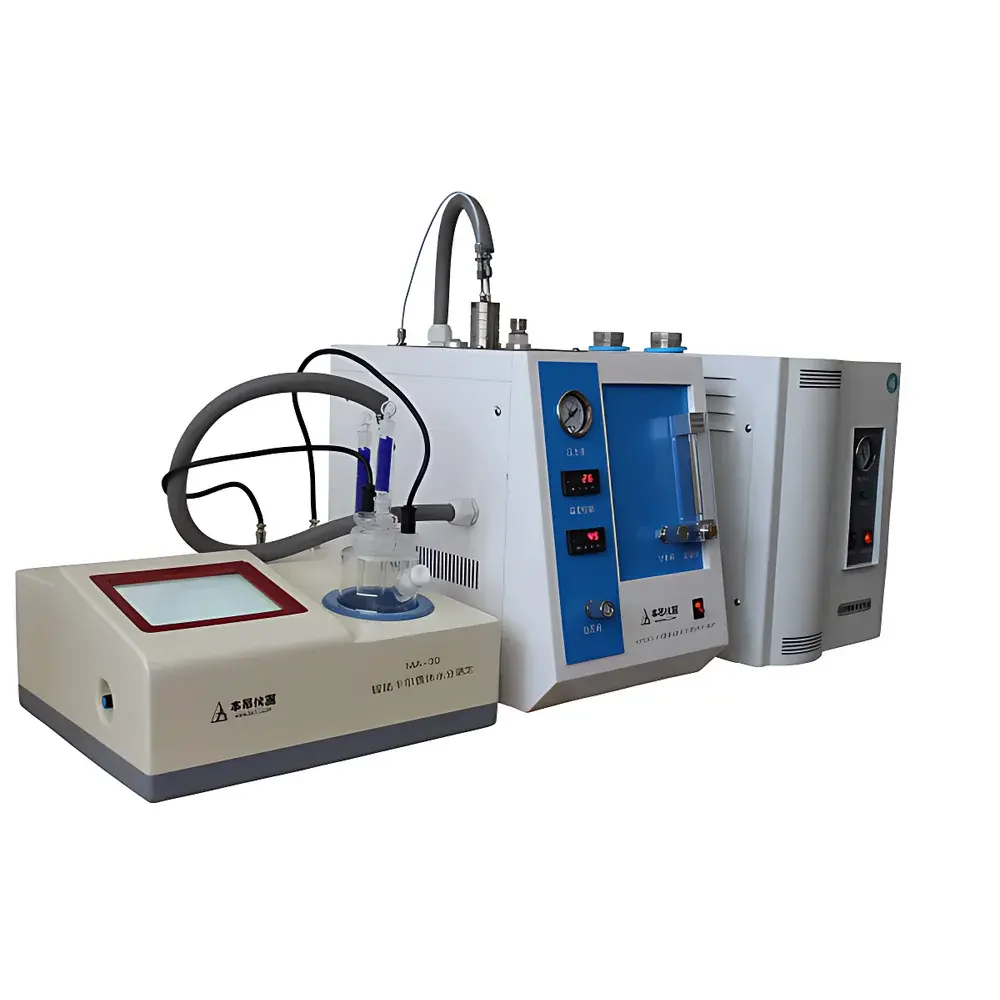
BenAng KFDO-11 Automated Karl Fischer Oven System
| Brand | BenAng |
|---|---|
| Origin | Shanghai, China |
| Manufacturer Type | Authorized Distributor |
| Country of Origin | China |
| Model | KFDO-11 |
| Price | USD 5,000 (FOB Shanghai) |
| Heating Capacity | 4 samples simultaneously |
| Sample Vial Volume | 20 mL |
| Oven Temperature Range | Ambient to 300 °C (1 °C increment) |
| Transfer Line Temperature Range | Ambient to 100 °C (1 °C increment) |
| Carrier Gas Flow Rate | 0–300 mL/min, continuously adjustable |
| Temperature Resolution | ±1 °C |
| Safety Features | Over-temperature & under-temperature cut-off with automatic power disconnection |
| Interface | Interchangeable inlet fitting compatible with major KF titrators (e.g., Mettler Toledo, Hanna, Metrohm, Thermo Fisher, and国产KF analyzers) |
Overview
The BenAng KFDO-11 Automated Karl Fischer Oven System is an integrated thermal sample preparation module engineered for precise, reproducible moisture determination in thermally labile or low-volatility solid and semi-solid materials. It operates on the principle of controlled pyrolytic release: samples are heated under inert carrier gas flow within a precisely regulated oven chamber, releasing bound water quantitatively into the vapor phase. The evolved moisture is swept via a temperature-controlled transfer line directly into a connected coulometric or volumetric Karl Fischer titrator for real-time quantification. Unlike conventional direct-injection KF methods—limited by solubility, reactivity, or electrode fouling—the KFDO-11 enables trace-level (<10 ppm) water analysis in challenging matrices including battery electrode materials, polymers, pharmaceutical excipients, medical sutures, and catalysts. Its design conforms to fundamental requirements of ASTM E203, ISO 15512, and USP , serving as a validated thermal extraction platform for GLP-compliant laboratories.
Key Features
- Four-position circular heating block with uniform radial thermal distribution—minimizes inter-position temperature deviation to ≤±1.5 °C at 200 °C, ensuring high inter-sample repeatability (RSD < 2.0% for replicate polymer standards).
- Electrically heated sample transfer line (ambient to 100 °C), independently controllable, prevents condensation of liberated water vapor during transit—critical for accurate quantitation of low-moisture samples (<500 ppm).
- Programmable purge-and-backflush sequence for the sampling needle and inlet tubing, eliminating carryover between analyses and extending system uptime without manual cleaning.
- Dual thermal safety logic: independent over-temperature shutdown (triggered at 310 °C) and under-temperature fault detection (alarm if setpoint deviates >5 °C for >30 s), both coupled to hardware-level power cutoff.
- Modular inlet interface with standardized Swagelok®-compatible ports and interchangeable adapters—enables seamless integration with Mettler Toledo V30S, Metrohm 852, Thermo Fisher Aquamax, and domestic KF titrators meeting ISO 8655-compliant dosing accuracy.
Sample Compatibility & Compliance
The KFDO-11 supports solid, granular, powder, and compressed pellet samples up to 20 mL vial capacity (standard 20 mL borosilicate glass vials with PTFE-lined caps). It is routinely deployed for compliance testing per GB/T 24533-2009 (graphitic anode materials for Li-ion batteries), SH/T 1770-2010 (polyethylene moisture content), YY 1116-2010 (absorbable surgical suture hydration), and ISO 15512 (plastics). All thermal protocols are fully documentable and support audit-ready reporting when paired with Part 11–compliant KF software (e.g., Mettler Toledo LabX or Metrohm TiBase). System calibration verification follows manufacturer-recommended procedures using certified reference materials (e.g., sodium tartrate dihydrate, water-in-oil standards).
Software & Data Management
While the KFDO-11 operates as a standalone hardware module, its temperature profiles, gas flow settings, and run timestamps are synchronized via RS-232 or USB-to-serial interface with host KF titrator software. Full traceability is maintained through time-stamped method files, electronic signatures (where supported by connected titrator firmware), and audit trails compliant with FDA 21 CFR Part 11 requirements. Raw oven parameters—including actual vs. setpoint temperature logs at 10-s intervals—are exportable in CSV format for QA review and long-term data archiving. No proprietary software installation is required; configuration is managed entirely through the titrator’s native interface.
Applications
- Lithium-ion battery R&D and QC: Quantification of residual moisture in cathode precursors (e.g., NMC, LFP), anode graphite, and separator films—critical for electrolyte stability and cell cycle life.
- Pharmaceutical manufacturing: Water content validation in lyophilized APIs, excipients (e.g., microcrystalline cellulose), and absorbable implantables per ICH Q5C and USP .
- Polymer processing: Moisture monitoring in engineering resins (PA6, PET, PC) prior to extrusion or injection molding to prevent hydrolytic degradation.
- Medical device testing: Hydration assessment of collagen-based hemostats, gelatin sponges, and synthetic absorbable sutures per YY/T 0606 series standards.
- Quality control in catalyst production: Detection of adsorbed water on alumina, silica, or zeolite supports affecting catalytic activity and selectivity.
FAQ
Is the KFDO-11 compatible with both coulometric and volumetric Karl Fischer titrators?
Yes—it delivers dry, condensed-water-free carrier gas streams suitable for either detection mode. Coulometric systems benefit from improved baseline stability; volumetric systems achieve enhanced endpoint sharpness.
What maintenance is required for the heated transfer line?
No routine disassembly is needed. Annual verification of heater continuity and insulation resistance (per IEC 61010-1) is recommended. Visual inspection for PTFE tube discoloration or cracking should be performed before each qualification cycle.
Can the oven temperature ramp rate be programmed?
No—the KFDO-11 provides static temperature setpoints only. For dynamic thermal profiling, external programmable controllers or third-party oven modules must be used.
Does the system include validation documentation?
A Factory Acceptance Test (FAT) report with as-tested temperature uniformity, flow calibration, and safety function verification is supplied. IQ/OQ protocols are available upon request for GMP environments.
What is the maximum allowable sample mass per vial?
Based on thermal mass and release kinetics, ≤1.0 g is recommended for homogeneous powders; ≤0.5 g for dense pellets or low-thermal-conductivity polymers to ensure complete water liberation within standard 10–15 min heating cycles.



