
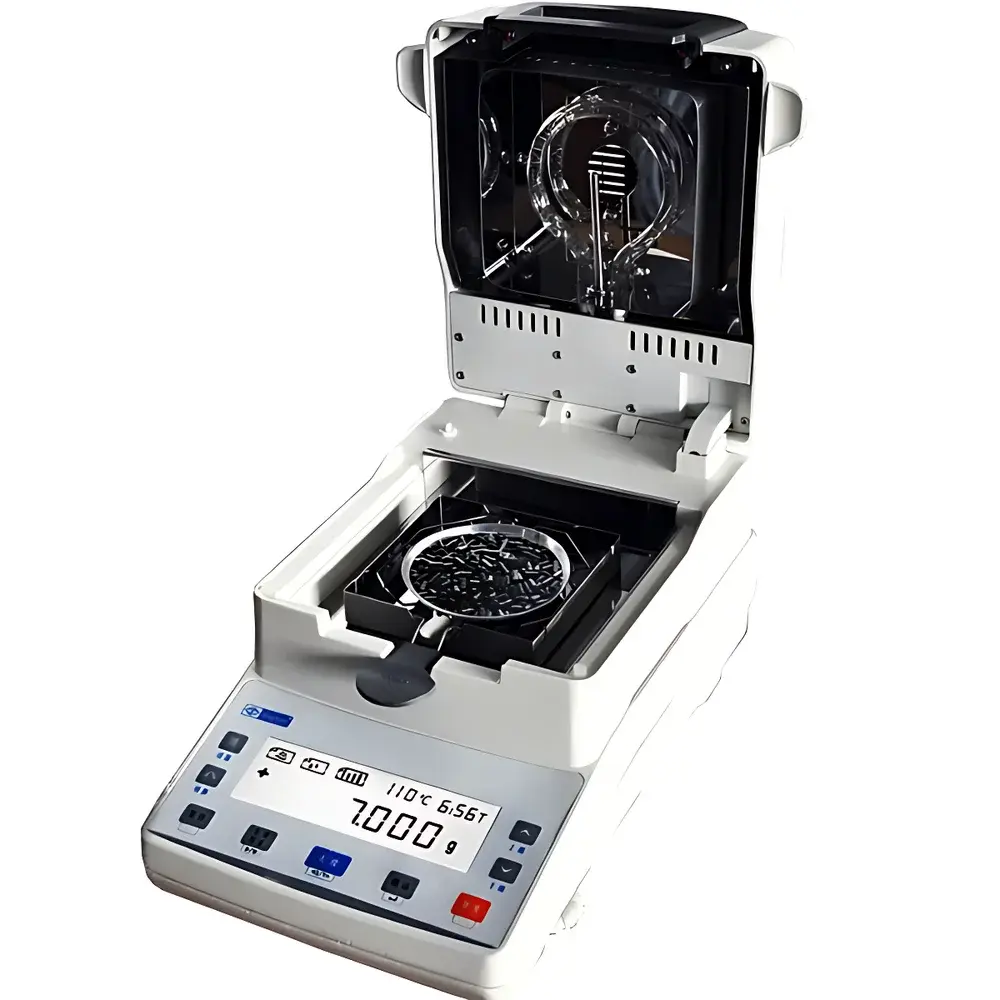
BenAng MA-8B Capacitance-Based Rapid Moisture Analyzer
| Brand | BenAng |
|---|---|
| Origin | Shanghai, China |
| Model | MA-8B |
| Maximum Capacity | 110 g |
| Readability | 5 mg |
| Pan Diameter | Φ90 mm |
| Heating Source | Halogen Lamp (Straight-Tube) |
| Temperature Range | 40–199 °C |
| Temperature Accuracy | ±1 °C |
| Moisture Content Range | 0.00–100.00 % |
| Moisture Resolution | 0.05 % |
| Data Storage | 15 Measurement Records |
| Calibration Standard Compatibility | Sodium Tartrate Dihydrate (Certified H₂O Content: 15.66 % ±0.1 %) |
| Operating Ambient | 5–35 °C |
Overview
The BenAng MA-8B Capacitance-Based Rapid Moisture Analyzer is a benchtop thermal gravimetric instrument engineered for precise, repeatable moisture content determination across solid and semi-solid samples in quality control, R&D, and production environments. Unlike traditional oven-drying methods requiring hours, the MA-8B employs a halogen heating system integrated with SRA (Secondary Radiation Assistance) technology — a proprietary radiant heat distribution architecture that ensures uniform thermal energy transfer across the sample surface. This design minimizes thermal gradients and accelerates drying kinetics without compromising measurement integrity. The instrument operates on the principle of loss-on-drying (LOD): real-time mass loss is continuously monitored via a high-stability strain-gauge load cell (SHS series), while an embedded PT-100 sensor provides closed-loop temperature feedback to maintain setpoint accuracy within ±1 °C. The result is a robust, ISO-compliant solution for rapid moisture quantification where speed, traceability, and operator safety are critical.
Key Features
- Halogen heating module with straight-tube lamp geometry and SRA reflector assembly — delivers rapid, homogeneous heating and reduces typical test duration by up to 60% versus conventional infrared or convection ovens.
- SHS-series strain-gauge weighing sensor with 5 mg readability and 110 g capacity — optimized for low-mass samples while maintaining linearity and long-term drift stability under thermal cycling.
- Ergonomic wing-style lid handle and heat-resistant pan grip — designed per ISO 13485 human factors guidelines to prevent operator contact burns during hot-sample handling.
- Modular lamp access and cleanable SRA filter window — enables lamp replacement without instrument downtime and simplifies routine maintenance in regulated environments.
- Integrated optical isolation barrier between lamp and sample chamber — prevents splatter-induced contamination of the radiation source, ensuring consistent spectral output over extended service life.
- Fluorescent monochrome display with backlight — provides high-contrast, glare-free readability under laboratory lighting conditions and supports multi-language UI configuration.
Sample Compatibility & Compliance
The MA-8B accommodates granular, powdered, pasty, and fibrous materials including pharmaceutical excipients, food ingredients (e.g., flour, starch, dairy powders), polymers, ceramics, and agricultural commodities. Its open-pan geometry (Φ90 mm stainless steel pan) allows direct placement of heterogeneous or irregularly shaped specimens without pre-grinding. The instrument complies with ASTM D4442 (Standard Test Methods for Direct Moisture Content of Wood and Wood-Based Materials), ISO 712 (Cereals and Cereal Products — Determination of Moisture Content), and supports validation protocols aligned with USP , EP 2.5.12, and FDA 21 CFR Part 11 when paired with audit-trail-enabled data export. Sodium tartrate dihydrate (CAS 6381-59-5) is recommended as the primary reference standard for daily performance verification due to its certified water content (15.66 % ±0.1 %) and thermal stability below 200 °C.
Software & Data Management
All measurement results — including initial mass, final mass, moisture percentage, drying curve timestamp, and user-defined ID — are stored internally in non-volatile memory (15-record capacity). Data can be exported via RS-232 serial interface to external printers or LIMS-compatible software platforms. The firmware supports GLP/GMP-compliant recordkeeping: each entry includes date/time stamp, operator ID field (manual input), and calibration history linkage. No proprietary software installation is required; ASCII-formatted output enables seamless integration into Excel-based QA workflows or validated enterprise systems. Firmware updates are delivered via USB-to-serial adapter and retain all stored calibration parameters post-update.
Applications
- Pharmaceutical manufacturing: Moisture verification of active pharmaceutical ingredients (APIs), tablet granules, and lyophilized powders prior to packaging — critical for stability and dissolution performance.
- Food quality assurance: Rapid screening of moisture in snacks, spices, coffee beans, and pet food to ensure shelf-life compliance and microbial safety thresholds.
- Chemical industry: Batch release testing of catalysts, silica gels, and desiccants where residual solvent or hydration state affects reactivity.
- Agricultural labs: Field-to-lab grain moisture analysis supporting storage recommendations and trade specification adherence (e.g., USDA FGIS standards).
- Plastics & composites: Pre-drying validation for hygroscopic resins (e.g., nylon, PET) to prevent hydrolysis during extrusion or injection molding.
FAQ
What calibration standard is recommended for routine accuracy verification?
Sodium tartrate dihydrate (Na₂C₄H₄O₆·2H₂O) is the preferred reference material, certified at 15.66 % ±0.1 % water content, with minimal decomposition below 200 °C.
Can the MA-8B be used for volatile organic compound (VOC) analysis?
No — the MA-8B measures total volatile loss as moisture-equivalent mass reduction. It does not distinguish between water and other volatiles; for VOC-specific quantification, GC or Karl Fischer titration is required.
Is the instrument suitable for regulatory submissions under ICH Q5C or FDA guidance?
Yes — when operated with documented calibration, preventive maintenance logs, and traceable reference standards, the MA-8B supports data integrity requirements for moisture-related stability studies.
How often should the halogen lamp be replaced?
Typical lamp service life exceeds 5,000 hours; replacement is indicated only upon visible filament degradation or inconsistent drying curves — no scheduled interval is mandated.
Does the MA-8B support automated method programming?
No — it operates with fixed-temperature, single-step LOD protocols; multi-stage ramp-and-hold profiles require external programmable ovens or advanced thermogravimetric analyzers.





