
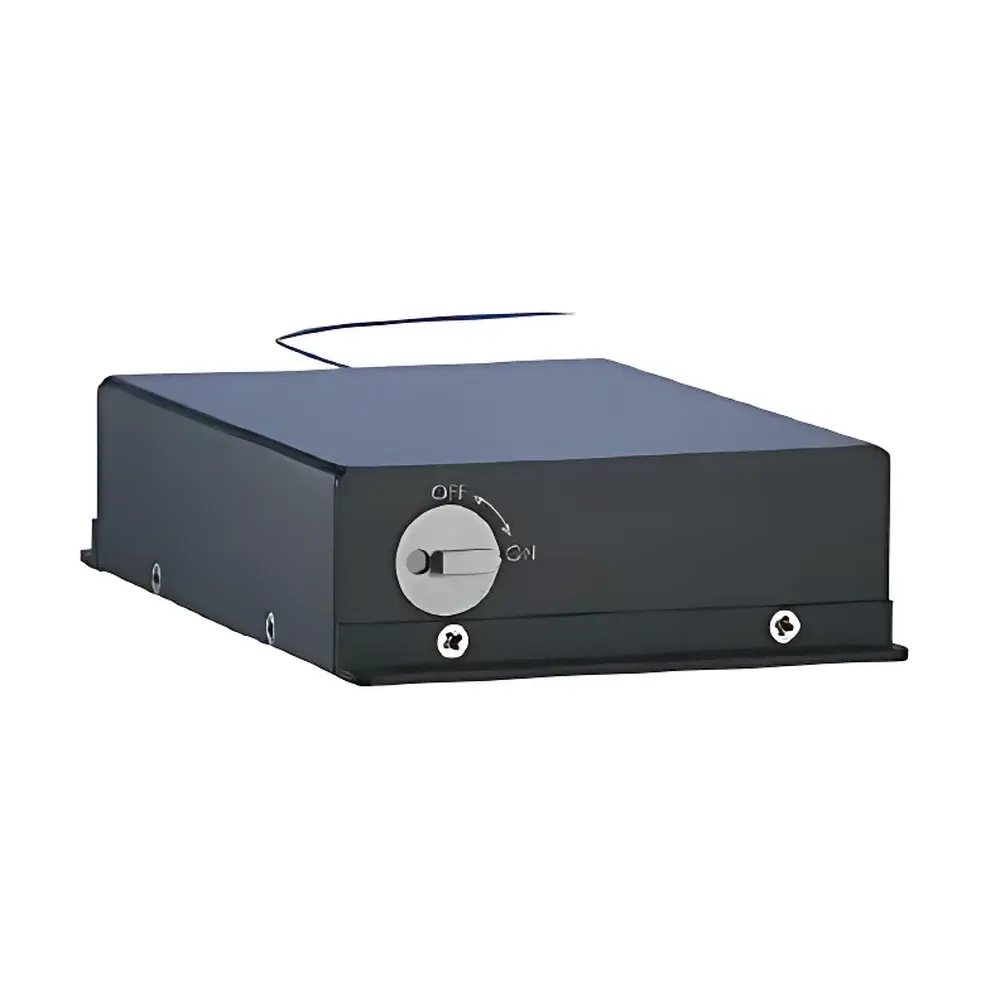
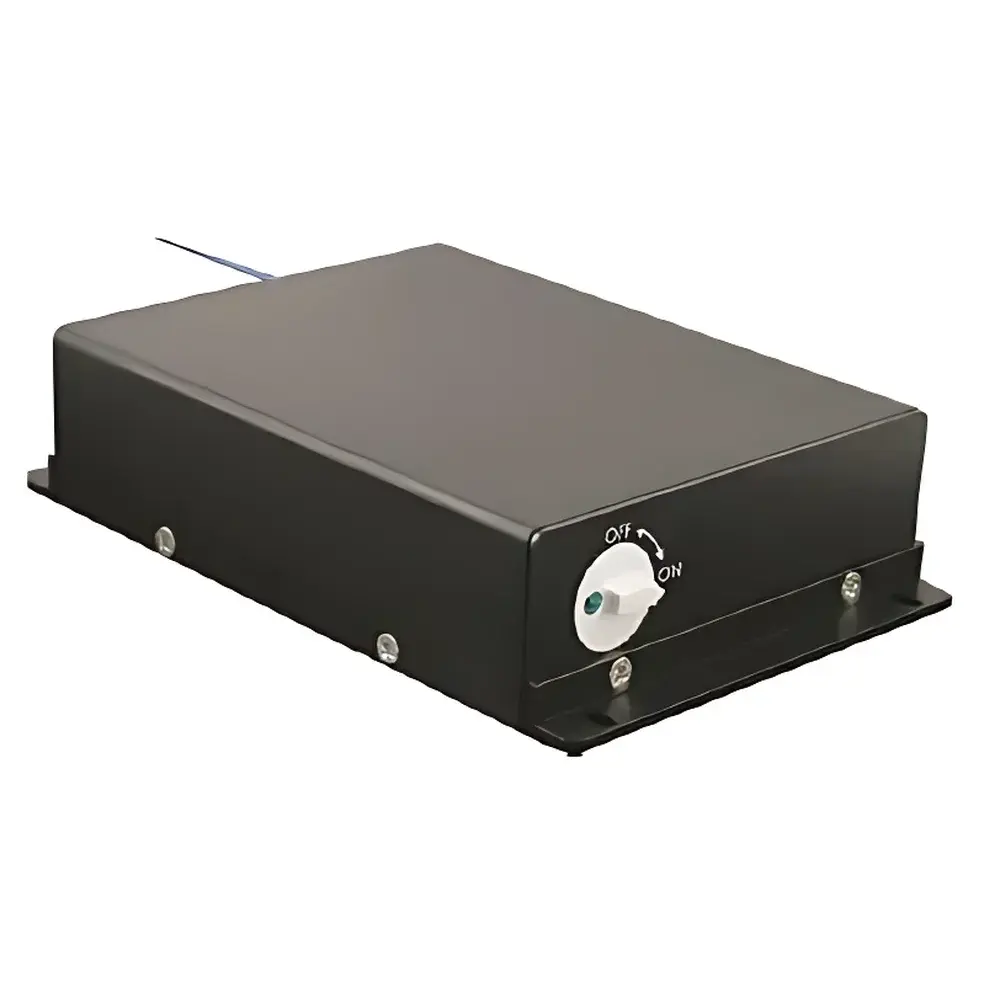
HCP 1×0 THG Mixer Triple-Photon Generation Module
| Brand | HCP |
|---|---|
| Origin | Taiwan |
| Manufacturer Type | Distributor |
| Model | 1×0 THG Mixer |
| Output Wavelength | 355 nm |
| Input | Fiber-Coupled (1064 nm fundamental) |
| Output Power | ≥50 mW (at 355 nm, with 1064 nm input ≥150 mW) |
| Conversion Efficiency | >33% (typical) |
| Polarization | Linear, orthogonal to input |
| Beam Quality | M² < 1.2 |
| Dimensions | 85 × 55 × 35 mm |
| Operating Temperature | 15–30 °C |
| Cooling | Conduction-cooled, no active cooling required |
| Compliance | RoHS 2015/863/EU, CE Marked (EMC Directive 2014/30/EU) |
Overview
The HCP 1×0 THG Mixer is a compact, fiber-coupled third-harmonic generation (THG) module engineered for stable, high-efficiency conversion of near-infrared laser radiation into the ultraviolet spectral region. Designed specifically for integration into ultrafast and CW laser systems operating at 1064 nm, the module employs critically phase-matched β-barium borate (BBO) or lithium triborate (LBO) nonlinear crystals in a monolithic, kinematically aligned optical architecture. The device implements type-I or type-II phase-matching geometry optimized for single-pass, collinear THG under low-power fundamental input conditions. Its core function is to generate 355 nm output via the nonlinear optical process: 3ω = ω + ω + ω, where ω corresponds to the 1064 nm fundamental frequency. This enables direct access to UV wavelengths without requiring external harmonic separation optics or active wavelength tuning—making it suitable for applications demanding minimal footprint, high beam pointing stability, and long-term power reproducibility.
Key Features
- Fiber-coupled input interface compatible with standard SMF-28 or PM980 fiber (FC/APC or FC/PC connector options available)
- Single-channel configuration delivering ≥50 mW average power at 355 nm when driven by ≥150 mW of linearly polarized 1064 nm light
- Conversion efficiency exceeding 33% under optimal alignment and thermal conditions—validated per ISO 11146-1 beam propagation measurements
- Monolithic mechanical housing fabricated from stress-relieved aluminum alloy with integrated thermal mass, ensuring passive thermal stabilization across ambient variations (15–30 °C)
- Pre-aligned and factory-optimized crystal orientation; no user realignment required during installation or routine operation
- Output beam exhibits diffraction-limited quality (M² < 1.2) and maintains polarization orthogonality relative to the fundamental input—critical for downstream polarization-sensitive experiments
- RoHS-compliant materials and CE-marked electromagnetic compatibility per EN 61326-1:2013 for laboratory instrumentation
Sample Compatibility & Compliance
The 1×0 THG Mixer is compatible with continuous-wave (CW) and quasi-CW Nd:YAG or fiber lasers emitting at 1064 nm with linewidths < 0.1 nm and beam divergence < 1.5 mrad. It supports input powers ranging from 80 mW to 250 mW—operation outside this range may compromise crystal longevity or conversion linearity. The module meets ISO 13406-2 Class 1 requirements for optical safety when used with appropriate interlocks and beam enclosures. For regulated environments—including pharmaceutical analytical labs and academic core facilities—the device’s fixed alignment, absence of moving parts, and traceable calibration history support compliance with GLP documentation standards. While not inherently 21 CFR Part 11 compliant (as it lacks embedded audit trail or electronic signature capability), its deterministic optical behavior and stable output permit integration into validated instrument platforms that implement full data integrity controls at the system level.
Software & Data Management
The HCP 1×0 THG Mixer operates as a passive optical component and does not incorporate onboard firmware, microcontroller, or digital interface. Consequently, it requires no driver software, configuration utility, or firmware updates. All operational parameters—including input power monitoring, temperature logging, and output power trending—are managed externally via host laser control systems or third-party power meters (e.g., Ophir StarLite, Coherent FieldMaxII). When integrated into automated test benches, the module’s consistent response enables repeatable power mapping across multi-wavelength workflows. Users are advised to record baseline THG output during initial commissioning and re-validate after any mechanical disturbance or environmental excursion exceeding ±2 °C/hour. Calibration certificates (traceable to NIST-standard photodiodes) are provided upon request for IQ/OQ documentation packages.
Applications
- UV excitation source for fluorescence lifetime imaging (FLIM) and time-resolved spectroscopy in biophotonics
- Pump-probe experiments requiring synchronized 355 nm pulses in ultrafast dynamics studies
- Microfabrication and laser-induced forward transfer (LIFT) of UV-absorbing thin films
- Calibration reference in spectroradiometric setups targeting the DUV–NUV transition region
- Seed source for optical parametric amplifiers (OPAs) operating in the deep-UV (< 300 nm) range
- Quality assurance testing of UV-transmissive optics (fused silica, CaF₂, MgF₂) using standardized irradiance protocols
FAQ
Is the 1×0 THG Mixer compatible with pulsed lasers?
Yes—provided pulse repetition rates exceed 10 kHz and peak powers remain below 10 kW to avoid optical damage thresholds in the nonlinear crystal. Average power must still fall within the 80–250 mW specification.
Can I use a 532 nm input to generate 176.5 nm output?
No. The module is designed exclusively for 1064 nm → 355 nm THG. A 532 nm input would produce second-harmonic (266 nm), not third-harmonic, and is outside the specified phase-matching design envelope.
Does the unit include harmonic separation optics?
No. Residual 1064 nm and 532 nm light is suppressed to OD6 fundamental rejection.
What maintenance is required?
None beyond periodic inspection of fiber connector cleanliness and verification of output power stability every 200 operational hours. No consumables or recalibration intervals are specified.



