
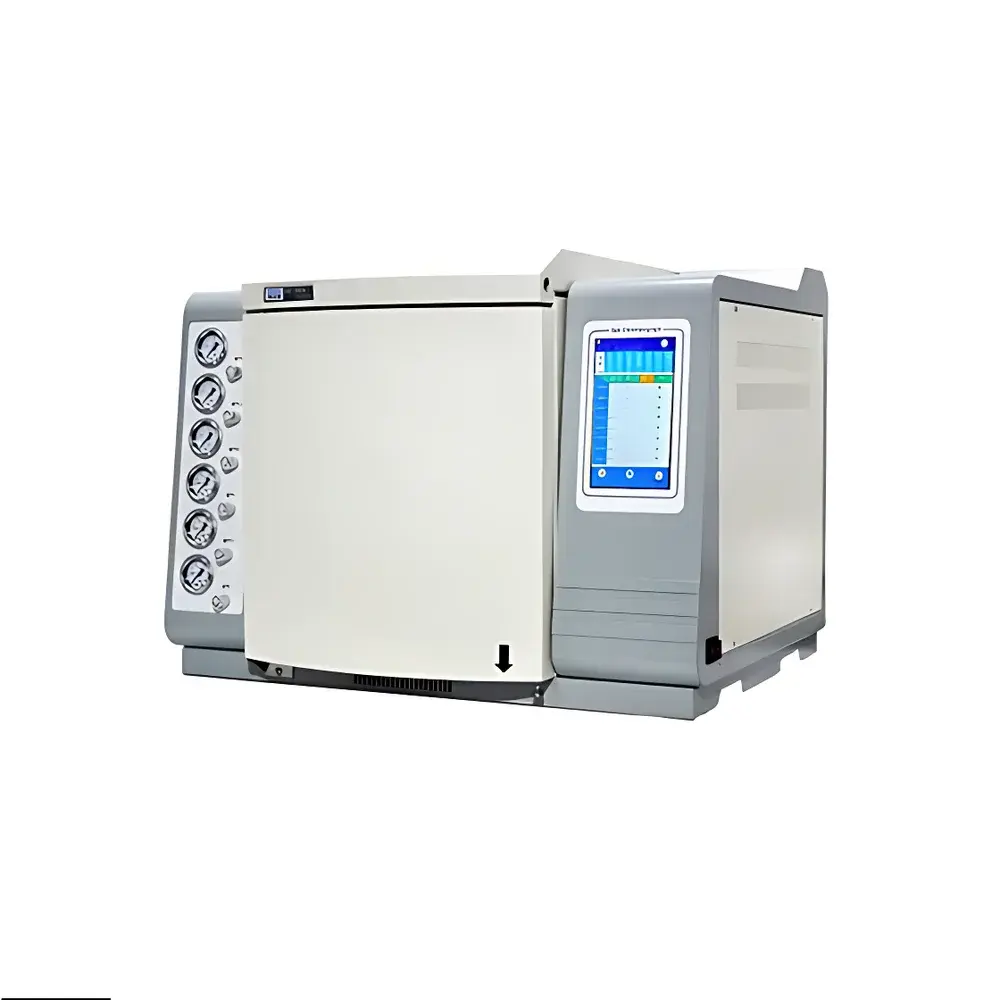
ZHONGKEHUIFEN GC-7820 Helium Ionization Gas Chromatograph
| Brand | ZHONGKEHUIFEN |
|---|---|
| Origin | Beijing, China |
| Model | GC-7820 Helium Ionization Gas Chromatograph |
| Instrument Type | Laboratory Gas Chromatograph |
| Application Scope | General-Purpose High-Purity Gas Analysis |
| Oven Temperature Range | Ambient + 3°C to 450°C |
| Ramp Rate | 0.1–40°C/min |
| Cool-down Time | ~8 min (450°C → 50°C) |
| Carrier Gas Flow Range & Control | 0–1200 mL/min |
| Carrier Gas Pressure Range & Control | 0–970 kPa |
| Injector Maximum Operating Temperature | 450°C |
| Injector Pressure Setting Range | 0–970 kPa |
| Injector Total Flow Setting Range | 0–1200 mL/min |
Overview
The ZHONGKEHUIFEN GC-7820 Helium Ionization Gas Chromatograph is a dedicated high-sensitivity analytical platform engineered for ultra-trace impurity quantification in high-purity inert and reactive gases—particularly He, Ar, Ne, Kr, Xe, H₂, N₂, O₂, CH₄, CO, CO₂, and related electronic-grade specialty gases. Unlike conventional thermal conductivity (TCD) or flame ionization (FID) detectors, the GC-7820 employs a pulsed discharge helium ionization detector (PDHID), which generates metastable helium ions (He*) under controlled RF excitation. These ions induce electron ejection from analyte molecules with ionization potentials below ~24.6 eV—enabling universal, near-equimolar response across permanent gases and hydrocarbons without chemical quenching or catalytic surface interference. The system integrates zero-dead-volume, passivated stainless-steel flow paths; multi-valve, multi-column configuration with center-cutting and back-flush capabilities; and precision pressure/flow control architecture—ensuring long-term baseline stability, sub-ppb detection limits, and compliance with stringent semiconductor and photovoltaic gas purity standards.
Key Features
- Passivated capillary and micro-packed column manifolds with zero-dead-volume design, minimizing adsorption and memory effects for trace-level analysis
- Imported high-cycle-life solenoid valves (10 ms switching, >1 million cycles) with purge-protected actuation to prevent ambient air ingress and maintain system integrity
- Dual-column strategy combining gas-specific micro-packed columns and high-resolution fused-silica capillaries, supported by programmable valve sequencing for pre-separation, heart-cutting, and column back-flush
- 8-channel independent temperature control system with ±0.01°C setpoint accuracy, enabling simultaneous optimization of injector, detector, and up to six column zones
- Intelligent oven airflow modulation via adjustable front/rear door ventilation—achieving <7 min cool-down from 350°C to 50°C
- 10/100M adaptive Ethernet interface supporting full bidirectional instrument control, remote diagnostics, and audit-ready data acquisition under GLP/GMP environments
Sample Compatibility & Compliance
The GC-7820 is validated for routine analysis of ultra-high-purity (UHP) industrial gases used in semiconductor fabrication, LED manufacturing, fiber optics, and aerospace applications. It meets or exceeds requirements specified in multiple national standards, including GB/T 16942–2009 (hydrogen), GB/T 16943–2009 (helium), GB/T 14604–2009 (oxygen), GB/T 14601–2009 (ammonia), GB/T 15909–2009 (silane), and GB/T 28125.1–2011 (cryogenic process hazard analysis). Detector performance adheres to ISO 6141:2015 for calibration gas certification and supports method validation per ICH Q2(R2) guidelines. All hardware and software components are designed to support 21 CFR Part 11-compliant electronic records and signatures when deployed with qualified chromatography data systems (CDS).
Software & Data Management
The integrated workstation provides intuitive sequence-based method setup, real-time chromatogram visualization, automated peak integration using retention time locking (RTL), and customizable reporting templates compliant with ISO/IEC 17025 documentation requirements. Raw data files include embedded metadata: instrument configuration, valve timing logs, temperature ramp profiles, pressure/flow traces, and detector voltage history—enabling full forensic traceability. Audit trail functionality records all user actions, parameter modifications, and data reprocessing events with timestamp, operator ID, and reason-for-change fields. Export options include ASTM E1319-compliant .cdf, .csv, and PDF formats suitable for regulatory submission.
Applications
- Quantification of ppb-level impurities (H₂O, O₂, N₂, CO, CO₂, CH₄, C₂H₂, C₂H₄, C₂H₆, N₂O, NH₃, NO) in helium carrier gas for GC-MS and ICP-MS laboratories
- Release testing of cylinder-filling batches for electronics-grade argon, neon, and krypton per SEMI F57 specifications
- Monitoring of hydrogen purity in PEM fuel cell feed streams per ISO 8573-8:2017
- Verification of nitrogen blanketing gas quality during pharmaceutical lyophilization and sterile filling operations
- Trace hydrocarbon profiling in oxygen used for medical device sterilization (EO residue validation)
FAQ
What detection principle does the GC-7820 employ?
It uses pulsed discharge helium ionization detection (PDHID), relying on metastable helium atoms generated in a low-power RF discharge to ionize analytes with ionization potentials below 24.6 eV.
Is the system compatible with FDA 21 CFR Part 11 requirements?
Yes—when operated with validated CDS software and configured with role-based access control, electronic signatures, and immutable audit trails.
Can the GC-7820 analyze corrosive gases such as ammonia or silane?
Yes—the entire flow path is electropolished and passivated stainless steel; optional nickel-plated or Monel components are available for extended service life with aggressive species.
What is the minimum detectable concentration for methane?
The system achieves ≤10 ppb (v/v) detection limit for CH₄ under optimized conditions, verified using certified standard mixtures traceable to NIST SRMs.
Does the instrument support unattended overnight operation?
Yes—programmable run sequences of up to 999.99 minutes, automatic valve cycling, and intelligent fault recovery enable fully autonomous batch analysis.
Related Products






