
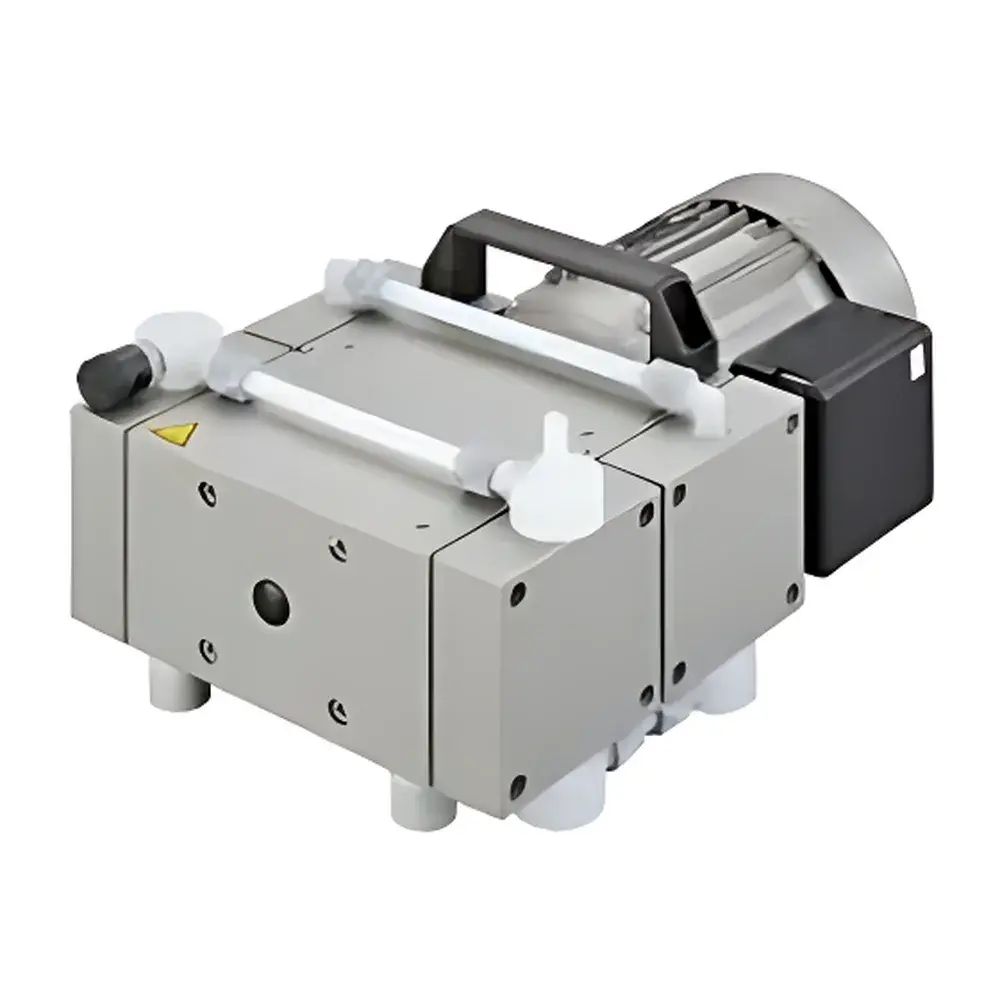
ILMVAC MPC901Z Chemical-Resistant Diaphragm Vacuum Pump
| Brand | ILMVAC |
|---|---|
| Origin | Germany (Manufactured under license |
| Model | MPC901Z |
| Pump Type | Oil-Free Diaphragm Vacuum Pump |
| Ultimate Vacuum | < 8 mbar (< 6 mmHg) |
| Suction Rate | 113.3 L/min (6.8 m³/h) |
| Dimensions (W × D × H) | 230 × 380 × 169 mm |
| Weight | 18.3 kg |
| Motor Power | 100 W |
| Voltage | 220 V, 50/60 Hz |
| Construction | PTFE-coated wetted parts with carbon-fiber reinforcement |
| Diaphragm | Multi-layer “sandwich” structure |
| Compliance | Designed for GLP-compliant labs |
Overview
The ILMVAC MPC901Z is a high-performance, oil-free diaphragm vacuum pump engineered for continuous-duty operation in chemically aggressive laboratory environments. Unlike rotary vane or piston pumps, the MPC901Z operates on a dry, positive-displacement principle—utilizing a dynamically balanced, multi-layer PTFE-reinforced diaphragm to generate vacuum without lubricants or hydrocarbon contamination. Its core architecture eliminates oil vapor backstreaming, making it ideal for applications where sample integrity, process repeatability, and operator safety are non-negotiable. The pump achieves an ultimate vacuum of < 8 mbar (< 6 mmHg) and delivers a stable suction rate of 113.3 L/min (6.8 m³/h), maintaining consistent performance across variable load conditions—including viscous solvent vapors, acidic or alkaline off-gases, and condensable volatiles encountered in synthesis, purification, and analytical workflows.
Key Features
- Chemical resistance certified via full-wetted-path fluoropolymer coating: All gas-contact surfaces—including valve plates, chamber walls, and diaphragm assemblies—are lined with PTFE and structurally reinforced with carbon fiber to withstand prolonged exposure to halogenated solvents, mineral acids (e.g., HCl, HNO₃), caustics (e.g., NaOH), and organic peroxides.
- Three-layer “sandwich” diaphragm design: Combines elastomeric resilience with tensile strength and fatigue resistance—enabling >20,000 hours of continuous operation at rated duty cycle without degradation in vacuum stability or flow linearity.
- True oil-free architecture: No lubrication required; zero risk of oil carryover into vacuum lines, traps, or connected instrumentation (e.g., mass spectrometers, lyophilizers, or glovebox antechambers).
- Compact footprint and low thermal signature: 230 × 380 × 169 mm dimensions and 18.3 kg mass facilitate benchtop integration; 100 W motor minimizes heat dissipation and ambient temperature drift during extended runs.
- Integrated thermal overload protection and pressure-relief bypass: Ensures safe operation under stalled or over-pressurized conditions—critical for unattended overnight vacuum concentration or reactor degassing protocols.
Sample Compatibility & Compliance
The MPC901Z is validated for use with corrosive, condensable, and reactive process streams common in pharmaceutical R&D, fine chemical synthesis, and environmental testing. It complies with ISO 8573-1 Class 0 certification requirements for oil-free compressed air/vacuum, ensuring suitability for GMP-regulated processes. When deployed in vacuum distillation (per ASTM D2879), filtration (per ISO 4003), or drying (per USP ), the pump supports audit-ready documentation through optional analog output (0–10 V) for vacuum level logging. Its construction meets CE Machinery Directive 2006/42/EC and RoHS 2011/65/EU standards. While not intrinsically rated for Zone 1 hazardous areas, it may be installed in ventilated fume hoods or secondary containment enclosures when handling flammable vapors.
Software & Data Management
The MPC901Z operates as a standalone, analog-controlled device—intentionally omitting embedded firmware or digital interfaces to maximize reliability and electromagnetic compatibility in shared lab infrastructure. Vacuum level is monitored externally via calibrated Pirani or capacitance manometers (e.g., MKS Baratron series). For automated systems, its 0–10 V analog output (standard) enables seamless integration with LabVIEW, DeltaV, or Siemens Desigo CC platforms for closed-loop pressure control and electronic batch record generation. All operational parameters—including runtime hours, thermal events, and voltage fluctuations—are traceable via external PLC data historians compliant with FDA 21 CFR Part 11 requirements when paired with appropriate audit-trail-enabled SCADA architecture.
Applications
- Vacuum distillation of acid-sensitive compounds (e.g., β-lactams, phosphines) where metal-catalyzed decomposition must be avoided.
- Continuous degassing of reaction mixtures in jacketed glass reactors—particularly under inert atmosphere purging with N₂ or Ar.
- High-throughput vacuum filtration of aggressive filtrates (e.g., spent catalyst slurries in HCl media, palladium black recovery from aqua regia).
- Lyophilization pre-freeze and primary drying stages requiring stable sub-10 mbar vacuum with zero hydrocarbon interference.
- Gas scavenging in Schlenk-line setups and glovebox regeneration cycles involving O₂/H₂O removal from inert atmospheres.
FAQ
Is the MPC901Z suitable for use with hydrofluoric acid (HF) vapors?
No. While PTFE exhibits excellent resistance to most mineral acids, HF attacks fluoropolymers at elevated temperatures and concentrations. Use only with HF-free systems or implement upstream cold traps and neutralization scrubbers.
Can the pump be mounted vertically or inverted?
Yes—its diaphragm actuation mechanism and sealed motor housing permit any orientation, provided inlet/outlet ports remain unobstructed and ambient temperature stays within 10–40 °C.
What maintenance intervals are recommended?
None beyond periodic visual inspection of inlet filters and diaphragm integrity every 6 months under standard lab use; no scheduled lubrication, valve replacement, or calibration is required.
Does the MPC901Z meet FDA requirements for pharmaceutical manufacturing?
It satisfies material biocompatibility (USP Class VI) and extractables profiling per ICH Q5C guidelines when used in non-product-contact vacuum service; formal validation must be conducted per site-specific PQ protocols.
How does ambient temperature affect ultimate vacuum performance?
Ultimate vacuum degrades by ~0.3 mbar per 10 °C above 25 °C due to increased vapor pressure of residual moisture in internal components—operation within 15–30 °C is recommended for specification compliance.



