
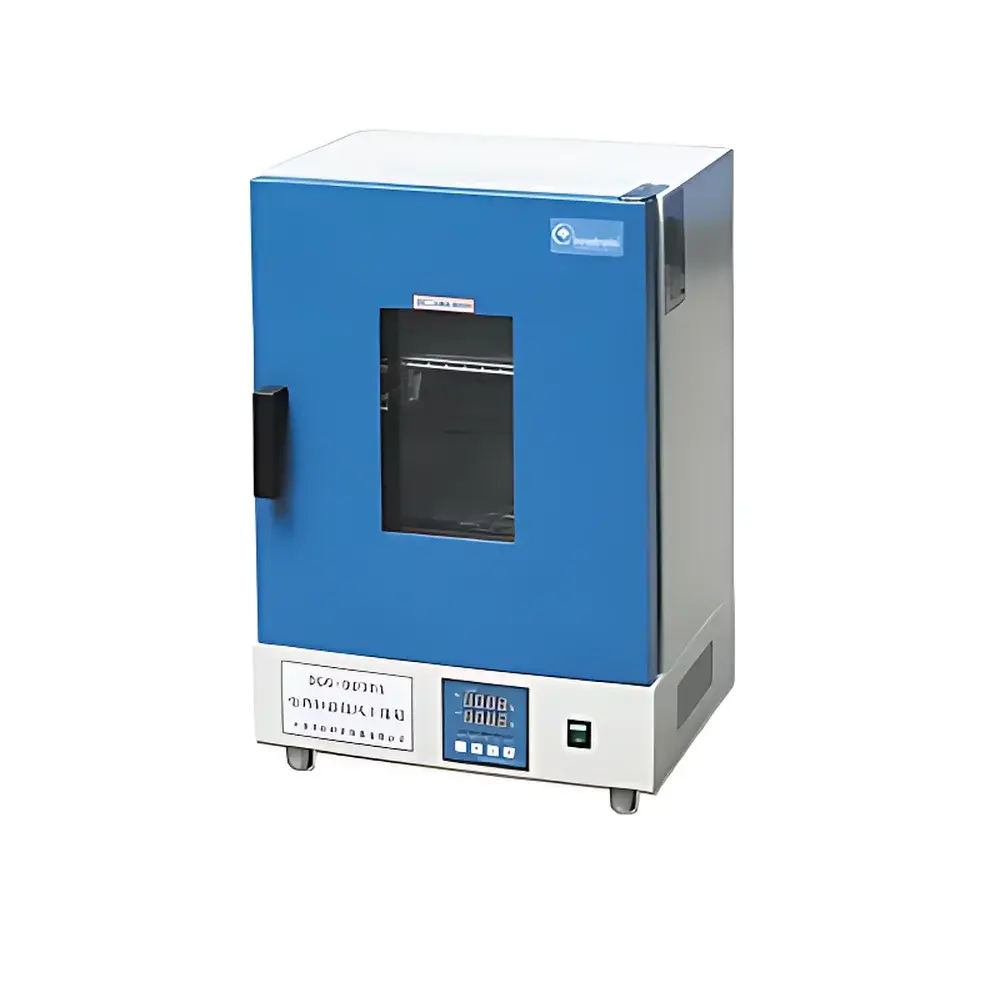
English Product Name
| Brand | Jihepu |
|---|---|
| Origin | Shandong, China |
| Model | DGG-9920A |
| Temperature Range | RT+10°C to 200°C |
| Temperature Uniformity | ±1°C |
| Interior Dimensions (W×D×H) | 1000 × 600 × 1600 mm |
| Exterior Dimensions (W×D×H) | 1140 × 800 × 2150 mm |
| Interior Material | Mirror-finish stainless steel or galvanized steel |
| Heating Method | Forced convection with axial fan |
| Power Supply | 380 V, 50 Hz |
| Rated Power | 6000 W |
| Timer Range | 1–9999 minutes |
| Temperature Resolution | 0.1°C |
| Standard Shelving | 4 adjustable stainless steel trays |
Overview
The Jihepu DGG-9920A is a vertical forced-air constant-temperature drying oven engineered for precision thermal processing in industrial laboratories, quality control facilities, and research institutions. It operates on the principle of horizontal airflow distribution via a high-efficiency axial fan mounted at the rear wall, ensuring uniform heat transfer across the entire working chamber through vertical forced convection. This architecture minimizes thermal stratification and supports reproducible drying, baking, sterilization, and moisture removal protocols under controlled ambient conditions. Designed for continuous operation in environments with ambient temperatures between 5°C and 40°C and relative humidity ≤80% RH (non-condensing), the DGG-9920A complies with general safety and electromagnetic compatibility requirements per GB/T 14710–2009 (Chinese National Standard for Environmental Adaptability of Medical Electrical Equipment) and meets structural integrity benchmarks defined in IEC 61010-1 for laboratory electrical equipment. Its temperature control system is calibrated against traceable reference standards and validated under no-load conditions at 20°C ambient and 50% RH per ISO/IEC 17025–compliant internal verification procedures.
Key Features
- Digital microprocessor-based temperature controller with PID algorithm, offering 0.1°C resolution and ±1°C uniformity across the full working volume.
- Mirror-finish stainless steel interior chamber (or optional galvanized steel), fabricated by argon arc welding for corrosion resistance and ease of cleaning—critical for residue-sensitive applications such as pharmaceutical residual solvent removal or polymer curing.
- Robust external casing constructed from high-grade cold-rolled steel with powder-coated finish, providing mechanical durability and long-term dimensional stability.
- Independent over-temperature protection circuit with audible/visual alarm and automatic power cutoff—configured to trigger at user-defined thresholds above the setpoint, satisfying basic functional safety requirements per IEC 60335-1 Annex G.
- Four standard adjustable stainless steel shelving trays (load capacity: 15 kg per tray), spaced to accommodate stacked sample containers without impeding airflow.
- Programmable timer with 1–9999 minute range, supporting unattended operation and process repeatability in GLP-compliant workflows.
Sample Compatibility & Compliance
The DGG-9920A accommodates a wide range of sample formats—including Petri dishes, glass desiccators, aluminum weighing pans, ceramic crucibles, and sealed polypropylene vials—provided they remain stable within the 200°C operational ceiling. It is routinely deployed in ASTM D1654 (corrosion testing), ISO 554 (standard atmospheres for conditioning), and USP (sterile processing validation) contexts where controlled thermal exposure is required. While not certified for Class II biological safety or explosion-proof operation, its construction adheres to material compatibility guidelines outlined in ISO 15190:2020 for laboratory design and is suitable for non-hazardous, non-volatile sample matrices. Optional RS485 interface enables integration into centralized facility monitoring systems compliant with FDA 21 CFR Part 11 when paired with validated data acquisition software.
Software & Data Management
The base configuration includes a digital LED display with manual setpoint entry and real-time temperature readout. For advanced process control, optional programmable controllers (e.g., 30-segment LCD models) support ramp-soak profiles, event logging, and password-protected parameter modification. When equipped with the RS485 communication module (Option #6), the unit transmits timestamped temperature data at user-configurable intervals to supervisory SCADA or LIMS platforms. Audit trails—including operator ID, setpoint changes, alarm events, and runtime logs—are retained locally for ≥30 days and exportable in CSV format. All firmware updates follow version-controlled release protocols aligned with ISO 13485 design history file requirements.
Applications
- Moisture content determination per AOAC 950.46 and ISO 6539 in food, feed, and agricultural commodities.
- Baking of ceramic green bodies and sintering pre-treatment of metal oxide powders prior to furnace processing.
- Accelerated aging studies of polymer films and packaging materials under ISO 11607-1 environmental stress conditions.
- Residual solvent evaporation from HPLC vial inserts and GC sample preparation plates.
- Pre-sterilization drying of reusable stainless steel instruments in ISO 17664-aligned reprocessing workflows.
- Thermal conditioning of calibration standards prior to gravimetric analysis or thermogravimetric instrument qualification.
FAQ
What is the maximum safe operating temperature for the DGG-9920A?
The unit is rated for continuous operation up to 200°C. Exceeding this limit may compromise sensor accuracy, insulation integrity, and fan motor longevity.
Can the DGG-9920A be used for vacuum drying?
No. This model is a forced-air convection oven only. Vacuum-capable variants are designated separately (e.g., DZF series) and require reinforced chamber walls and vacuum-rated seals.
Is the stainless steel interior electropolished?
Standard configuration uses mirror-finish (No. 4) stainless steel; electropolishing is available upon request as a custom fabrication option.
Does the timer function interrupt heating during power loss?
The timer retains its count only if auxiliary backup power is provided; otherwise, it resets upon restoration of mains supply.
How often should temperature uniformity be verified?
Per ISO/IEC 17025 Clause 6.4.8, verification is recommended before first use, after relocation, following major maintenance, and at least annually using NIST-traceable thermocouples placed at 9 standardized locations within the chamber.



