
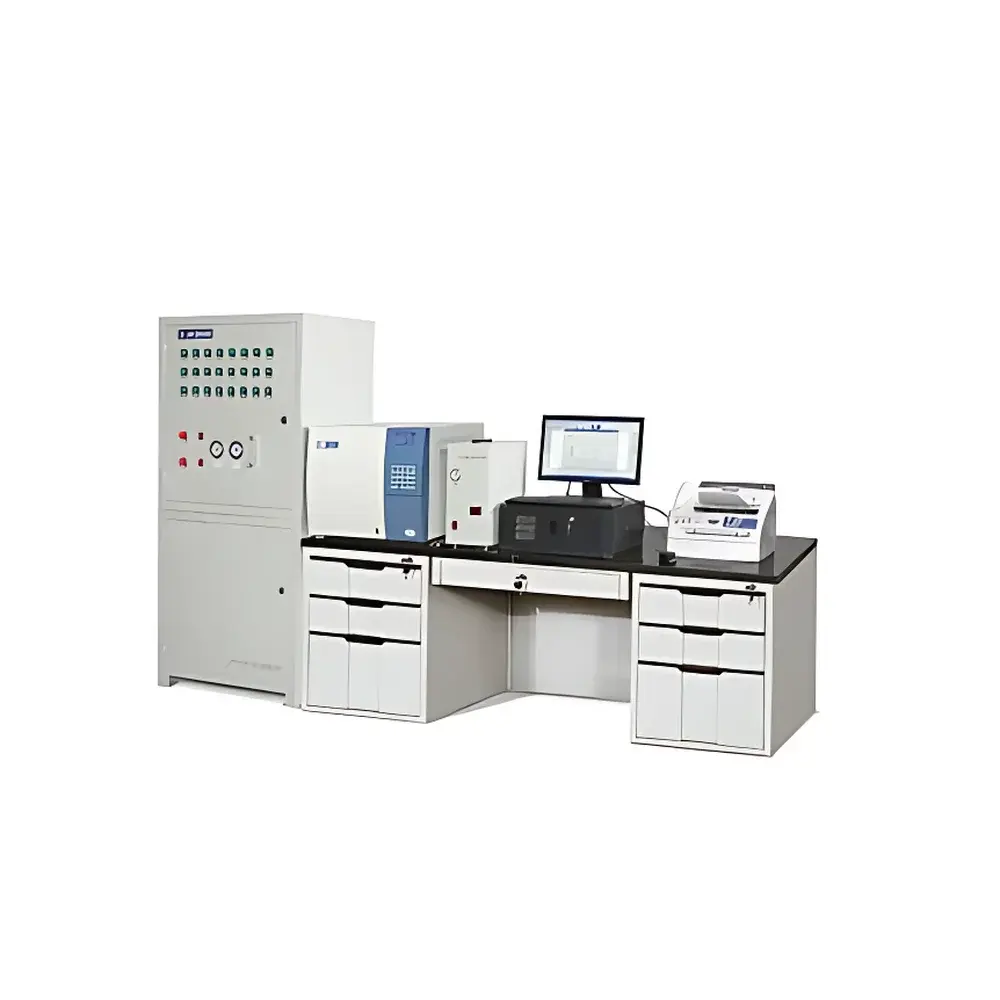
ZHONGKEHUIFEN ZX-2000 Online Gas Chromatograph
| Brand | ZHONGKEHUIFEN |
|---|---|
| Origin | Beijing, China |
| Model | ZX-2000 |
| Instrument Type | Online Gas Chromatograph |
| Application Field | High-Purity Gas Analysis |
| Oven Temperature Range | Ambient + 3°C to 450°C |
| Ramp Rate | 0.1–40°C/min |
| Cool-down Time | ~8 min (450°C → 50°C) |
| Carrier Gas Flow Range & Control | 0–1200 mL/min |
| Carrier Gas Pressure Range & Control | 0–970 kPa |
| Injector Maximum Operating Temperature | 450°C |
| Injector Pressure Setpoint Range | 0–970 kPa |
| Injector Total Flow Setpoint Range | 0–1200 mL/min |
Overview
The ZHONGKEHUIFEN ZX-2000 Online Gas Chromatograph is an industrial-grade, fully automated gas analysis system engineered for continuous, real-time compositional monitoring of high-purity process gases in demanding production environments. Unlike laboratory-based GC systems, the ZX-2000 integrates directly into plant infrastructure via dedicated sampling manifolds and vacuum-assisted extraction lines, enabling unattended, 24/7 operation without manual intervention. Its core analytical architecture follows standardized gas chromatographic separation principles—utilizing capillary or packed columns with precise temperature-programmed ovens and flame ionization (FID), thermal conductivity (TCD), or methanizer-compatible detectors (configurable per application). Designed specifically for applications where sample integrity, operator safety, and regulatory traceability are critical—including semiconductor gas delivery, hydrogen purity verification, electronic specialty gas certification, and ultra-high-purity nitrogen/oxygen stream validation—the ZX-2000 delivers reproducible retention time stability and quantitative accuracy under dynamic process conditions.
Key Features
- Industrial-grade oven with programmable temperature control from ambient +3°C to 450°C, supporting rapid thermal ramping (0.1–40°C/min) and accelerated cool-down (~8 min from 450°C to 50°C) for high-throughput cycle times.
- Dual-time-controlled auto-sampling module using imported solenoid valves and stepper motor actuators, ensuring precise injection timing, long-term mechanical reliability, and minimal carryover between cycles.
- Integrated carrier gas management system with digital mass flow and pressure control (0–1200 mL/min flow; 0–970 kPa pressure), compatible with helium, hydrogen, nitrogen, and argon carriers.
- High-temperature injector capable of sustained operation up to 450°C, with independent pressure and total flow setpoints for method flexibility across diverse gas matrices.
- Modular hardware architecture designed for seamless integration with Distributed Control Systems (DCS), including native support for analog output (4–20 mA), Ethernet TCP/IP communication, and D/A conversion interfaces for real-time data streaming to central SCADA or MES platforms.
- Robust stainless-steel multi-point sampling manifold (single- or multi-core configuration), vacuum-pump-driven gas transport, and heated transfer lines to prevent condensation or adsorption losses in trace-level analysis.
Sample Compatibility & Compliance
The ZX-2000 is validated for routine analysis of permanent gases (e.g., O₂, N₂, H₂, CO, CO₂, CH₄, Ar, He), hydrocarbons (C₁–C₆), and reactive impurities (NH₃, H₂S, HF, HCl) in high-purity bulk gases (≥99.999% purity). Its sampling design conforms to ISO 8573-1 (compressed air purity classes), ASTM D1945 (gas analysis by GC), and IEC 61511 functional safety guidelines for SIS-integrated analyzers. All firmware and data handling routines support audit-trail generation and user-access logging—aligned with GLP/GMP documentation requirements and preparatory for FDA 21 CFR Part 11 compliance when deployed with validated software configurations and electronic signature modules.
Software & Data Management
The embedded acquisition and control software provides full method scheduling, real-time chromatogram visualization, peak integration with customizable baseline algorithms, and automatic calibration curve generation (external standard, internal standard, or area normalization). All analytical results—including retention times, peak areas, concentration values, and system diagnostic logs—are timestamped, stored locally on industrial-grade SSD storage, and simultaneously exported via configurable protocols (Modbus TCP, OPC UA, CSV over FTP, or RESTful API). Data export formats comply with ASTM E1382 and ISO/IEC 17025 reporting standards. Optional remote maintenance mode enables secure, encrypted SSH-based diagnostics and firmware updates without compromising network segmentation policies.
Applications
- Continuous purity verification of electronic-grade nitrogen, argon, helium, and hydrogen in semiconductor fabrication tool gas cabinets.
- In-line monitoring of trace moisture, oxygen, and hydrocarbon contaminants in cryogenic air separation unit (ASU) product streams.
- Real-time composition tracking in syngas, biogas, and reformate gas streams for chemical synthesis and energy generation facilities.
- Quality assurance of medical oxygen and nitrous oxide in pharmaceutical manufacturing, per USP and EP 2.5.27 specifications.
- Leak detection and impurity profiling in vacuum chamber purge gases used in thin-film deposition and photolithography processes.
FAQ
Is the ZX-2000 compliant with FDA 21 CFR Part 11 for electronic records and signatures?
Yes—when deployed with optional validated software packages, role-based access control, and tamper-evident audit trails, the system meets foundational requirements for Part 11 compliance in regulated environments.
Can the ZX-2000 interface directly with Siemens PCS7 or Honeywell Experion DCS platforms?
Yes—it supports native Modbus TCP and OPC UA server functionality, enabling bidirectional data exchange and alarm forwarding without third-party gateways.
What is the typical maintenance interval for the vacuum pump and sampling valves?
Under continuous operation, the oil-free vacuum pump requires inspection every 6 months; solenoid valves are rated for ≥1 million cycles and typically exceed 18 months of service before preventive replacement.
Does the system support method transfer from lab-based Agilent or Shimadzu GC methods?
Yes—retention time alignment, column compatibility, and detector response linearity allow direct adaptation of existing laboratory methods with minor optimization of oven ramp profiles and carrier flow settings.
Is remote calibration and performance qualification (PQ) possible without on-site technician support?
Yes—via secure remote desktop access and built-in calibration gas management logic, users can execute PQ protocols, generate IQ/OQ documentation templates, and archive raw chromatograms with full metadata for regulatory review.




