
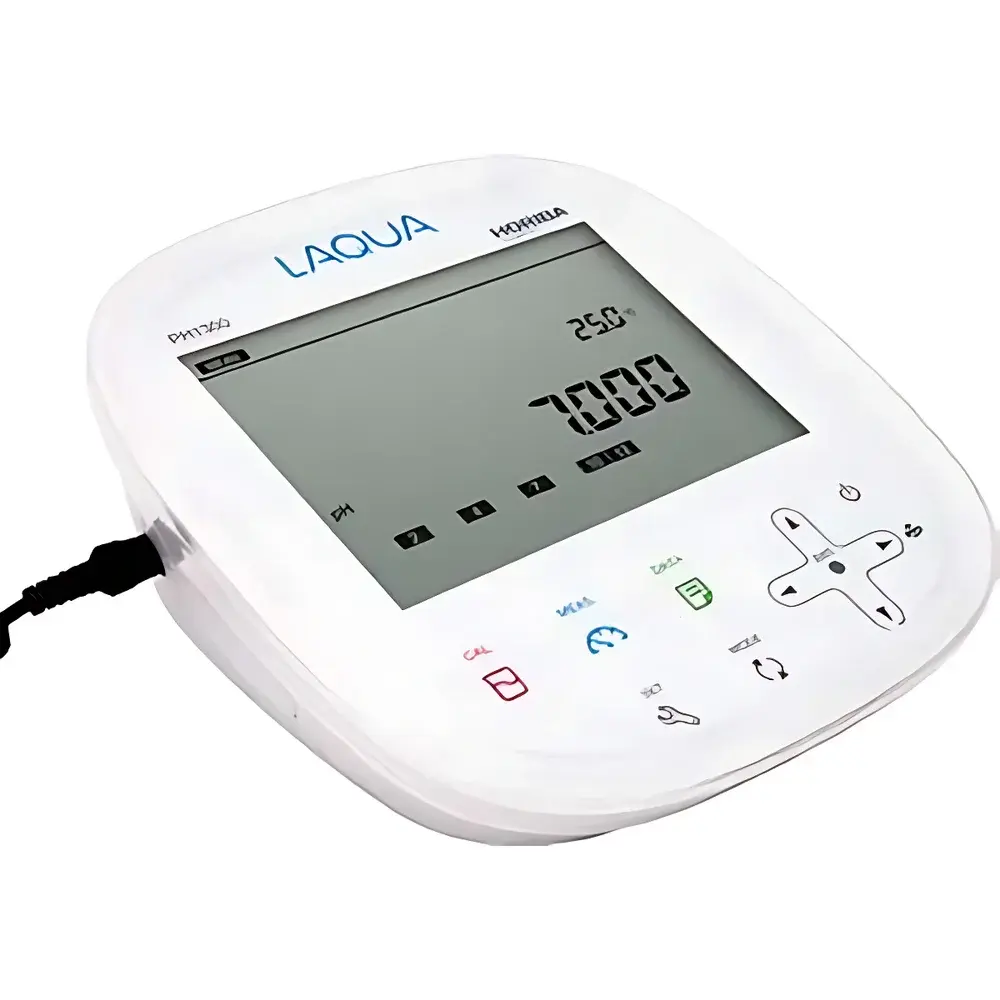
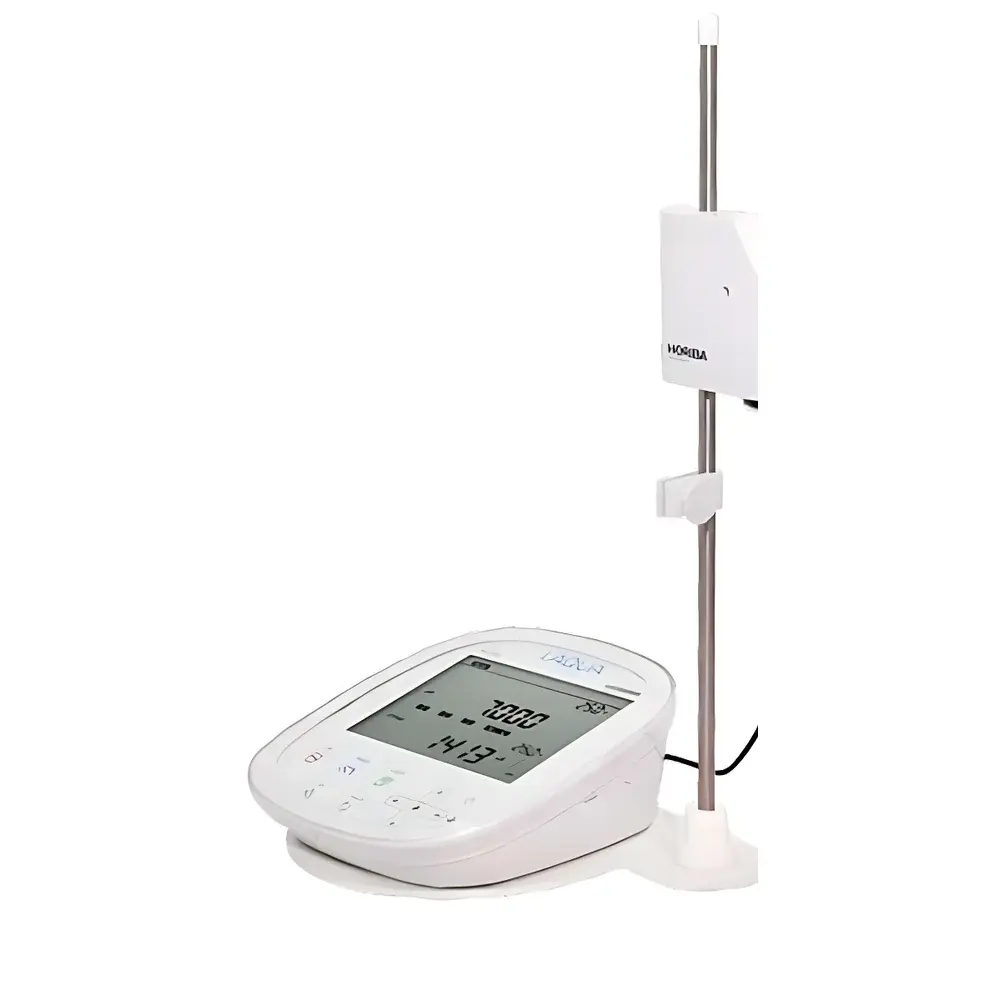
HORIBA PH1100 / PH1200 / PH1300 Benchtop pH and Multi-Parameter Water Quality Analyzers
| Brand | HORIBA |
|---|---|
| Origin | Japan |
| Model Series | PH1100, PH1200, PH1300 |
| Measurement Parameters | pH, ORP, Temperature (°C), Ion Concentration (PH1300 only) |
| pH Range | −2.000 to 19.999 |
| pH Resolution | 0.001 (PH1200/PH1300), 0.01 (PH1100) |
| pH Accuracy | ±0.003 (PH1200/PH1300), ±0.01 (PH1100) |
| ORP Range | ±1999.9 mV |
| ORP Resolution | 0.1 mV |
| ORP Accuracy | ±0.2 mV |
| Temperature Range | −30.0 to 130.0 °C |
| Temp Accuracy | ±0.4 °C |
| Ion Range (PH1300) | 0.00 µg/L to 9999 g/L |
| Ion Accuracy | ±0.8% of full scale |
| Calibration Points | Up to 5-point pH/ORP |
| Buffer Standards | USA, NIST, Custom |
| Memory Capacity | 500 (PH1100), 999 (PH1200/PH1300) |
| Data Logging | Auto Log enabled (PH1200/PH1300), timestamped with real-time clock |
| Connectivity | RS232C and USB (PH1200/PH1300) |
| GLP/GMP Compliance | Full parameter capture (electrode ID, calibration history, timestamps, slope/asymmetry), printable reports |
| Power Supply | Universal AC adapter (100–240 V, 50/60 Hz) with six international plug options |
| Dimensions | 170 × 174 × 73 mm |
| Weight | 500 g |
Overview
The HORIBA PH1100, PH1200, and PH1300 series are benchtop electrochemical analyzers engineered for high-precision, routine water quality assessment in regulated laboratory environments. These instruments operate on potentiometric measurement principles—applying the Nernst equation to quantify hydrogen ion activity (pH), redox potential (ORP), and, in the case of the PH1300, ion concentration via direct potentiometry or known-concentration standard addition. Each model integrates a built-in temperature sensor for automatic thermal compensation, ensuring thermodynamically consistent readings across diverse aqueous matrices—from ultrapure water and pharmaceutical buffers to industrial wastewater and seawater analogs. Designed and manufactured in Japan, the series adheres to stringent quality control standards aligned with ISO 9001 and supports traceable metrology workflows required under GLP (Good Laboratory Practice) and GMP (Good Manufacturing Practice) frameworks.
Key Features
- 5.5-inch chemically resistant, scratch-resistant glass touchscreen with intuitive icon-driven interface—no menu diving required for daily operations.
- Integrated electrode stand with vertical height adjustment (0–650 mm range) and modular base platform compatible with standard 100 mL beakers; optional telescopic arm enables ergonomic positioning without bench clutter.
- Real-time electrode health monitoring: dynamic calibration logging, slope/asymmetry diagnostics, and configurable alarm thresholds for electrode degradation or response drift.
- Fuzzy logic stabilization algorithm automatically detects endpoint stability per IUPAC-recommended criteria, freezing the display only when signal deviation falls below user-defined noise tolerance.
- Comprehensive self-diagnostic system reporting up to 10 distinct error codes—including open-circuit detection, reference junction blockage, temperature sensor fault, and buffer recognition failure—for rapid root-cause troubleshooting.
- Universal power architecture with auto-ranging 100–240 V AC input and interchangeable regional plugs (US, UK, EU, AU/NZ, KR, CN) ensures seamless deployment across global laboratories.
Sample Compatibility & Compliance
The PH1100/PH1200/PH1300 series accommodates a broad spectrum of liquid samples: aqueous solutions, buffered standards, low-ionic-strength deionized water, high-salinity brines, and mildly aggressive media (e.g., diluted acids/bases up to pH 2 or 12). All models accept standard BNC + audio (Lemo-style) combination electrodes—including HORIBA’s ruggedized plastic-body pH electrode (Model 58702-50) with integrated Pt1000 temperature sensor. The PH1300 extends compatibility to ion-selective electrodes (ISEs) for monovalent and divalent cations/anions (e.g., Na⁺, K⁺, F⁻, Cl⁻, NO₃⁻), supporting both direct measurement and Gran plot titration modes. Regulatory alignment includes full support for FDA 21 CFR Part 11 audit trails (via optional software), ISO/IEC 17025 documentation requirements, and ASTM D1293 (pH of water) and ASTM D3222 (ORP of aqueous systems) test protocols.
Software & Data Management
Internal non-volatile memory stores up to 999 timestamped measurements (PH1200/PH1300) with embedded real-time clock, sample ID tagging, and operator-defined metadata fields. Auto Log functionality captures data at user-configurable intervals (1 sec to 60 min), while manual triggers preserve transient equilibration points. Data export occurs via USB mass-storage mode (no driver required) or RS232C serial output compatible with LabVIEW, Excel, or LIMS platforms. GLP-compliant reporting includes instrument serial number, electrode calibration history (date/time, buffers used, slope %, offset mV), temperature-compensated values, and user annotations—all printable directly to thermal or inkjet printers. Firmware updates are performed via USB stick, maintaining version-controlled traceability.
Applications
- Environmental monitoring labs performing EPA Method 150.1 (pH) and Method 150.2 (ORP) compliance testing on surface water, groundwater, and effluent streams.
- Pharmaceutical QC units verifying pH stability of injectables, ophthalmic solutions, and buffer preparations per USP and Ph. Eur. 2.2.3.
- Food & beverage R&D validating acidification kinetics during fermentation, pasteurization validation, and shelf-life modeling.
- Academic research groups conducting kinetic studies of proton-transfer reactions, corrosion inhibition assays, and electrochemical sensor development.
- Power plant chemistry departments monitoring condensate purity, boiler feedwater alkalinity, and demineralizer breakthrough endpoints.
FAQ
What distinguishes the PH1100, PH1200, and PH1300 models?
The PH1100 is a core pH/ORP/temperature analyzer with basic data logging; the PH1200 adds enhanced resolution (0.001 pH), expanded memory (999 points), real-time clock, and configurable auto-shutdown; the PH1300 further integrates ion concentration measurement with full ISE support, multi-point ion calibration, and advanced Gran plot analysis.
Are calibration certificates included with purchase?
Factory calibration certificates (traceable to NIST SRMs) are provided for each instrument and bundled electrodes. Optional accredited calibration services (ISO/IEC 17025) are available upon request.
Can the PH1300 measure fluoride in drinking water per EPA Method 300.0?
Yes—when paired with a certified LaF₃-based fluoride ISE and appropriate ionic strength adjuster (TISAB), the PH1300 meets all instrumental performance criteria specified in EPA Method 300.0 for fluoride quantification in the 0.01–1.5 mg/L range.
Is remote operation supported?
While the hardware lacks Ethernet or Wi-Fi, full bidirectional SCPI command set support over USB/RS232C enables integration into automated test sequences using Python, MATLAB, or custom LabVIEW VIs.
How frequently should the pH electrode be recalibrated?
Per ISO 7027 and CLSI C30-A guidelines, recalibration is recommended before each analytical batch, after electrode cleaning, following prolonged storage (>24 h), or when slope drops below 95% or asymmetry exceeds ±30 mV.
Related Products







