
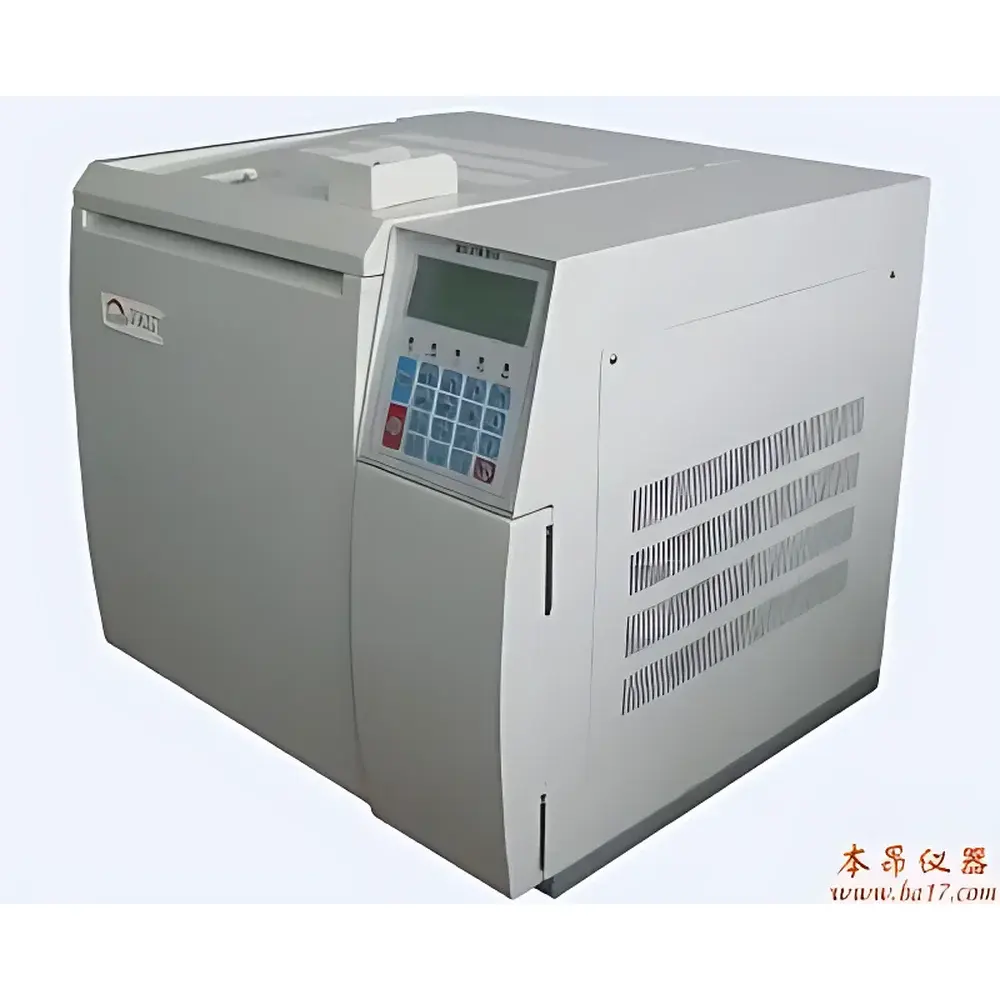
BenAng GC9217I Network-Enabled Gas Chromatograph
| Brand | BenAng |
|---|---|
| Origin | Shanghai, China |
| Model | GC9217I |
| Detector Options | FID or TCD (selectable) |
| Temperature Control Zones | 6 |
| Oven Temp Range | 8 °C above ambient to 400 °C (1 °C increment, ±0.1 °C accuracy) |
| Programmed Temperature Ramping | 8-step, 0.1–39 °C/min (standard) or 0.1–80 °C/min (high-speed option) |
| Detector Limits | FID — Mt ≤ 3×10⁻¹² g/s (n-hexadecane), noise ≤ 5×10⁻¹⁴ A, drift ≤ 1×10⁻¹³ A/30 min, linear range ≥ 10⁶, max operating temp ≤ 450 °C |
| Input/Output | 4 external event channels |
| Injector Types | packed column or capillary column (user-selectable) |
| Injection Mode | manual or automated |
| Communication Interface | Ethernet (IEEE 802.3) |
| Display | 192×64 dot-matrix Chinese-language LCD |
Overview
The BenAng GC9217I Network-Enabled Gas Chromatograph is a single-detector, benchtop gas chromatography system engineered for routine qualitative and quantitative analysis in academic laboratories, quality control environments, and industrial R&D settings. Built upon proven packed- and capillary-column separation principles, the instrument employs temperature-programmed elution to resolve volatile and semi-volatile organic compounds based on differential partitioning between a mobile gas phase (carrier gas: He, H₂, or N₂) and a stationary phase coated inside the column. Its modular architecture supports either flame ionization detection (FID) for hydrocarbon-rich matrices or thermal conductivity detection (TCD) for universal, non-destructive analysis—including permanent gases and light organics—making it suitable for method development, stability-indicating assays, and batch release testing under GLP-aligned workflows.
Key Features
- Six independently programmable temperature zones—including oven, injector(s), and detector(s)—enable precise thermal management across complex multi-component separations.
- High-resolution oven temperature control (±0.1 °C) with 8-stage ramping capability and selectable ramp rates (0.1–39 °C/min standard; up to 80 °C/min with high-speed module) ensures reproducible retention time alignment across analytical runs.
- Integrated Ethernet interface (IEEE 802.3 compliant) allows remote instrument control, real-time data streaming, and centralized fleet management via standard TCP/IP networks—eliminating dependency on proprietary hardware interfaces.
- Configurable injection options include both packed-column and split/splitless capillary injectors, supporting diverse sample introduction strategies without hardware modification.
- Dual-detector compatibility (FID/TCD) permits method flexibility: FID delivers sub-picomolar sensitivity for hydrocarbons and oxygenates; TCD provides robust, calibration-stable response for inorganic gases and low-molecular-weight organics—even in absence of carbon-hydrogen bonds.
- Onboard 192×64 dot-matrix display with localized Chinese-language UI reduces training overhead in bilingual lab environments while maintaining full parameter accessibility during method execution.
Sample Compatibility & Compliance
The GC9217I accommodates liquid, gaseous, and headspace-derived samples introduced via syringe, gas-tight valve, or autosampler-compatible ports (with optional third-party integration). It complies with fundamental instrumentation requirements outlined in ASTM D3606 (gasoline aromatics), ISO 10301 (volatile organic compound determination), and USP (chromatography general chapter) when operated within validated method parameters. While not pre-certified for 21 CFR Part 11, its Ethernet-based data acquisition architecture supports integration with LIMS or ELN platforms that implement audit trail, electronic signature, and role-based access controls required for regulated pharmaceutical or food safety applications.
Software & Data Management
Data acquisition and processing are performed using vendor-supplied PC-based software compatible with Windows 10/11 (64-bit). The software supports peak integration using tangent skim, exponential skim, and valley-to-valley algorithms; customizable reporting templates aligned with ISO/IEC 17025 documentation standards; and export to CSV, PDF, and CDF formats for long-term archival. Raw signal files retain full detector voltage/time metadata, enabling retrospective reprocessing without loss of fidelity. Remote monitoring via browser-based dashboard (via embedded web server) allows supervisory review of run status, oven temperature profiles, and detector baselines without direct workstation access.
Applications
- Pharmaceutical QC: Residual solvent analysis per ICH Q3C guidelines using headspace-GC/FID.
- Food & Beverage: Quantification of flavor volatiles, ethanol content, and pesticide residues in aqueous or fatty matrices.
- Chemical Manufacturing: Purity assessment of monomers, catalysts, and reaction intermediates via isothermal or gradient elution.
- Environmental Testing: Detection of BTEX (benzene, toluene, ethylbenzene, xylene) and chlorinated hydrocarbons in soil extracts or air canisters.
- Academic Research: Teaching chromatographic theory—including resolution optimization, selectivity tuning, and detector response modeling—in undergraduate and graduate analytical chemistry curricula.
FAQ
Is the GC9217I compliant with FDA 21 CFR Part 11?
No—the instrument itself does not include built-in electronic signature, audit trail, or user authentication features required for Part 11 compliance. However, its Ethernet output enables connection to validated third-party data systems that provide these capabilities.
Can I upgrade from TCD to FID after purchase?
Yes—detector modules are field-replaceable. Swapping requires mechanical installation, gas line reconfiguration, and firmware calibration verification, all supported by BenAng technical documentation.
What carrier gases are compatible with the GC9217I?
Helium, hydrogen, and nitrogen are supported. Hydrogen offers optimal speed-efficiency balance for capillary columns; helium remains preferred for method transfer from legacy systems; nitrogen is suitable for TCD operation where sensitivity trade-offs are acceptable.
Does the system support automatic calibration verification?
Not natively—the GC9217I lacks onboard standard delivery. Calibration verification must be performed manually using certified reference materials and external calibration curves generated in software.
Is remote diagnostics available?
Yes—through the integrated Ethernet port, authorized service personnel can initiate secure remote sessions for firmware updates, configuration review, and basic fault isolation, subject to network security policies.





