
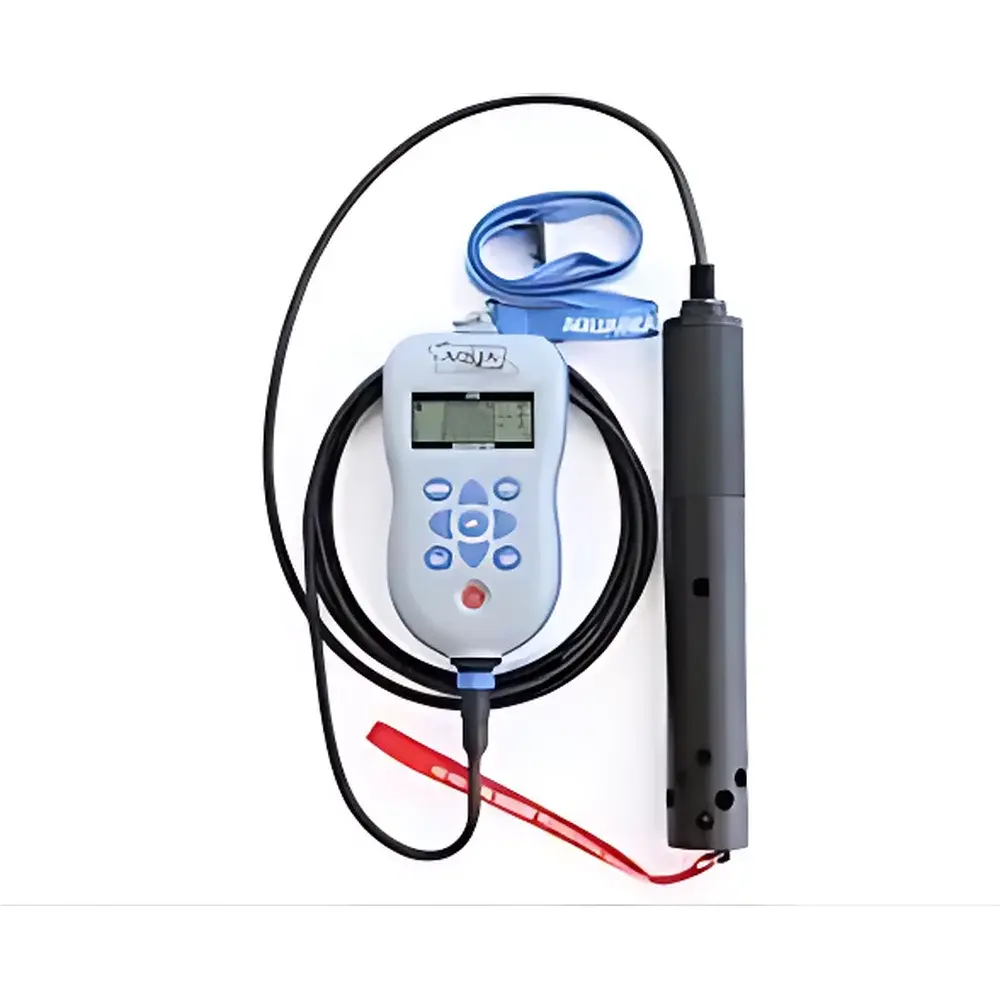
Aquaread AP-800 Portable Multiparameter Water Quality Analyzer
| Brand | Aquaread |
|---|---|
| Origin | United Kingdom |
| Model | AP-800(2) |
| Instrument Type | Portable/Handheld Water Quality Analyzer |
| Enclosure Rating | IP68 (sensor), IP67 (Aquameter display unit) |
| Construction | Marine-grade anodized aluminum housing |
| Cable Length | 3 m (replaceable) |
| Measured Parameters | pH, ORP, Conductivity, Dissolved Oxygen (DO), Temperature, Turbidity (AP-800 only) |
| Compliance | CE, RoHS, UKCA |
| Software | AquaLink v5.x (Windows/macOS) with GLP-compliant data logging and audit trail |
Overview
The Aquaread AP-800 Portable Multiparameter Water Quality Analyzer is a field-deployable, optical-electrochemical sensing platform engineered for high-reliability in situ monitoring of freshwater, estuarine, and marine environments. Built upon Aquaread’s proprietary modular sensor architecture, the AP-800 integrates six core water quality parameters—pH, oxidation-reduction potential (ORP), electrical conductivity (EC), dissolved oxygen (DO), temperature, and turbidity—into a single, ruggedized probe assembly. Its measurement methodology combines potentiometric (pH/ORP), conductometric (EC), luminescence-based optical (DO), and near-infrared scattering (turbidity) principles to ensure long-term stability and minimal drift under variable salinity, flow, and biofouling conditions. Designed for compliance with international environmental monitoring protocols—including ISO 5667-3 (water sampling), ASTM D1293 (pH), ASTM D888 (DO), and EN 27888 (conductivity)—the AP-800 supports regulatory-grade data acquisition in both research and operational contexts.
Key Features
- Marine-grade anodized aluminum housing rated IP68 for continuous submersion up to 50 m depth; Aquameter display unit rated IP67 for rain-resistant operation
- Modular, field-replaceable sensor cartridges—no tool required for pH, DO, turbidity, or conductivity module swaps
- Integrated temperature compensation across all electrochemical and optical sensors using a high-accuracy Pt1000 thermistor
- Optical DO sensor based on phase-fluorometry, eliminating membrane replacement and electrolyte refills; stable for >12 months in seawater
- Turbidity measurement via 90° NIR scattering (850 nm LED source), compliant with ISO 7027; range 0–1000 NTU with <±2% FS accuracy
- Three-meter detachable cable with stainless-steel strain relief and waterproof M12 connectors; factory-replaceable without recalibration
- Onboard memory stores >100,000 timestamped readings with GPS-tagged metadata (when paired with optional external GNSS)
Sample Compatibility & Compliance
The AP-800 operates across a broad physicochemical spectrum: freshwater (0–1000 µS/cm EC), brackish water (1–50 mS/cm), and full-strength seawater (up to 55 mS/cm). Its titanium-sheathed pH and ORP electrodes resist chloride poisoning; the DO sensor maintains linearity from 0–20 mg/L across 0–40 °C. All sensors meet ISO/IEC 17025 traceability requirements when calibrated using NIST-traceable standards. The system complies with EU Water Framework Directive (WFD) monitoring specifications and supports EPA Method 180.1 (turbidity), USP (particulate matter), and GLP/GMP data integrity requirements through encrypted, tamper-evident file export. Calibration verification logs include operator ID, date/time stamp, standard values used, and deviation metrics—all retained for FDA 21 CFR Part 11–compliant audit trails when using AquaLink software.
Software & Data Management
AquaLink v5.x is a desktop application supporting Windows 10/11 and macOS 12+, providing real-time telemetry, automated calibration workflows, and customizable reporting templates. Data files are stored in encrypted .aqd format with SHA-256 checksums; export options include CSV, PDF (with embedded calibration certificates), and XML for LIMS integration. The software enforces electronic signatures, session locking, and role-based access control (RBAC) to satisfy ALCOA+ principles (Attributable, Legible, Contemporaneous, Original, Accurate). Field data syncs via USB-C or Bluetooth 5.0 to the Aquameter unit, enabling offline logging with automatic time synchronization upon reconnection. Firmware updates are delivered via signed OTA packages verified against Aquaread’s public key infrastructure.
Applications
- Regulatory compliance monitoring for WFD, Clean Water Act Section 305(b), and EU Marine Strategy Framework Directive
- Long-term ecological studies in rivers, lakes, wetlands, and coastal zones requiring multi-parameter trend analysis
- Ballast water management verification per IMO G8 guidelines (pH, EC, DO, turbidity as proxy for organism viability)
- Academic fieldwork where instrument portability, battery life (>24 h continuous use), and sensor interchangeability reduce logistical overhead
- Emergency response deployments—rapid setup for post-spill or algal bloom assessment with turbidity-triggered DO/pH anomaly detection
- Calibration reference for fixed-site monitoring networks; AP-800 serves as a mobile validation standard for station-based sondes
FAQ
What is the maximum operating depth for the AP-800 sensor probe?
The AP-800 sensor is rated IP68 to 50 meters static water pressure; however, dynamic profiling beyond 10 m requires optional depth-rated cable strain relief.
Can the AP-800 be used in highly turbid or sediment-laden waters?
Yes—the NIR turbidity sensor includes automatic gain adjustment and anti-fouling wiper compatibility (optional); optical path length is optimized to minimize scattering saturation at >400 NTU.
Is calibration traceable to national metrology institutes?
All factory calibrations use NIST-traceable buffer solutions (pH), certified conductivity standards (KCl), and WTW-certified DO saturation tables; calibration certificates include uncertainty budgets per ISO/IEC 17025.
How does the AP-800 handle biofouling in long-term deployments?
The DO sensor uses fouling-resistant optical chemistry; pH/ORP electrodes feature double-junction reference systems with KNO₃ electrolyte; optional copper-alloy anti-fouling sleeves are available for extended immersion.
Does AquaLink support automated report generation for regulatory submissions?
Yes—preconfigured templates comply with EPA Form 3330-1, Environment Agency WQMS, and EEA Waterbase formats; reports include metadata, calibration history, QA/QC flags, and statistical summaries (min/max/mean/stdev).







