
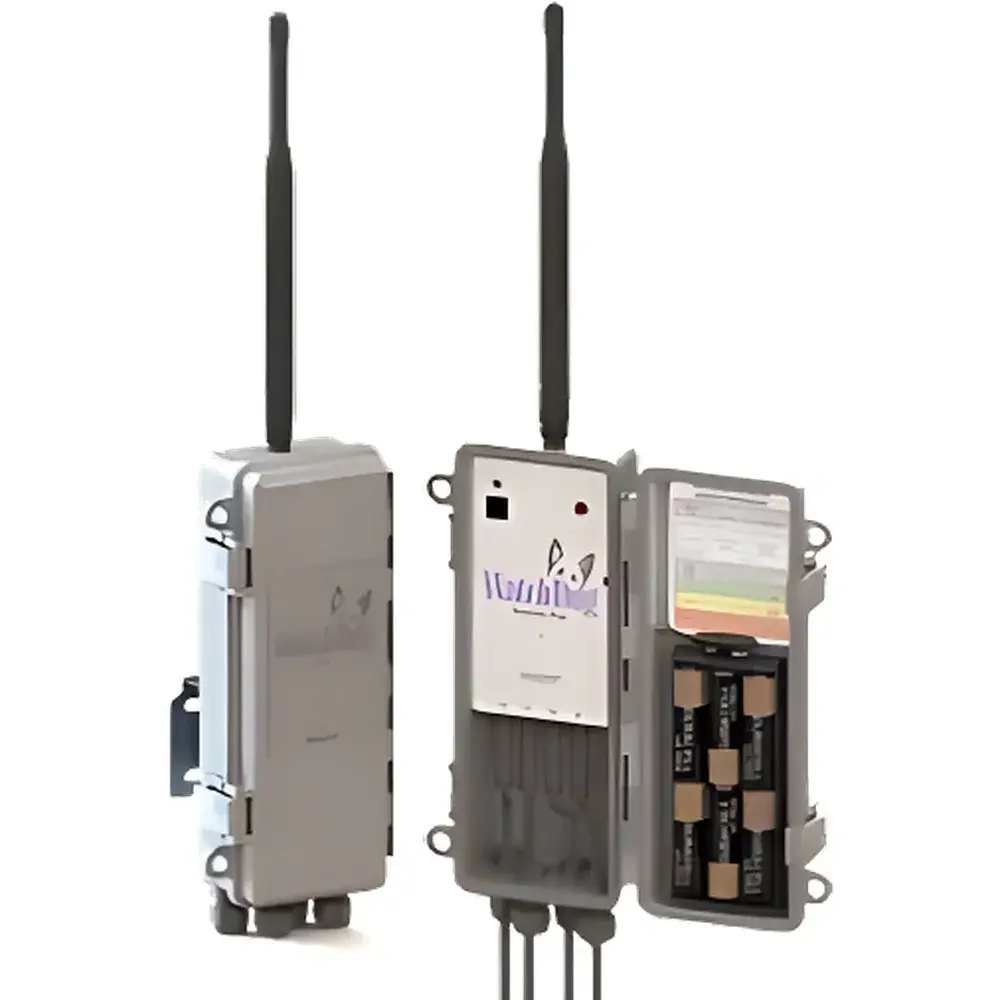
Spectrum Technologies WatchDog 3900 Wireless Mesh Network Weather Monitoring System
| Brand | Spectrum Technologies |
|---|---|
| Origin | USA |
| Model | WatchDog 3900 |
| Communication Frequencies | 900 MHz / 2.4 GHz |
| Max. Hop Count | 4 |
| Inter-node Range | 762 m (2500 ft) |
| Sensor Pup Channels | 16 data channels, 4 sensor ports |
| Station Pup Compatibility | WatchDog 2000 Series & Mini Weather Stations |
| Data Logging Interval | 1–60 min (configurable) |
| Onboard Memory | 4 GB internal + USB flash drive expansion |
| Power | 6 × AA alkaline (8-month typical life) or optional 5 W solar panel + 7.2 V NiMH 2200 mAh battery |
| Enclosure Rating | IP65 |
| Retriever Capacity | Up to 16 Pups, ~6 months of storage at 15-min intervals |
| Data Transmission | USB direct download, cellular (4G), GSM/GPRS, Wi-Fi via optional modem |
| Software Access | Desktop client, web browser interface, iOS/Android mobile app |
Overview
The Spectrum Technologies WatchDog 3900 Wireless Mesh Network Weather Monitoring System is an industrial-grade, self-organizing environmental telemetry platform engineered for long-term, unattended operation across distributed agricultural and ecological sites. Built upon a robust IEEE 802.15.4-compliant mesh architecture, the system employs adaptive routing to maintain reliable data integrity in dynamic outdoor environments—where terrain, vegetation, and infrastructure may obstruct line-of-sight RF propagation. Unlike point-to-point or star-topology weather networks, the WatchDog 3900 dynamically selects optimal transmission paths between Pup nodes, limiting latency and packet loss while supporting up to four sequential hops. Its core measurement paradigm integrates real-time meteorological, edaphic, and radiometric parameters—enabling evidence-based decision support for irrigation scheduling, pest pressure modeling, frost mitigation, and crop quality optimization. Designed for compliance with USDA ARS field deployment standards and aligned with FAO’s Agroclimatic Data Collection Guidelines, the system delivers traceable, time-stamped environmental records suitable for agronomic research, regulatory reporting, and precision agriculture program validation.
Key Features
- Self-healing wireless mesh network with automatic node discovery and route optimization
- Three node types: Sensor Pup (4 analog/digital sensor inputs, 16-channel logging), Station Pup (direct integration with WatchDog 2000-series or Mini Weather Stations), and Repeater Pup (RF range extension without sensing capability)
- IP65-rated enclosures for continuous outdoor exposure to rain, dust, and UV radiation
- Dual-band RF operation (900 MHz for extended rural range; 2.4 GHz for high-throughput local deployment)
- Configurable logging intervals from 1 to 60 minutes, with per-channel timestamping of instantaneous, min/max, and rolling average values
- Onboard 4 GB non-volatile memory; expandable via industry-standard USB flash drives (FAT32 formatted)
- Flexible power options: 6×AA alkaline (8-month nominal life under typical duty cycle) or field-deployable solar charging kit (5 W monocrystalline panel + 7.2 V NiMH 2200 mAh battery)
- Optional embedded cellular modem supporting LTE Cat-1 (4G), GSM/GPRS, and Wi-Fi 802.11 b/g/n for remote data push to cloud-hosted or on-premise servers
Sample Compatibility & Compliance
The WatchDog 3900 supports heterogeneous sensor integration across multiple environmental domains. Sensor Pups accept industry-standard analog (0–5 V, 4–20 mA) and digital (SDI-12, pulse-count) outputs from third-party and Spectrum-manufactured transducers—including air temperature/humidity (±0.3 °C, ±3 % RH), wind speed/direction (cup/anemometer + vane), tipping-bucket rainfall (0.2 mm resolution), PAR and solar irradiance (μmol/m²/s), volumetric water content (TDR/FDR probes), and soil EC (dS/m). Station Pups natively acquire full parameter sets from WatchDog 2000-series stations (e.g., barometric pressure, dew point, leaf wetness) and Mini Weather Stations. All hardware conforms to FCC Part 15 Subpart C (900 MHz/2.4 GHz ISM bands) and IC RSS-247 (Canada). Data structures adhere to OGC SensorML 2.0 metadata conventions and are exportable in CSV, JSON, and NetCDF formats—facilitating ingestion into USDA Water Management Information Systems (WMIS), CIMIS, or ISO 11464-compliant soil moisture databases.
Software & Data Management
Data acquisition, visualization, and alerting are managed through Spectrum’s proprietary WatchDog Live platform—a multi-tiered software suite supporting desktop (Windows/macOS), web (HTML5-compliant browsers), and mobile (iOS/Android) clients. The system implements role-based access control (RBAC), audit-trail logging per FDA 21 CFR Part 11 Annex 11 requirements, and TLS 1.2+ encrypted data transit. Raw sensor time series are stored with microsecond-precision timestamps, and derived metrics—including dew point depression, vapor pressure deficit (VPD), growing degree days (GDD), and accumulated evapotranspiration (ETo)—are computed using ASCE-EWRI standardized Penman-Monteith equations. Automated email/SMS alerts trigger on user-defined thresholds (e.g., soil moisture < 12 % VWC, air temperature < 2 °C for frost warning). Historical datasets are exportable in ISO 8601-compliant time-series format, compatible with R, Python (Pandas), MATLAB, and commercial analytics platforms such as SAS Viya and Tableau.
Applications
- Precision irrigation management via real-time soil moisture and atmospheric demand (VPD) correlation
- Frost event prediction and automated activation of anti-frost irrigation or wind machines
- Disease forecasting models (e.g., Botrytis, powdery mildew) using leaf wetness duration, relative humidity, and temperature accumulation
- Insect phenology modeling (e.g., codling moth, corn earworm) based on degree-day accumulation and microclimate gradients
- Regulatory compliance monitoring for USDA NRCS EQIP, EPA Clean Water Act Section 319 reporting, and state-level irrigation efficiency certification programs
- Long-term climate trend analysis in university extension trials, USDA ARS experimental farms, and private agribusiness R&D plots
FAQ
What is the maximum number of Pup nodes supported by a single Retriever unit?
A WatchDog 3900 Retriever can manage up to 16 Pup nodes—comprising any combination of Sensor Pups, Station Pups, and Repeaters.
Can the system operate entirely off-grid for extended periods?
Yes. With the optional solar charging kit (5 W panel + 7.2 V NiMH 2200 mAh battery), the Retriever and Pup nodes sustain continuous operation across all seasons in latitudes ≤ 45°N, assuming ≥ 4 h daily insolation.
Is raw sensor calibration data preserved in the logged files?
Yes. Each record includes embedded sensor serial numbers, factory calibration coefficients, and user-applied linearization offsets—ensuring full metrological traceability per ISO/IEC 17025:2017 Clause 7.6.
Does the system support integration with third-party farm management software (FMS)?
Yes. RESTful API endpoints and MQTT brokers are available via the optional cellular/Wi-Fi modem, enabling bidirectional synchronization with platforms including Climate FieldView, Granular, and FarmLogs.
How is data security enforced during wireless transmission?
All RF communications employ AES-128 encryption at the MAC layer; cellular/Wi-Fi transmissions use TLS 1.2+ with certificate-pinned endpoints and configurable firewall rules.







