
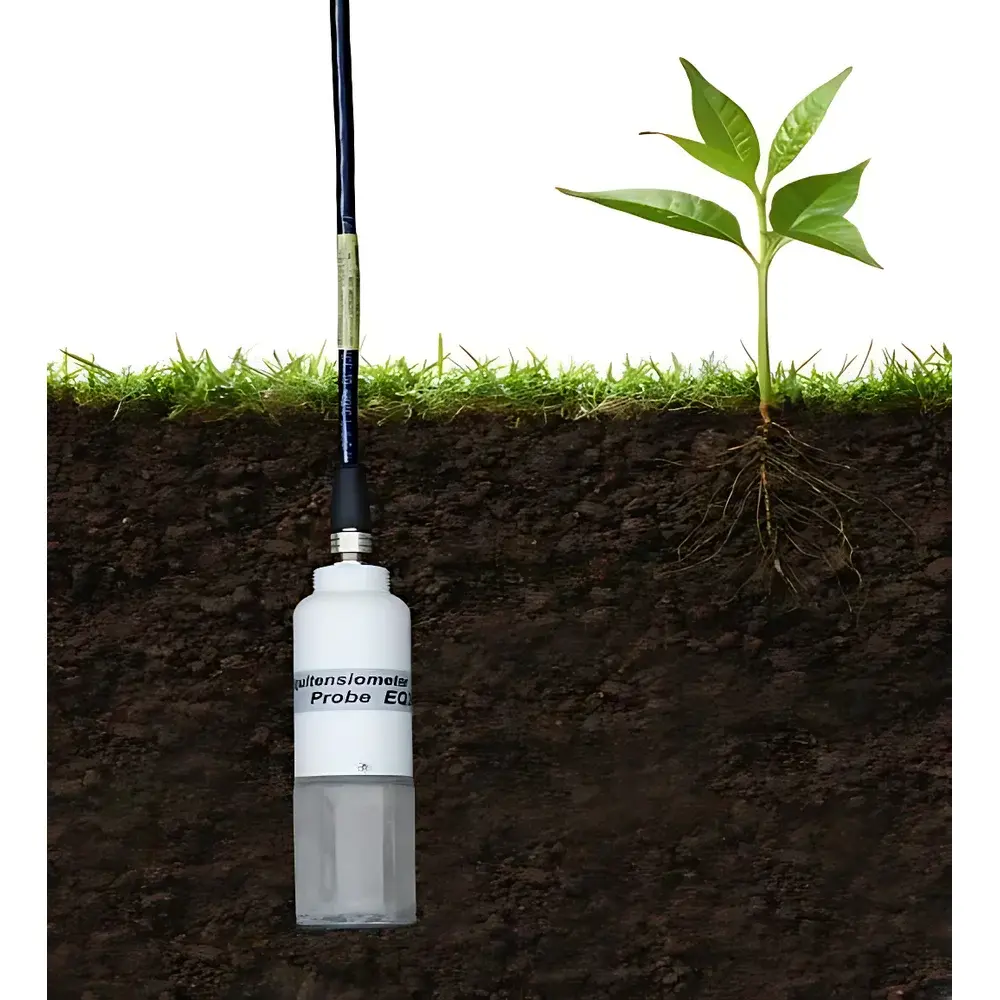
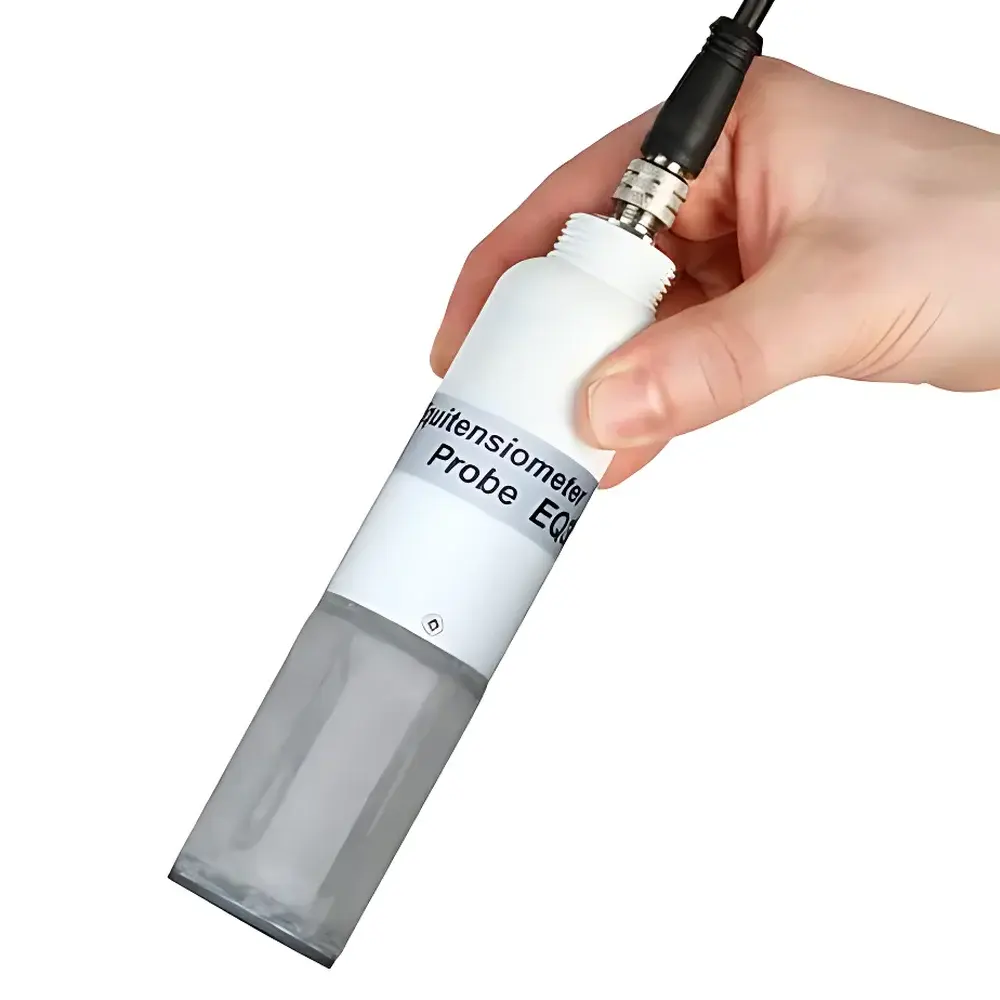
Delta-T EQ3 Equitensiometer Soil Water Potential Meter
| Brand | Delta-T |
|---|---|
| Origin | UK |
| Model | EQ3 Equitensiometer |
| Instrument Type | Soil Water Potential (Matric Potential) Meter |
| Measurement Range | 0 to −1000 kPa |
| Accuracy | ±10 kPa (0 to −100 kPa), ±10% of reading (−100 to −1000 kPa) |
| Temperature Accuracy | ±0.5°C (0–40°C), ±0.75°C (−20–+60°C) |
| Output | 0–1.0 V (non-linear), with individual calibration curve |
| IP Rating | IP68 |
| Power Supply | 5–14 V DC, 18 mA per reading |
| Probe Dimensions | 181 mm × 40.5 mm Ø |
| Weight | 0.3 kg |
| Calibration Interval | Recommended every 2 years |
| Compatible Loggers | Delta-T GP2, DL6, GP1, HH2, DL2e |
Overview
The Delta-T EQ3 Equitensiometer is an engineered solution for continuous, in-situ measurement of soil matric potential—the primary component of total soil water potential governing water movement and plant availability in unsaturated soils. Unlike traditional tensiometers requiring frequent maintenance, vacuum refilling, and bubble removal, the EQ3 operates on a thermodynamic equilibrium principle rooted in the well-characterized relationship between water content and matric potential within a calibrated porous ceramic matrix (the “equilibrium body”). The sensor integrates a high-stability ML3 ThetaProbe moisture sensor embedded directly into this matrix. As soil moisture conditions change, the ceramic equilibrates with surrounding soil matric potential; the resulting volumetric water content of the ceramic is measured and converted to matric potential using a device-specific, factory-derived calibration curve. This method eliminates hydraulic discontinuity, avoids freezing-point limitations of liquid-filled systems, and enables reliable operation down to −20°C—including in seasonally frozen ground—making the EQ3 uniquely suited for long-term ecological, agronomic, and geotechnical monitoring programs.
Key Features
- True matric potential measurement via ceramic equilibrium body and integrated ThetaProbe technology
- Maintenance-free operation: no refilling, no degassing, no capillary breakage concerns
- IP68-rated housing ensures full submersion capability and long-term burial stability
- Integrated Pt1000-class temperature sensor (±0.5°C accuracy in 0–40°C range) for simultaneous soil thermal profiling
- Wide operational range: 0 to −1000 kPa (0 to −10 bar), with enhanced resolution and repeatability between −100 and −500 kPa—optimal for detecting plant water stress thresholds
- Low-power analog output (0–1.0 V, non-linear) compatible with industry-standard data loggers without signal conditioning
- Robust mechanical design: stainless-steel probe body, ceramic equilibrium element, and UV-stabilized cable jacket
Sample Compatibility & Compliance
The EQ3 is validated for use in non-saline, mineral, and organic soils across diverse textures—from sandy loams to clay-rich profiles—as well as horticultural substrates (e.g., peat-perlite mixes, coconut coir). It is not recommended for highly saline environments (>4 dS/m EC) due to ionic interference with ceramic-water interaction kinetics. All units are manufactured under ISO 9001-certified processes at Delta-T Devices’ UK facility and conform to IEC 60529 (IP68 ingress protection), EN 61326-1 (EMC for laboratory and field instrumentation), and RoHS 2011/65/EU. Calibration certificates traceable to NPL (UK National Physical Laboratory) standards are supplied with each unit. For regulated environmental monitoring or GLP-compliant research, the EQ3 supports audit-ready data collection when paired with Delta-T loggers configured for time-stamped, tamper-evident storage (aligned with ALCOA+ principles).
Software & Data Management
Raw voltage outputs from the EQ3 are converted to matric potential (kPa) and temperature (°C) using the included calibration equation—typically a third-order polynomial or segmented look-up table—available in CSV and Excel formats. Delta-T’s Loggernet and PC-Logger software natively support EQ3 integration, enabling automated linearization, unit conversion, and metadata tagging (e.g., depth, soil type, installation date). When connected to GP2 or DL6 loggers, data can be exported in CFStandard-compliant NetCDF files for interoperability with R, Python (via netCDF4), or MATLAB workflows. All logger configurations support timestamped, battery-voltage-compensated readings and optional SD-card backup—critical for unattended deployments exceeding 12 months. While the EQ3 itself does not store data, its analog interface ensures compatibility with third-party systems compliant with IEEE 1451.2 transducer electronic data sheet (TEDS) conventions.
Applications
- Long-term phenological studies linking soil water status to root-zone dynamics and stomatal conductance
- Irrigation scheduling in precision viticulture and orchard management, particularly under deficit irrigation regimes
- Permafrost and seasonally frozen soil hydrology—validated performance at −20°C enables winter monitoring without sensor retrieval
- Slope stability assessment in civil engineering, where matric suction governs shear strength in unsaturated fill materials
- Ecohydrological modeling input for SWAT, HYDRUS-1D, or ParFlow simulations requiring spatially distributed matric potential time series
- Regulatory compliance monitoring for landfill cover systems and constructed wetland evapotranspiration budgets
FAQ
How does the EQ3 differ from conventional tensiometers?
It replaces fluid-filled ceramic cups and vacuum manometers with a solid-state equilibrium matrix and dielectric moisture sensing—eliminating hydraulic failure modes and enabling freeze-tolerant deployment.
Can the EQ3 be used in saline soils?
No. Elevated electrolyte concentrations disrupt the ceramic–water matric potential relationship; use only in non-saline soils (<4 dS/m EC).
What is the recommended recalibration interval?
Delta-T recommends verification every 24 months under typical field conditions; more frequent checks are advised after exposure to extreme desiccation or mechanical shock.
Is temperature compensation automatic?
Yes—the integrated temperature sensor provides real-time correction within the calibration algorithm; no external thermistor is required.
Does the EQ3 meet FDA 21 CFR Part 11 requirements?
The sensor itself is not a regulated medical device; however, when deployed with Delta-T GP2 loggers configured for electronic signatures, audit trails, and role-based access, full Part 11 compliance is achievable in environmental QA/QC workflows.
Related Products







