
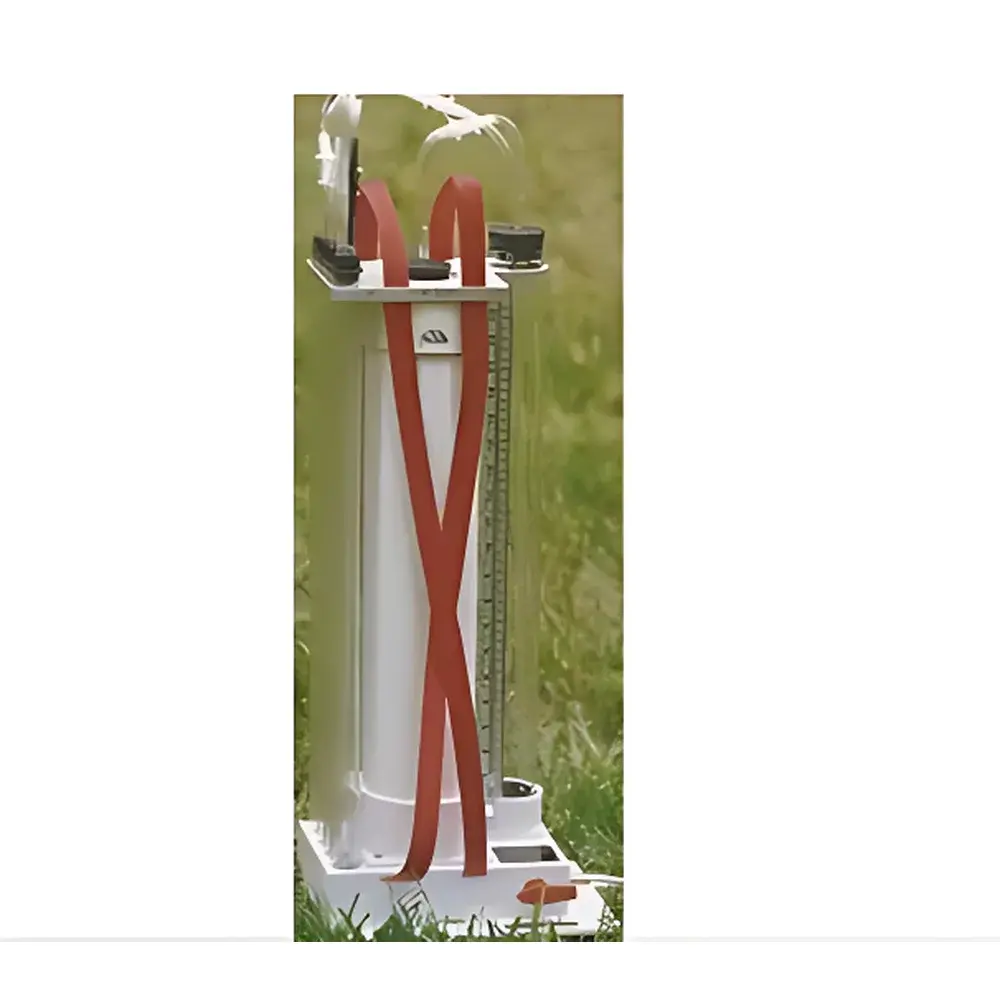
K-SAT Soil Saturated Hydraulic Conductivity Analyzer
| Origin | Germany |
|---|---|
| Manufacturer Type | Authorized Distributor |
| Origin Category | Imported Instrument |
| Model | K-SAT |
| Instrument Type | Soil Moisture / Matric Potential Analyzer |
| Ksat Measurement Range | 0.01–5000 cm/d |
| Ceramic Plate Ksat | 20,000 cm/d |
| Measurement Accuracy | ±2% |
| Pressure Sensor Accuracy | ±1 Pa |
| Temperature Sensor Accuracy | ±0.2 °C |
| Sample Volume | 250 mL |
| Ring Sampler Dimensions | 50 mm height × 80 mm internal diameter |
Overview
The K-SAT Soil Saturated Hydraulic Conductivity Analyzer is a precision laboratory instrument engineered for the quantitative determination of saturated hydraulic conductivity (Ks) in undisturbed soil cores, based on Darcy’s Law under controlled steady-state flow conditions. It operates by establishing a constant hydraulic head gradient across a fully saturated soil specimen—typically mounted between two porous ceramic plates—and measuring volumetric water flux over time. The system maintains laminar, vertically upward flow through the sample under precisely regulated pressure differentials, eliminating evaporation loss and ensuring thermodynamic equilibrium during measurement. Designed for reproducible, traceable soil hydraulic characterization, the K-SAT delivers Ks values critical to vadose zone hydrology, irrigation scheduling, contaminant transport modeling, and regulatory soil permeability assessment in accordance with ASTM D5084 and ISO 11274 standards.
Key Features
- Automated temperature compensation integrated into Ks calculation algorithms, referencing real-time sensor data (±0.2 °C accuracy) to correct for viscosity and density variations in water across 5–40 °C.
- High-stability ceramic plate system (Ks > 20,000 cm/d) enabling uniform water entry without preferential flow or boundary clogging, validated per ISO 27209 for porous media performance.
- Dual high-resolution pressure transducers (±1 Pa) independently monitoring inlet and outlet heads, supporting dynamic range from low-permeability clays (0.01 cm/d) to highly conductive gravels (5000 cm/d).
- Sealed, evaporation-free measurement chamber with integrated overflow collection and digital volumetric flow accumulation—eliminating manual gravimetric weighing errors and operator dependency.
- Robust mechanical architecture accommodating standard 50 mm × 80 mm ring samplers (250 mL volume), compatible with field-collected monoliths preserved in aluminum or stainless-steel cores.
Sample Compatibility & Compliance
The K-SAT accepts intact soil cores collected using standardized ring samplers meeting ISO 28580 specifications. It supports mineral soils ranging from heavy clay (plasticity index > 25) to coarse sand (USDA textural class: loamy sand to gravelly sand), provided structural integrity is maintained during extraction and handling. The instrument conforms to GLP-compliant operation protocols, including audit-trail-enabled parameter logging, timestamped raw data capture, and user-accessible calibration certificates traceable to NIST-certified pressure and temperature references. All measurement procedures align with ASTM D5084-22 (“Standard Test Method for Measurement of Saturated Hydraulic Conductivity”) and support documentation required for EPA Region IV groundwater vulnerability assessments and EU Soil Thematic Strategy reporting.
Software & Data Management
The K-SAT is operated via dedicated Windows-based software that implements ISO/IEC 17025-aligned data acquisition workflows. Each test session automatically generates a structured XML metadata file containing instrument configuration, environmental conditions, raw pressure/time series, cumulative outflow volumes, calculated Ks, and uncertainty propagation per GUM (Guide to the Expression of Uncertainty in Measurement). Software features include configurable test duration, automatic endpoint detection based on flow stabilization thresholds (e.g., <1% variation over 10 min), and export to CSV, PDF, or LIMS-compatible formats. Audit trails record all user actions—including method edits, calibration events, and result approvals—in compliance with FDA 21 CFR Part 11 requirements when deployed in regulated environmental testing laboratories.
Applications
- Quantifying infiltration capacity for agricultural land-use planning and drainage design in accordance with FAO Irrigation and Drainage Paper No. 56.
- Parameterizing numerical models of subsurface solute transport (e.g., HYDRUS-1D, MODFLOW-NWT) used in site remediation and landfill liner performance evaluation.
- Supporting regulatory submissions under EU Directive 2008/98/EC on waste acceptance criteria for engineered soil barriers.
- Validating biochar-amended soil hydraulic properties in climate-smart agriculture research.
- Calibrating in-situ tension infiltrometer and double-ring infiltrometer field data against laboratory reference values.
FAQ
What soil sample preparation is required prior to K-SAT measurement?
Soil cores must be saturated slowly from the bottom up using de-aired water over ≥24 h to avoid air entrapment; optional vacuum saturation may be applied for low-permeability samples.
Can the K-SAT measure anisotropic conductivity (e.g., vertical vs. horizontal Ks)?
Yes—by reorienting the core within the chamber, users can assess directional differences; however, horizontal measurements require custom mounting fixtures not included in base configuration.
Is the ceramic plate replaceable, and what is its service life?
Ceramic plates are field-replaceable consumables with typical longevity exceeding 500 tests under proper cleaning (HCl rinse + ultrasonic bath); replacement kits include NIST-traceable certification.
Does the system support automated multi-sample sequencing?
No—the K-SAT is a single-core analyzer; high-throughput labs typically deploy parallel units or integrate with robotic core handling systems via RS-232/Modbus TCP interface.
How is measurement uncertainty quantified in the final Ks report?
Total expanded uncertainty (k=2) is computed from combined contributions of pressure differential error, volumetric collection error, temperature-dependent water property uncertainty, and geometric tolerance of the ring sampler—reported alongside each result.
Related Products







