
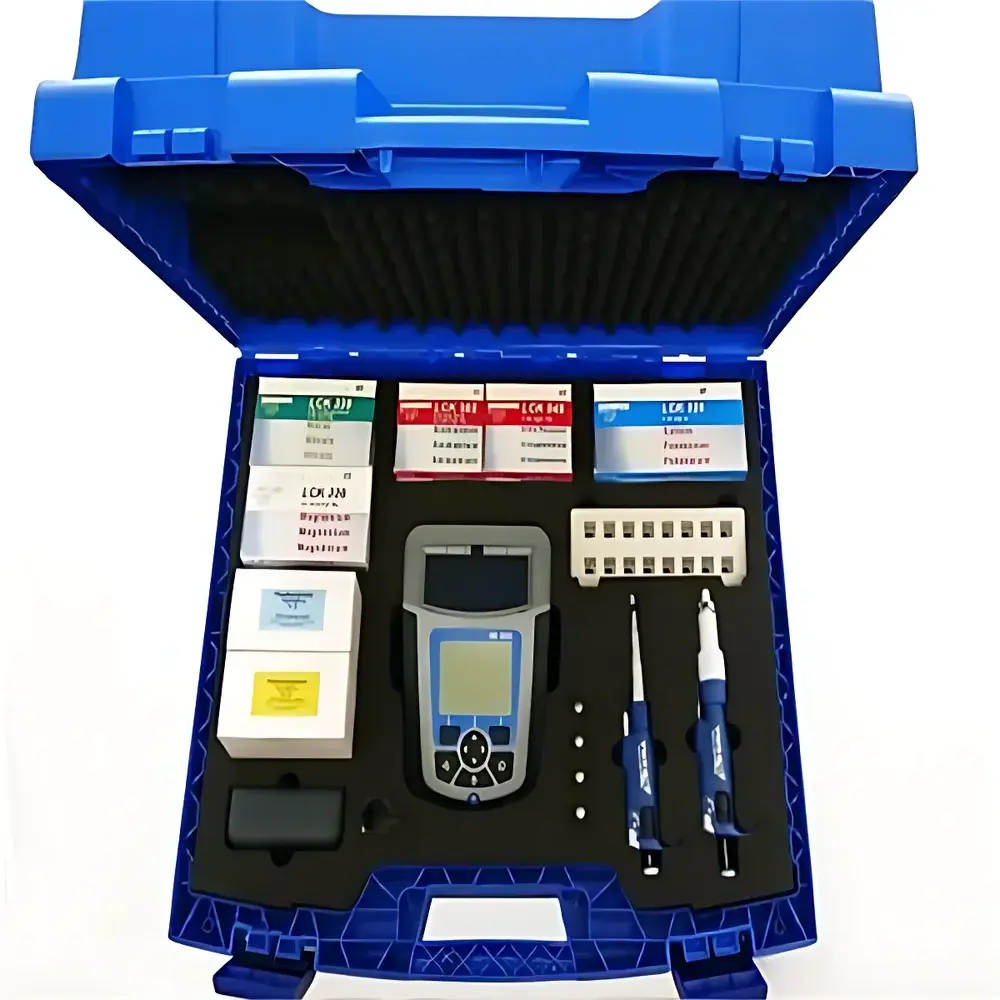
COMBI5000 Multi-Parameter Soil Analyzer (pH, EC, Salinity, Moisture, Temperature)
| Origin | Germany |
|---|---|
| Manufacturer Type | Authorized Distributor |
| Origin Category | Imported Instrument |
| Model | COMBI5000 |
| Instrument Type | Multiparameter Soil Analyzer |
| Connector | BNC & 8-pin proprietary interface |
| Weight | 280 g |
| Resolution | 0.01 g/L (salinity), 0.1 % (moisture), 0.1 °C (temperature) |
| Probe Material | Stainless steel with dual-pin sensor architecture |
| Operating Range | Moisture 0–100 % v/v |
Overview
The COMBI5000 Multi-Parameter Soil Analyzer is a field-deployable, handheld instrument engineered for simultaneous in-situ measurement of five critical soil physicochemical parameters: pH, electrical conductivity (EC), salinity (expressed as g/L), volumetric moisture content, and temperature. Designed around embedded microprocessor architecture, the device implements automatic sensor recognition upon physical connection—eliminating manual mode selection and reducing operator error. Its measurement principle integrates potentiometric pH detection (via glass electrode), conductometric EC/salinity determination (using dual-pin stainless-steel electrodes calibrated for soil matrix compatibility), capacitive or dielectric-based moisture sensing (optimized for heterogeneous substrates including peat, coco coir, and mineral soils), and precision thermistor-based temperature acquisition. The instrument is purpose-built for agronomic diagnostics, horticultural substrate monitoring, environmental site assessment, and controlled-environment agriculture (CEA) applications where rapid, repeatable, and location-specific soil status evaluation is required without laboratory sample transport.
Key Features
- Auto-sensing architecture: Identifies connected probe type (pH, EC/moisture/temperature combo, or standalone SMT probe) and configures measurement units and calibration logic accordingly.
- Dual-language interface: Factory-default English and German menu navigation; optional firmware localization available for French, Italian, Spanish, and Russian—supporting multilingual field teams and international deployment.
- IP67-rated housing: Fully sealed against dust ingress and immersion up to 1 m for 30 minutes, enabling reliable operation in humid greenhouses, open-field conditions, and rain-exposed substrates.
- Integrated calibration assistance: Automatic buffer recognition during pH calibration (pH 4.01 and 7.00 certified buffers included); eliminates manual input of standard values and ensures traceable calibration documentation.
- Lightweight ergonomics: 280 g total mass with balanced center-of-gravity design supports extended handheld use during large-area sampling campaigns.
- Flexible power architecture: Accepts digital supply (4–24 VDC) for direct integration into IoT gateways or dataloggers; analog output (12–24 VDC) supports legacy SCADA or PLC interfacing via 4–20 mA or 0–10 V signal conversion modules (external).
Sample Compatibility & Compliance
The COMBI5000 is validated for direct insertion measurements in undisturbed mineral soils, organic growing media (e.g., peat moss, bark, coconut coir), hydroponic substrates, and aqueous solutions such as irrigation water and nutrient reservoirs. Its stainless-steel dual-pin sensor geometry minimizes polarization effects and ensures stable EC readings across variable ionic strength ranges typical of agricultural runoff or fertilized leachate. While not certified to ISO/IEC 17025 for accredited testing, the instrument complies with fundamental metrological principles outlined in ISO 11277 (soil analysis — general guidance) and ASTM D4972 (standard test method for pH of soils). Calibration traceability follows NIST-traceable pH buffer standards (DIN 19268), and salinity output is reported in g/L per DIN 19680-2 (water quality — determination of salt content). Device firmware supports GLP-compliant audit trails when paired with compliant external data loggers.
Software & Data Management
The COMBI5000 operates as a stand-alone field instrument with no onboard data storage; however, its analog and digital I/O interfaces enable seamless integration into third-party environmental monitoring platforms. When connected to a compatible datalogger (e.g., Campbell Scientific CR1000X, HOBO UX120, or Decagon EM50), it supports time-stamped, multi-parameter datasets with configurable sampling intervals (1 min to 24 h). Exported CSV files include columns for timestamp, pH, EC (µS/cm), salinity (g/L), moisture (% v/v), and temperature (°C)—structured for direct ingestion into farm management software (e.g., Granular, Climate FieldView) or statistical analysis tools (R, Python pandas). No proprietary cloud platform is required; all data remain under user control and comply with GDPR and local data sovereignty requirements.
Applications
- Agronomic soil health screening: Rapid mapping of spatial pH and salinity gradients prior to planting or after fertilizer application.
- Horticultural substrate QC: Verification of peat-based or soilless media consistency across batches in nursery and greenhouse production.
- Irrigation water quality assessment: On-site verification of pH and EC stability in recirculating hydroponic systems to prevent nutrient lockout.
- Environmental remediation monitoring: Tracking changes in soil moisture and salinity during phytoremediation or desalination trials.
- Research-grade field phenotyping: Correlating real-time soil moisture–temperature–EC dynamics with crop water-use efficiency metrics in drought-stress experiments.
FAQ
Does the COMBI5000 require routine recalibration between field sites?
Yes—pH electrodes must be recalibrated before each new sampling session using certified pH 4.01 and 7.00 buffers; EC/salinity sensors should be verified weekly with KCl standard solution (1.413 mS/cm at 25 °C) if used daily.
Can the instrument measure pH in highly buffered substrates like compost or manure?
It is not recommended for high-organic, high-buffering matrices due to electrode fouling and junction potential drift; use only in mineral soils or standardized growing media per DIN 19680-1 guidelines.
Is the moisture sensor affected by soil texture or bulk density?
Capacitive moisture response varies with particle size distribution and pore geometry; factory calibration assumes loam-textured mineral soil—field-specific empirical correction factors are advised for clay or sandy extremes.
What is the expected service life of the pH electrode under regular field use?
With proper storage in 3 mol/L KCl solution and monthly cleaning, typical electrode lifespan is 12–18 months depending on exposure to heavy metals or sulfide-rich soils.
Does the device support FDA 21 CFR Part 11 compliance for regulated environments?
No—the COMBI5000 lacks electronic signature capability, audit trail logging, or user access controls; it is intended for non-GMP field diagnostics, not pharmaceutical or clinical soil testing.
Related Products







