
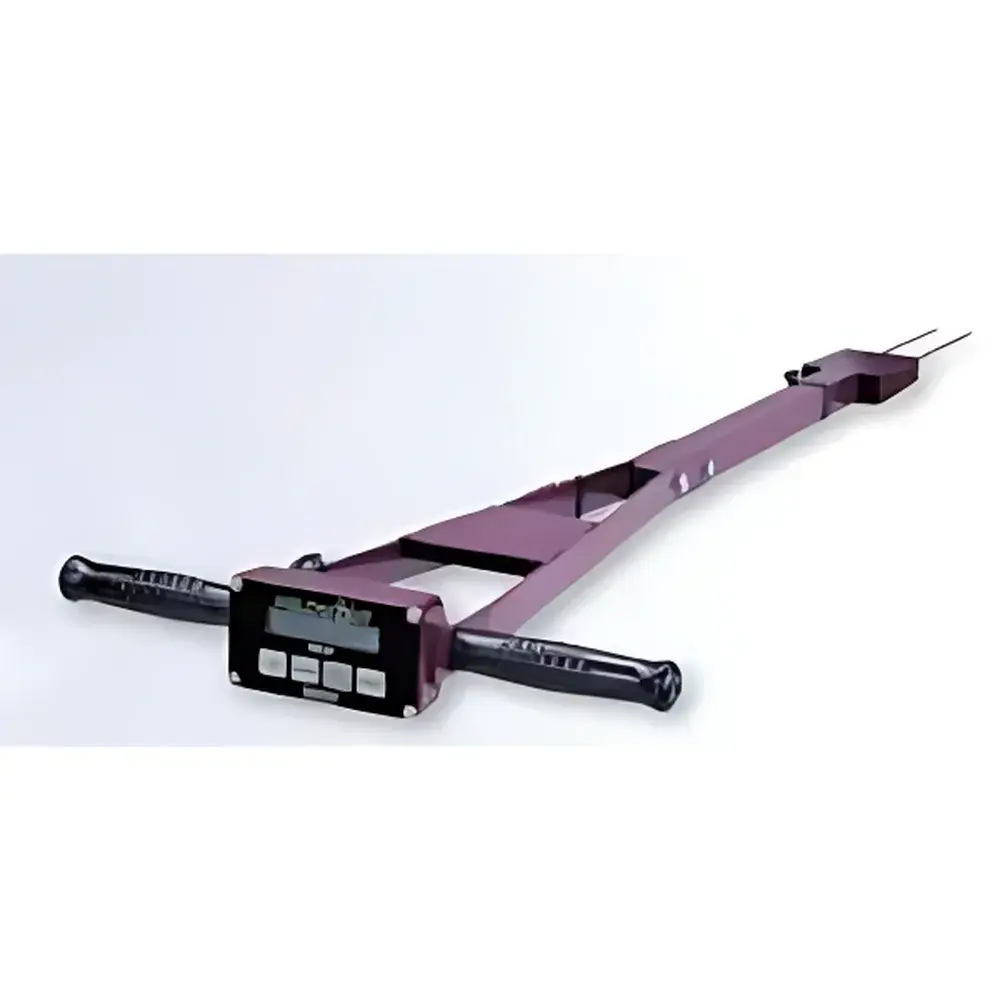
Spectrum TDR300 Time-Domain Reflectometry Soil Moisture Analyzer
| Origin | USA |
|---|---|
| Manufacturer Type | Authorized Distributor |
| Import Status | Imported |
| Model | TDR-300 |
| Instrument Type | Volumetric Water Content (VWC) and Relative Water Content (RWC) Analyzer |
| Measurement Principle | Time-Domain Reflectometry (TDR) |
| Range | 0–Saturation (v/v) |
| Accuracy | ±3.0% (for EC < 2 dS/m and clay content < 30%) |
| Resolution | 1.0% |
| Data Storage Capacity | 2,700 readings (1,250 with GPS synchronization) |
| Power Supply | 4 × AAA alkaline batteries (typical lifespan: ~12 months) |
| Weight | 1.36 kg |
| Display | Backlit LCD with on-device data logging |
| Communication Interface | RS-232 serial port |
| Probe Options | 3.8 cm, 7.5 cm, 12 cm, and 20 cm stainless steel rods (0.5 cm diameter, 3.3 cm inter-rod spacing) |
| Housing Dimensions (Meter) | 10.5 × 7.0 × 1.8 cm |
| Probe Housing Dimensions | 10.41 × 7.11 × 1.78 cm |
Overview
The Spectrum TDR300 is a field-deployable time-domain reflectometry (TDR) soil moisture analyzer engineered for high-reproducibility volumetric water content (VWC) and relative water content (RWC) measurements in situ. Based on the physical principle of electromagnetic pulse propagation and reflection along parallel stainless-steel probe rods, the TDR300 quantifies dielectric permittivity of the surrounding soil matrix—directly correlated to water volume fraction—without requiring soil-specific calibration under standard salinity and texture conditions. Its compact handheld architecture supports rapid, non-destructive point measurements across diverse land-use contexts including precision agriculture, turfgrass management, rangeland monitoring, greenhouse production, and controlled-environment research. The instrument operates independently of soil type within defined electrical conductivity (EC ≤ 2 dS/m) and clay fraction (<30%) limits, delivering traceable, physics-based data essential for irrigation scheduling, drought response planning, and long-term soil hydrological modeling.
Key Features
- True TDR-based measurement architecture compliant with ASTM D5778 and ISO 11276 standards for dielectric soil water assessment
- Dual-mode readout: direct volumetric water content (m³/m³) and normalized relative water content (RWC) optimized for irrigation threshold interpretation
- Onboard backlit LCD display with real-time numeric output and intuitive menu navigation
- Integrated data logger storing up to 2,700 timestamped readings (1,250 when synchronized with external GPS)
- RS-232 serial interface for direct connection to PCs or data loggers; compatible with Spectrum’s proprietary software suite for post-processing and visualization
- Modular probe system with four standardized lengths (3.8 cm, 7.5 cm, 12 cm, 20 cm) enabling depth-resolved profiling without recalibration
- Ruggedized housing (10.5 × 7.0 × 1.8 cm) and corrosion-resistant stainless-steel probes designed for repeated insertion into mineral and organic soils
- Battery-powered operation (4 × AAA) supporting continuous field use for approximately 12 months under typical sampling frequency (≤50 readings/day)
Sample Compatibility & Compliance
The TDR300 is validated for use in mineral soils, sandy loams, silty clays, and peat-based substrates where bulk electrical conductivity remains below 2 dS/m and clay content does not exceed 30% by mass. It meets functional requirements outlined in USDA NRCS Soil Survey Field and Laboratory Methods Manual (Chapter 4), and its measurement methodology aligns with FAO guidelines for agricultural water productivity assessment. While not certified for regulatory compliance under GLP or FDA 21 CFR Part 11, the device supports audit-ready data collection when paired with timestamped GPS coordinates and version-controlled firmware logs. All probe geometries maintain consistent rod spacing (3.3 cm) and diameter (0.5 cm), ensuring measurement comparability across depth intervals and field sites.
Software & Data Management
Data export occurs via RS-232 cable to Windows-based desktop applications provided by Spectrum Technologies, enabling CSV export, time-series plotting, spatial interpolation (when GPS-tagged), and batch statistical summary (mean, SD, min/max per site). The software enforces structured metadata capture—including operator ID, location code, probe depth, and ambient temperature—and generates PDF reports suitable for internal QA review or third-party agronomic consultation. No cloud dependency or subscription model is required; raw binary files retain full fidelity for reprocessing using custom MATLAB or Python scripts adhering to IEEE Std 1528-2019 conventions for TDR waveform analysis.
Applications
- Precision irrigation scheduling in row crops, orchards, and vineyards using VWC thresholds relative to field capacity and permanent wilting point
- Turfgrass moisture mapping on golf courses and sports fields to identify over/under-irrigated zones
- Rangeland health monitoring through seasonal VWC trends correlated with NDVI and precipitation records
- Greenhouse substrate moisture optimization to reduce leaching and improve nutrient use efficiency
- Calibration validation for permanent capacitance or neutron probe networks
- Undergraduate and graduate soil physics laboratory instruction demonstrating dielectric theory and sensor response curves
FAQ
Does the TDR300 require soil-specific calibration?
No—factory calibration is based on standard quartz-sand and kaolinite reference media. Field use assumes EC < 2 dS/m and clay < 30%. For high-salinity or heavy-clay soils, empirical correction factors may be applied post-measurement.
Can multiple probe lengths be used interchangeably with one meter unit?
Yes—the TDR300 electronics module accepts all four probe variants without hardware modification or firmware update.
Is GPS integration mandatory for spatial analysis?
No—GPS is optional. Spatial mapping requires external GPS/DGPS receiver connected via the dedicated interface cable; coordinate data are embedded in the logged record only when enabled.
What is the minimum recommended sample volume for accurate measurement?
The effective sensing volume approximates a cylindrical region 5 cm in radius and equal to probe length; ensure undisturbed soil contact and avoid air gaps during insertion.
How is measurement repeatability verified in practice?
Repeat measurements at identical locations show standard deviation ≤ ±0.8% VWC under stable soil conditions, consistent with published inter-laboratory TDR reproducibility studies (Soil Science Society of America Journal, Vol. 79, 2015).
Related Products







