
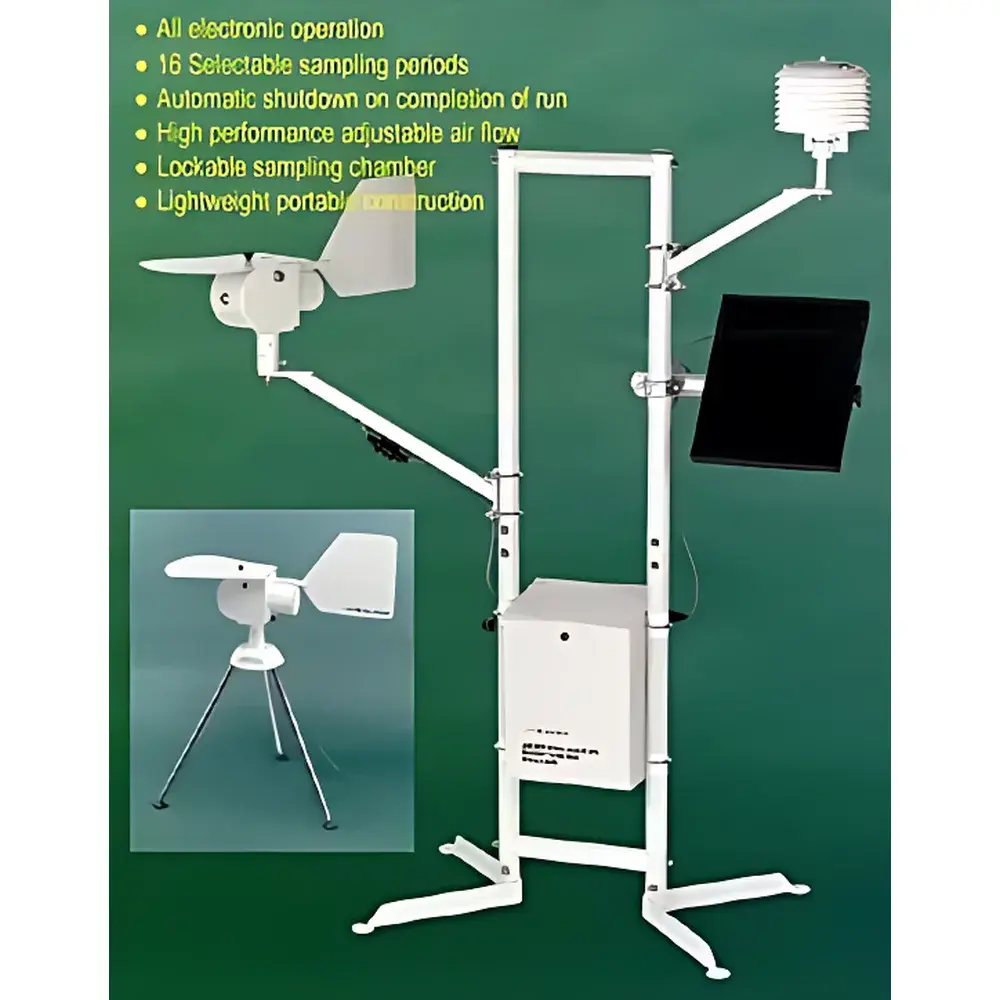
Burkard Spore Watch Automatic Volumetric Spore and Pollen Sampler
| Brand | Burkard |
|---|---|
| Origin | United Kingdom |
| Model | Spore Watch |
| Sampling Duration Options | 1–24 hr (1 hr increments), 2–7 days (1 day increments) |
| Airflow Rate | 10 L/min |
| Orifice Dimensions | 2 mm × 14 mm |
| Drum Advancement | 2 mm/hr (full 7-day cycle) |
| Sampling Surface Area | 0.882 m² (drum radius: 53 cm) |
| Power Supply | 12 V DC (AC adapter, rechargeable battery, or solar panel compatible) |
| Net Weight | 3.5 kg |
| Dimensions (L×W×H) | 240 × 100 × 550 mm |
| Drum Capacity | 200 standard microscope slides |
| Compliance | Fully compatible with Hirst-type spore trapping methodology per ISO 21527-1:2008 and EN 16814:2017 |
Overview
The Burkard Spore Watch is a fully electronic, volumetric spore and pollen sampler engineered for precision atmospheric bioaerosol monitoring in compliance with internationally recognized Hirst-type sampling principles. Designed and manufactured in the United Kingdom, it operates on the same fundamental aerodynamic impaction principle as the original Hirst spore trap—drawing ambient air at a calibrated flow rate of 10 L/min across a standardized orifice (2 mm × 14 mm), directing airborne particles onto a rotating adhesive-coated drum surface via inertial impaction. The drum advances continuously at 2 mm/hr, enabling time-resolved, high-resolution temporal profiling over extended periods (up to 7 days). Its compact form factor (240 × 100 × 550 mm), low power consumption, and multi-source power architecture (12 V DC via AC adapter, sealed lead-acid battery, or photovoltaic panel) make it suitable for permanent station deployment, mobile field campaigns, and remote ecological monitoring networks.
Key Features
- Fully microprocessor-controlled operation with 16 programmable sampling schedules—including hourly intervals (1–24 hr) and daily cycles (2–7 days)—ensuring protocol flexibility across epidemiological, agricultural, and regulatory use cases.
- Electronically regulated brushless motor drive eliminates mechanical clock dependency, delivering consistent drum advancement (2 mm/hr) and airflow stability without drift or manual calibration.
- Integrated environmental sensor interface supports concurrent logging of ambient temperature and relative humidity—critical for normalizing spore concentration data and interpreting diurnal dispersion patterns.
- Secure, lockable sample drum chamber and control housing meet field-deployment requirements for unattended operation in public or sensitive locations.
- Modular mounting system enables rapid installation on tripods, wall brackets, or custom masts; optimized for minimal wind turbulence interference and representative aspiration height (typically 1.5–2 m above ground level).
- Energy-efficient design achieves >14 days of continuous operation on a single 12 V/7 Ah battery under typical field conditions—enhanced by optional solar charging integration.
Sample Compatibility & Compliance
The Spore Watch is validated for quantitative collection of fungal conidia, ascospores, pollen grains, and other respirable biological particulates ≥3 µm aerodynamic diameter. Its orifice geometry, airflow rate, and drum rotation profile conform strictly to the Hirst methodology specified in ISO 21527-1:2008 (“Microbiology of food and animal feeding stuffs — Horizontal method for the enumeration of yeasts and molds — Part 1: Colony count technique”) and EN 16814:2017 (“Air quality — Standardised method for the determination of airborne fungal spores using the Hirst-type spore trap”). Data generated are directly comparable to legacy Hirst networks maintained by national health agencies, agricultural extension services, and aerobiological observatories worldwide. All components—including drum substrate, adhesive media, and slide handling protocols—support GLP-aligned documentation and traceability.
Software & Data Management
The device operates autonomously but interfaces with Burkard’s proprietary SporeWatch Manager software (Windows-based) for configuration, firmware updates, and event log retrieval. Timestamped operational logs—including start/stop times, motor status, voltage levels, and error flags—are stored onboard with non-volatile memory retention. While the instrument itself does not feature internal data storage for microscopic image capture, its standardized 200-slide drum format ensures full compatibility with automated slide scanning systems (e.g., Zephyr, AeroAllergen™) and digital image analysis platforms compliant with FDA 21 CFR Part 11 audit trail requirements when deployed in regulated environments.
Applications
- Aerobiological surveillance for early warning of allergenic pollen seasons (e.g., birch, grass, ragweed) and fungal pathogen outbreaks (e.g., Cladosporium, Alternaria, Botrytis) in public health and clinical allergy forecasting.
- Phytopathological monitoring in crop protection programs, supporting integrated pest management (IPM) decisions through real-time detection of rust, smut, and mildew spore loads.
- Baseline environmental impact assessments for construction, land-use change, or biomass facility permitting—aligned with EU Directive 2001/42/EC (SEA) and national air quality management frameworks.
- Long-term climate-biology interaction studies, including phenological correlation of spore release dynamics with meteorological variables (temperature, RH, wind speed, precipitation).
- Validation and cross-calibration of passive samplers, optical particle counters, and DNA-based eDNA air sampling systems.
FAQ
Is the Spore Watch certified to any international standards?
Yes—it adheres to the physical and operational specifications defined in ISO 21527-1:2008 and EN 16814:2017 for Hirst-type volumetric spore sampling.
Can it operate unattended for an entire pollen season?
With solar charging and periodic drum replacement (every 7 days), multi-month deployments are routinely achieved in field trials across Europe and North America.
Does it require routine calibration?
No scheduled calibration is required; airflow is maintained via factory-trimmed orifice and constant-speed motor control—though annual verification using a calibrated flow meter is recommended per ISO/IEC 17025 guidelines.
Is the drum compatible with automated microscopy systems?
Yes—the 200-position drum uses industry-standard 26 mm × 76 mm glass slides, compatible with all major slide-scanning platforms and AI-assisted identification pipelines.
What maintenance is required in the field?
Routine tasks include weekly visual inspection of orifice cleanliness, monthly battery voltage check, biannual motor lubrication (if specified in local operating manual), and replacement of adhesive tape or silicone oil coating per sampling protocol.



