
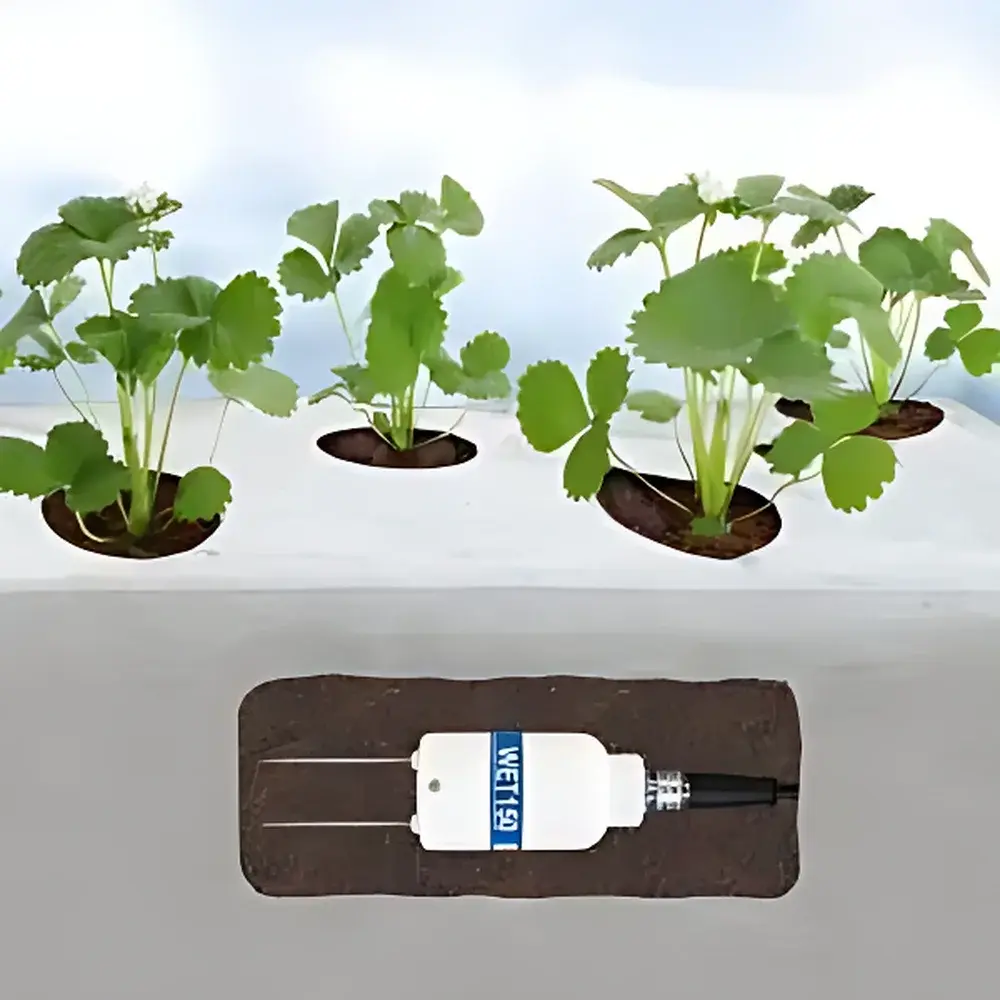
Delta-T WET150 Multi-Parameter Soil Sensor
| Brand | Delta-T |
|---|---|
| Origin | United Kingdom |
| Model | WET 150 |
| Instrument Type | Multi-Parameter Soil Analyzer |
| Measurement Principles | Capacitive Dielectric Permittivity (Volumetric Water Content), Thermistor-based Temperature, Four-Electrode Conductivity (Bulk EC) |
| Volumetric Water Content Range | 0–1.0 m³·m⁻³ |
| Resolution | 0.001 m³·m⁻³ |
| Accuracy | ±0.03 m³·m⁻³ (±3% @ 0.05–1.0 m³·m⁻³) |
| Bulk Electrical Conductivity (ECb) Range | 0–2000 mS·m⁻¹ |
| ECb Accuracy | ±(6% + 10 mS·m⁻¹) @ 0–1200 mS·m⁻¹ |
| Soil Temperature Range | −20 to +60 °C |
| Temp. Accuracy | ±1 °C @ −20 to +50 °C |
| Temp. Resolution | 0.1 °C |
| Power Supply | 6–20 V DC |
| Active Current Draw | Avg. 22 mA (12 ms pulse, peak 45 mA) |
| Idle Current | <0.5 mA |
| Probe Dimensions | L143 mm × Ø40 mm |
| Electrode Pins | L55 mm × Ø2.5 mm |
| Sensing Volume Approx. | 55 mm × 70 mm |
| Weight | 77 g (probe only) |
| Ingress Protection | IP68 |
| Cable Length | 5 m (standard) |
| Calibration Support | Mineral soils, organic soils, perlite, coir, peat, rockwool |
Overview
The Delta-T WET150 Multi-Parameter Soil Sensor is a research-grade, digital SDI-12 soil probe engineered for simultaneous, in-situ measurement of volumetric water content (θv), bulk electrical conductivity (ECb), and soil temperature. Designed and manufactured in the United Kingdom by Delta-T Devices—a leader in environmental sensor technology with over four decades of field-proven expertise—the WET150 implements capacitive dielectric permittivity sensing for water content, a four-electrode AC conductivity method for robust ECb determination, and a high-stability thermistor embedded directly within the sensor body. Critically, the temperature sensor is positioned adjacent to the EC electrodes to enable real-time thermal compensation—essential for accurate ECb derivation and subsequent calculation of pore-water electrical conductivity (ECp). ECp represents the ionic strength of plant-available water and serves as a direct indicator of salinity stress in root zones. The WET150’s architecture eliminates external calibration dependencies for common horticultural and agricultural substrates, including mineral soils, peat, coir, perlite, and rockwool—making it suitable for both open-field deployment and controlled-environment agriculture (CEA) systems.
Key Features
- Digital SDI-12 interface enabling plug-and-play integration with widely deployed dataloggers (e.g., Campbell Scientific CR series, Onset HOBO, Decagon EM50)
- Integrated thermal compensation: On-board temperature measurement ensures precise ECb correction per ASTM D257 and ISO 11265 standards
- Patented electronics delivering laboratory-grade stability in long-term field operation—validated for <1% drift per year in EC and θv under continuous burial
- IP68-rated housing with stainless-steel electrode pins, certified for permanent burial in saturated, saline, or chemically aggressive soils
- Low-power design optimized for solar-powered remote stations: <0.5 mA quiescent current, 12-ms active measurement cycle
- Internal signal processing includes automatic averaging (configurable n=1–64), offset correction, and non-linear dielectric calibration mapping
Sample Compatibility & Compliance
The WET150 is validated across heterogeneous media commonly encountered in agronomic, ecological, and horticultural research. Factory calibration covers mineral soils (sandy loam to clay), organic substrates (peat-based mixes, coir pith), and inert growing media (perlite, expanded clay, rockwool slabs). Its four-electrode geometry minimizes polarization effects and contact resistance errors—particularly critical in low-conductivity substrates (1000 mS·m⁻¹). The sensor complies with IEC 60529 (IP68), meets CE marking requirements for electromagnetic compatibility (EMC Directive 2014/30/EU), and supports audit-ready data collection under GLP and GMP frameworks when paired with compliant dataloggers featuring time-stamped, immutable storage and event logging.
Software & Data Management
Raw SDI-12 output is compatible with Delta-T’s PC-based DeltaLINK software (v5.0+), which provides automated conversion to θv, ECb, temperature, and derived ECp using built-in substrate-specific algorithms. All calculations adhere to the Rhoades et al. (1999) and Hilhorst (2000) models for ECp estimation. For enterprise deployments, the WET150 integrates seamlessly with cloud platforms—including ThingSpeak, AWS IoT Core, and custom SCADA systems—via ASCII-formatted SDI-12 responses. Data integrity is reinforced through CRC-16 checksum validation on every transmission. When used with FDA 21 CFR Part 11-compliant dataloggers (e.g., Campbell CR6 with secure firmware), the system supports electronic signatures, audit trails, and role-based access control for regulated trials.
Applications
- Irrigation scheduling and deficit irrigation management in orchards, vineyards, and row crops
- Salinity monitoring in reclaimed soils, coastal agriculture, and wastewater-irrigated fields
- Substrate moisture and EC profiling in greenhouse hydroponics and vertical farming stacks
- Long-term edaphic monitoring in ecological restoration projects and climate change observatories
- Validation of soil hydraulic models (e.g., HYDRUS-1D) and remote-sensing soil moisture products (e.g., Sentinel-1 SAR backscatter)
- Controlled-environment experiments requiring concurrent θv, ECb, and Tsoil at sub-hourly intervals
FAQ
How does the WET150 calculate pore-water conductivity (ECp)?
The sensor measures bulk EC (ECb) and volumetric water content (θv) simultaneously. ECp is derived using the empirical relationship ECp = ECb / θv, corrected for tortuosity and surface conduction effects via the Hilhorst model embedded in DeltaLINK software.
Can the WET150 be used in frozen soils?
No. While the operating temperature range extends to −20 °C, dielectric measurement of θv becomes invalid below 0 °C due to phase change interference; however, temperature and ECb readings remain functional in unfrozen layers above the frost line.
Is recalibration required after installation?
Field recalibration is not necessary for standard mineral or organic soils. Delta-T provides substrate-specific calibration coefficients; users may import custom calibrations via DeltaLINK if deploying in atypical media such as biochar-amended soils or synthetic aggregates.
What is the recommended installation depth for root-zone monitoring?
For most annual crops and turf, install the sensor with its central sensing volume aligned to the primary root density zone—typically 10–30 cm depth. In trees or deep-rooted perennials, multiple probes at 15, 45, and 90 cm provide stratified profiles.
Does the WET150 support multi-drop SDI-12 networks?
Yes. Up to 63 WET150 sensors can share a single SDI-12 bus using unique address assignment; timing synchronization is managed automatically via the master datalogger’s polling sequence.







