
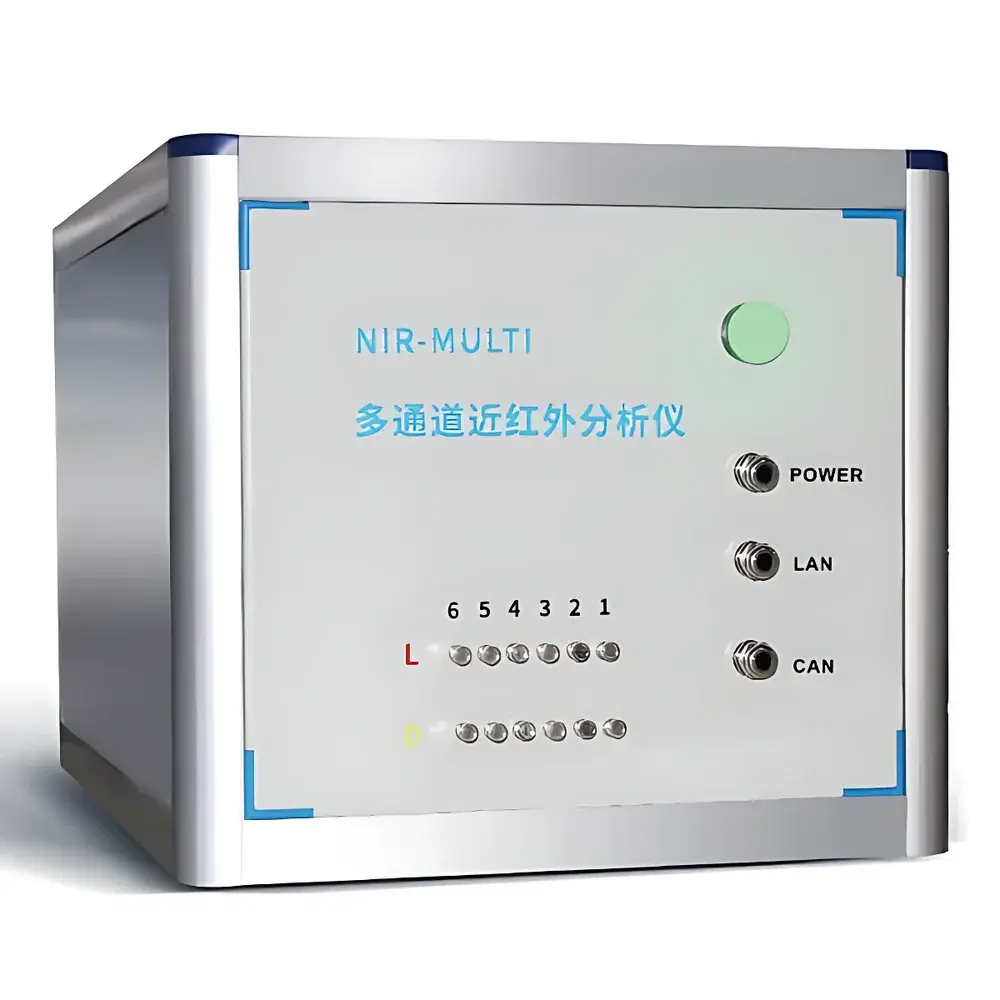
NIR-MULTI Multi-Channel Near-Infrared Spectrometer by Future-Spectrum
| Brand | Future-Spectrum |
|---|---|
| Origin | Shanghai, China |
| Model | NIR-MULTI |
| Instrument Type | Online/At-Line |
| Optical Principle | Fixed Grating with Array Detector (Non-Scanning) |
| Wavelength Range | 900–1700 nm |
| Sampling Modes | Diffuse Reflectance and Transmission |
| Chemometrics Software | FlyChemometrics |
| Operating Systems | Linux & Windows (Multi-User Concurrent Access) |
Overview
The NIR-MULTI Multi-Channel Near-Infrared Spectrometer is an engineered solution for robust, real-time quantitative and qualitative analysis across industrial process lines and laboratory environments. Based on fixed-grating optical architecture with a high-sensitivity silicon-based array detector, the system operates in non-scanning mode—eliminating moving parts to ensure long-term mechanical stability and measurement repeatability. Its spectral coverage from 900 to 1700 nm targets key overtones and combination bands of C–H, O–H, and N–H functional groups, enabling reliable prediction of moisture, fat, protein, starch, and active pharmaceutical ingredients (APIs) in solid, semi-solid, and liquid matrices. Designed for continuous operation under variable ambient conditions, the NIR-MULTI integrates hardware-level diagnostics—including real-time source energy monitoring and automated wavelength calibration—to maintain spectral fidelity without manual intervention.
Key Features
- Multi-channel architecture supporting up to four independent optical paths, each configurable for reflectance or transmission geometry—ideal for parallel monitoring of multiple process streams or reference-validation setups.
- Fixed-grating monochromator with thermally stabilized detector array ensures <0.1 nm wavelength reproducibility over 8-hour continuous operation (per ASTM E1655-22 guidelines for NIR instrument qualification).
- FlyChemometrics software suite—developed in-house with full intellectual property rights—provides validated PLS, PCR, and SVM regression models, outlier detection, and spectral preprocessing (SNV, MSC, derivatives, Savitzky-Golay smoothing).
- Automated wavelength calibration routine executed at user-defined intervals or triggered by thermal drift thresholds, referencing internal rare-earth oxide absorption peaks for traceable alignment.
- Integrated light source energy monitoring continuously logs LED or tungsten-halogen output intensity; algorithmic compensation adjusts integration time and baseline correction to suppress signal drift.
- Cross-platform compatibility: native support for Windows 10/11 and Ubuntu LTS (20.04+); concurrent multi-user access via role-based authentication (admin, operator, analyst) with session logging compliant with GLP audit requirements.
Sample Compatibility & Compliance
The NIR-MULTI accommodates diverse physical forms—including powders, granules, pellets, slurries, and clear or turbid liquids—via interchangeable probe heads (fiber-optic contact probes, immersion probes, and flow cells). Diffuse reflectance measurements are optimized for opaque solids using integrating sphere accessories (optional), while transmission mode supports cuvette-based or inline flow cell configurations with pathlengths from 0.1 to 50 mm. All optical interfaces meet IP65 rating for dust and water resistance in plant-floor deployment. The system complies with IEC 61000-6-2/6-4 (EMC immunity/emission), ISO/IEC 17025:2017 clause 5.5.2 (equipment verification), and supports 21 CFR Part 11-compliant electronic signatures and audit trails when deployed with FlyChemometrics’ secure server mode.
Software & Data Management
FlyChemometrics serves as both acquisition engine and chemometric workbench. It supports method transfer between instruments via .nirml standard format (aligned with ASTM E2983), enables batch model validation per USP , and generates IQ/OQ/PQ documentation templates. Raw spectra are stored in HDF5 format with embedded metadata (timestamp, operator ID, environmental sensor readings). Data export options include CSV, XML, and direct SQL database push to LIMS or MES systems via ODBC/JDBC drivers. Version-controlled method libraries allow rollback to prior calibration states, and change history is logged with user attribution and timestamp for regulatory review.
Applications
- Pharmaceutical manufacturing: Real-time monitoring of blend uniformity, tablet coating thickness, and moisture content during fluid-bed drying (aligned with FDA Process Analytical Technology guidance).
- Food & agriculture: In-line quantification of protein in wheat flour, oil content in soybeans, and sugar concentration in fruit juice processing lines.
- Chemical synthesis: Reaction endpoint detection via carbonyl peak tracking in esterification processes; catalyst deactivation monitoring through OH/NH band ratio shifts.
- Polymer production: Identification of copolymer composition ratios (e.g., ethylene-propylene ratio in EPDM) and additive dispersion homogeneity assessment.
- Recycling & waste sorting: Rapid classification of plastic types (PET, HDPE, PP) based on spectral fingerprinting in conveyor-belt mounted configurations.
FAQ
Is the NIR-MULTI suitable for GMP-regulated environments?
Yes—the system supports full 21 CFR Part 11 compliance when configured with FlyChemometrics Server Edition, including electronic signatures, audit trail archiving, and role-based access control.
Can existing PLS models developed on other NIR platforms be imported?
Yes—FlyChemometrics accepts .csv and .jdx spectral files, and supports model import/export in .nirml format per ASTM E2983 for cross-platform method portability.
What maintenance is required for long-term wavelength stability?
No routine optical alignment is needed; the built-in rare-earth reference calibration executes automatically and requires no consumables or user service intervention.
How is temperature sensitivity mitigated during extended online operation?
The spectrometer housing incorporates passive thermal mass design and PID-controlled thermoelectric stabilization of the detector array, maintaining spectral resolution within ±0.3 nm across 15–40 °C ambient range.
Does the system support third-party SCADA or DCS integration?
Yes—OPC UA and Modbus TCP protocols are natively supported for real-time spectral feature extraction (e.g., predicted moisture %) into distributed control systems.






